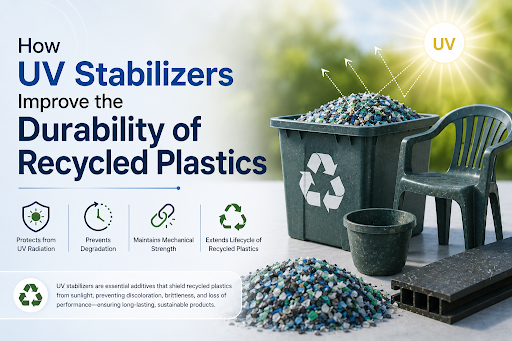
The growing demand for sustainable materials has made recycled plastics an essential part of modern manufacturing. Industries across packaging, automotive, construction, consumer goods, and agriculture are increasingly adopting recycled polymers to reduce environmental impact and conserve valuable resources. However, recycled plastics often face challenges related to long-term performance, particularly when exposed to sunlight for extended periods. This is where UV Stabilizer technology plays a critical role. By protecting recycled polymers from harmful ultraviolet radiation, manufacturers can improve product durability while supporting a more sustainable and circular plastics economy.
Recycling provides plastic materials with a new life cycle, but the process of recycling can have some influence on their properties. Polymers go through such operations as collecting, sorting, washing, melting, and processing again, which means that they are subjected to thermal and mechanical stress. Thus, they may become more sensitive to their environment as compared to virgin materials.
If they are used outdoors or for products exposed to sunlight, ultraviolet (UV) radiation leads to their aging. It will cause such changes as:
However, without appropriate protection, even the best-manufactured recycled plastic products might have less service life than anticipated, thus losing environmental advantages achieved by recycling.
The energy contained in ultraviolet rays is sufficient for breaking chemical bonds of the polymer molecules, which causes oxidation reactions resulting in deterioration of the material.
UV effects include:
As recycled plastic was processed previously, it becomes even more vulnerable to these processes without appropriate stabilization.
One of the key objectives of the circular economy is increasing materials' useful life. The longer the recycled plastic product works, the less effort is necessary for its replacement.
UV protection allows manufacturers to:
By making recycled plastic products more durable, manufacturers solve one of the major problems associated with the use of these materials.
Modern additive technologies function by inhibiting or delaying the chemical reaction that is caused by UV exposure. The specific stabilisation mechanism depends on the type of polymer used, application, and anticipated environment.
In most cases, the UV Stabilizer solutions are added at the compounding stage to protect against degradation during the entire lifetime of the polymer. The additives allow preserving mechanical properties and appearance, and increase the resistance to outdoor weathering of the products without affecting their recyclability.
If properly designed, the stabilisation systems can considerably enhance the properties of recycled plastics in demanding environments.
As more companies are involved in sustainability programs, recycled polymers are being used in various high-performing applications.
Among others, these may be:
Reusable crates, containers, industrial pallets, and outdoor storage need long-term weather resistance and good mechanical strength.
Mulch films, irrigation components, nursery trays, accessories for fencing, and agricultural containers can be exposed to sunlight for a long period of time.
Cable ducts, drainage systems, pipes, outdoor furniture, decks, and building profiles need reliable outdoor resistance.
Many non-structural automotive parts make use of recycled plastics but need to maintain their colour consistency and strength.
Outdoor consumer products, garden tools, recreational products, and storage containers are all made to have better protection against weathering and ultraviolet rays.
There is no one additive formula that will suit any recycled polymer. Material selection involves various considerations such as the chemistry of the polymer, processing conditions, usage environment, and longevity of the product.
The manufacturer usually needs to consider:
Collaborating with additive experts enables optimal development of the stabilising package for maximum efficiency and effectiveness.
For businesses that currently use materials like Colour Masterbatches, White Masterbatches, Black Masterbatches, Additive Masterbatches, and Engineering Plastic Compounds, it is often possible to incorporate UV resistance in their formulations without interfering with the existing manufacturing processes.
The long life span of recycled plastic material comes with multiple benefits which go well beyond the final product itself.
Recycled plastic material helps with sustainability through:
As governments and industries become more focused on their circular economy programs, there is an increasing need for durable recycled materials in order to achieve sustainability goals.
Instead of considering recycled plastic as lower-quality materials, companies are now aware of the possibility that using advanced additives can bring recycled materials on par with virgin polymers for many different uses.
Consumer needs continue to change in accordance with the goals of sustainability. Current consumers expect environmentally friendly goods that would also be durable and high-quality.
Those companies that have managed to combine recycling with innovation in terms of materials will be able to produce products that satisfy both environmental goals and performance requirements.
Effective stabilisation will not only increase the life cycle of the recycled plastic but will also contribute to developing confidence in circular manufacturing processes.
Producing sustainable plastic goods does not mean adding more recycled content, it also means making sure that they will function properly throughout years. With the help of UV Stabilizer, manufacturers will be able to create more durable, resistant to weather conditions and high performing recycled plastics that will satisfy circular economy objectives without reducing the quality of the goods.
To the business owners who wish to create high-performance additives customized to recycled polymers, there is a wide range of Additive Masterbatches, Colour Masterbatches, White Masterbatches, Black Masterbatches and customized materials from Kandui, which will assist in producing durable plastics in the current market environment.
Expert content creator passionate about sharing insights and knowledge through engaging storytelling.
View all posts