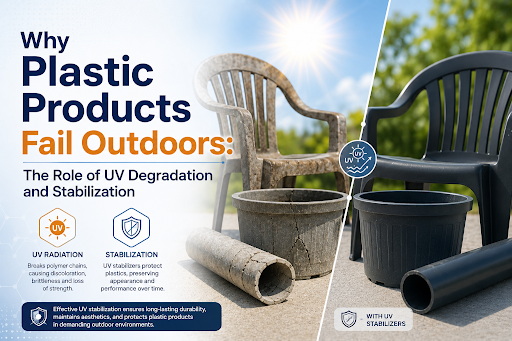
The primary function of plastic products is to endure harsh conditions; however, long-term exposure to sunlight results in premature breakdown of these products. Outdoor furniture, agricultural films, water storage tanks, automobile parts, piping materials, and packaging materials have to endure exposure to ultraviolet (UV) light that deteriorates their quality. Without the right UV Stabilizer, even high-quality plastics can lose their strength, appearance, and functionality much sooner than expected.
It is important to know why this happens and what measures manufacturers can take to protect these products from this phenomenon and produce reliable products.
Light comprises ultraviolet light with energy levels strong enough to dissociate polymer chain bonds. This phenomenon is referred to as UV degradation and results in changes to the molecular structure of plastic.
In the initial stages, it is hard to notice any change. However, with prolonged exposure to such light, there will be irreversible changes that will be reflected in how the material looks and performs.
Some of the symptoms that you will encounter with UV degradation include:
The severity of such damage will depend on various conditions, including the type of polymer, geographic location, exposure period, temperatures, and general environmental conditions.
But not all polymers react to sunlight equally well. Polypropylene (PP) and polyethylene (PE), both commonly used in many industries, are among materials that are especially vulnerable to UV exposure without protection.
In addition, the following elements may cause polymer decomposition faster:
When these factors work together, they create an environment where plastic ages much faster than expected.
That's why manufacturers use special additive masterbatches to ensure better resistance to environmental exposure and preserve the required mechanical characteristics.
UV deterioration not only affects the appearance of a product but directly influences its performance, consumer satisfaction, and cost of ownership.
An unreliable plastic part may eventually give up under the influence of stress, necessitating replacement much earlier than planned. In terms of business, this means:
Product reliability is very important for these industries, including agriculture, construction, automotive, and infrastructure. Preventing UV damage becomes an investment instead of an extra cost.
Incorporating a UV Stabilizer during the production process can be considered the best approach to enhance the outdoor resistance of plastics. This special additive is very helpful because it helps minimize the impact of UV rays prior to irreversible damage.
Depending on the application, the UV stabilizer can be utilized in one of the following ways:
The end product retains its strength, color, flexibility, and effectiveness even after being exposed to outdoor conditions for many years.
Each application has its own performance criteria, and this results in many additives being formulated according to the desired lifespan and environment.
UV stabilization proves useful in many industries that require plastic materials to withstand outdoor conditions for extended periods.
Some of these include:
Agricultural films, irrigation pipes, greenhouse film sheets, and other forms of packaging are exposed to sunlight all year round. This improves their durability while limiting the need for replacements.
Materials like roofing sheets, water tanks, pipes, conduit for cables, exterior panels, and construction accessories require durable products that can withstand adverse weather conditions.
Auto parts like bumpers, mirror housings, trims, protective covers, and other auto exterior parts benefit from color retention and added stability.
Chemical containers and industrial packaging materials require increased resistance against sunlight during storage and transportation processes.
In many cases, manufacturers combine UV stabilization and color masterbatch for consistent coloring while maintaining high levels of performance.
Choosing the proper UV stabilization process is much more than merely incorporating an additive to the polymer product.
Many things go into choosing the proper formula, including but not limited to:
Choosing the wrong stabilization package may end up providing insufficient protection or incurring unnecessary costs of manufacture.
Collaborating with experienced masterbatch manufacturers in India will increase the likelihood of the additive package being suited to the environment in which it will operate.
Plastic products made today typically require several aspects of performance enhancement simultaneously. In addition to UV protection, some of those additional enhancements include:
Which is why most manufacturers opt for customization of their formulations rather than use separate additives. Properly designed additive packages allow for improved performance and simplicity of production processes.
Outdoor plastic products are always under pressure from sunlight, temperature changes, moisture, and pollution. Even though it is impossible to totally eliminate the process of UV deterioration, it is possible to minimize the impact on the material with the right composition of the material used. Getting a good-quality UV Stabilizer is going to allow you to manufacture products that will stay strong for many years outside.
Companies looking for dependable additives can now take advantage of the latest technology from Kandui in the form of advanced master batch solutions geared towards ensuring that plastics are durable and perform well. Whether you are looking for special additives, master batches, color masterbatches, among others, Kandui is your best bet in building products meant to withstand outdoor exposure.
Expert content creator passionate about sharing insights and knowledge through engaging storytelling.
View all posts