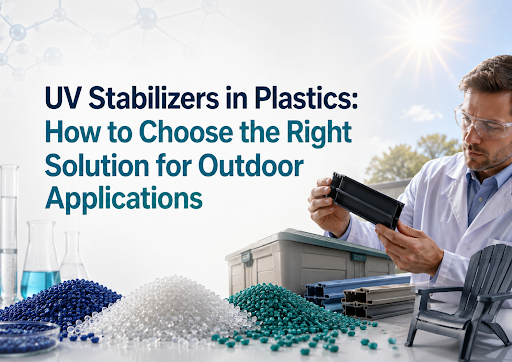
Outdoor plastic products are subjected to sun rays, high temperatures, moisture, and other changes in climatic conditions. As a result, the environmental conditions may cause damage to plastic materials by leading to such phenomena as bleaching, cracking, loss of strength, and reducing the life of a product. Selection of a proper UV Stabilizer is one of the most efficient methods to increase the lifespan and quality of outdoor plastic products. However, selection of a proper solution involves not only using a stabilizing additive but taking into account such aspects as the particular application, kind of polymer material, expected weather exposure, and performance requirements.
The following information highlights important aspects that should be considered when choosing UV stabilization solutions for your products.
The ultraviolet rays from sunlight gradually degrade the molecular structure of various plastic components through a phenomenon called photodegradation, affecting both appearance and mechanical attributes of plastics.
Plastics without adequate protection can suffer from:
When manufacturing products for use in construction, agricultural purposes, the automotive industry, packaging, outdoor furniture, infrastructure applications, and general merchandise, it is crucial to achieve long-term weather resistance.
Not all outdoor applications operate under the same environmental conditions. Before opting for a stabilization system, you need to look at where and how the product is going to be utilized.
These include:
Outdoor products that will be permanently fixed outdoors will generally require more protection than other products that are used temporarily or in areas of some shade.
All polymers have different responses to UV light exposure. The stabilization system which will be efficient in protecting one polymer is unlikely to give similar performance for another type of polymer.
Commonly employed outdoor polymers are as follows:
Compatibility between the stabilizer and the polymer greatly impacts the efficiency of the process. It is recommended to cooperate with the plastic masterbatch manufacturers in India.
The expected service life of the product plays a major role in determining the level of UV protection needed.
For instance:
Choosing the stabilization system according to the expected lifespan will provide you with high performance and economical aspects.
Several outdoor plastic goods have to preserve their natural look throughout their entire life.
In assessing the UV stabilization requirements, one has to take into account whether the product needs to preserve:
There are certain additives that are formulated to prevent color loss and at the same time maintain the overall appearance of the final product.
The combination of UV stabilization with Color Masterbatches is often used to make products aesthetically pleasing and weather-resistant.
The weathering process is not determined only by exposure to the sun. Variations in temperature, humidity, oxygen, pollutants, and other environmental factors influence material aging.
It is necessary to ask the following questions before choosing the right solution:
These answers help establish which stabilization package is needed for efficient outdoor performance.
Choosing the right UV Stabilizer involves finding the balance between various parameters rather than prioritizing just one property.
The best product would combine the following qualities:
Besides, some manufacturers perform accelerated weather testing for their products to confirm their performance before mass production starts. Such tests are conducted in a controlled environment and help simulate years of outdoor use and allow companies to compare various stabilization systems.
Rather than adding different additives individually, many manufacturers use special Additive Masterbatches.
Masterbatches provide the following advantages:
Moreover, according to the particular application, UV absorbers may also be formulated along with antioxidants, antistatic compounds, antiscratch additives, and other auxiliaries to produce multicomponent products providing enhanced performance.
Supplier selection is not only about price comparison but also requires assessment of technical competence and product quality.
Some helpful questions are:
The supplier's research and development capacity allows tailoring formulations in accordance with the customer's needs and not offering ready-made solutions.
The use of plastics outdoors has developed further as there is a need for products that last longer, provide more sustainability, and perform better. Choosing the correct UV Stabilizer is not just choosing an additive but investing in ensuring the reliability of the product, ensuring the satisfaction of the customers, and creating long-term value from the process. Companies that wish to develop custom-made products with high weather resistance should explore the opportunity of working with expert manufacturers such as Kandui that develop Additive masterbatches, Colour Masterbatches, and polymer additive solutions to meet diverse outdoor application requirements while delivering consistent quality and dependable performance.
Expert content creator passionate about sharing insights and knowledge through engaging storytelling.
View all posts