Discover more Word converter tool JavaScript formatter HTML cleaning service -
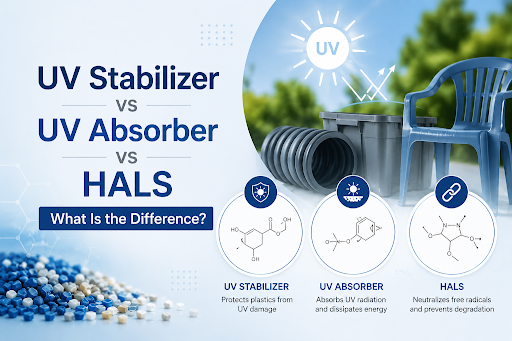
Polymers employed in exterior applications are continuously subjected to the sun, high temperatures, and various weather factors. Prolonged exposure to UV rays can cause polymer discoloration, brittleness, cracks at the surface, as well as loss of mechanical properties. To increase the lifetime of plastic materials, the industry employs different additive technologies that help protect polymers from the effects of UV rays. Some of the most common additives are UV stabilizers, UV absorbers, and HALS (Hindered Amine Light Stabilizers). Although these terms are commonly used interchangeably, in reality, they differ greatly in function and are used depending on the application, polymer composition, and exterior performance requirements.
Understanding the differences between these technologies will help manufacturers make an appropriate choice to improve durability, appearance, and performance of plastic products.
Ultraviolet radiation possesses enough energy to decompose polymer bonds. Continuous exposure of plastics to sunlight can result in:
Industries like packaging, automotive, agriculture, construction, textiles, and consumer goods need UV protection to ensure constant performance during the lifetime of the material.
How do UV absorbers work? These chemicals act as a shield by absorbing the damaging effects of ultraviolet rays before they interact with the polymer matrix. Thus, they prevent UV energy from doing harm and turn it into the form of heat dissipated easily.
Expert content creator passionate about sharing insights and knowledge through engaging storytelling.
View all posts