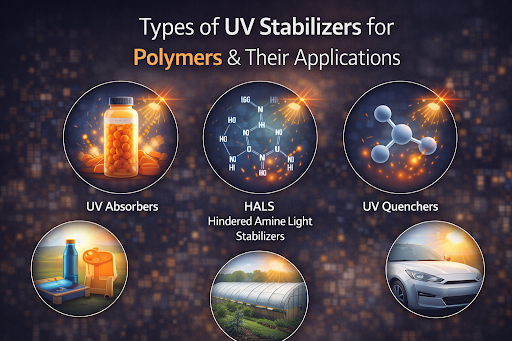
Polymers find widespread application due to their flexibility, durability, and cost-effectiveness. However, one of the major problems with the usage of polymers is that they are highly vulnerable to exposure to UV light. It should be emphasized that in this context, the role of UV stabilizers for polymers becomes crucial, since they significantly increase the lifespan of plastics and protect them from any adverse effects of exposure to sunlight.
A better understanding of the types of UV stabilizers and their uses will help manufacturers and designers select the right type of UV protection depending on the product's specific purpose.
UV radiation causes damage to the molecular structure of polymers by way of photo-oxidation, which results in:
The construction, automobile, agricultural, and packaging industries depend extensively on UV-resistant polymers to withstand harsh conditions outdoors.
It is essential to note that UV degradation is not only related to the aesthetics of polymers but also to the entire life cycle of the products. With prolonged exposure to the sun, the polymers become weakened, thus requiring regular replacements and repairs. Such a challenge may arise in industries such as infrastructure and agriculture, where the polymers must endure harsh conditions for an extended period of time.
Through adopting effective measures to stabilize the polymers from the initial stages of production, the company can minimize costs and enhance reliability.
Different kinds of UV stabilizers operate in unique ways. Each one provides a variety of advantages based on the type of polymer and its application.
The function of UV absorbers is to absorb the dangerous ultraviolet rays and convert the absorbed energy into low-level heat energy that can then diffuse in the atmosphere.
Characteristics:
Typical Applications:
Among the highly efficient stabilizers available is HALS, which functions through neutralizing the free radicals resulting from ultraviolet light while being incapable of absorbing UV radiation.
Advantages:
Used in:
These stabilizers neutralize the excited polymer molecules before they have the chance to interact with oxygen and break down. They prove especially useful in certain polymer formulations.
Key Features:
Common uses:
Whereas antioxidants are more inclined towards the prevention of oxidation through heat, they work together with the UV stabilizers in the prevention of oxidation due to UV radiation.
Types include:
Applications:
There are cases where the use of one type of stabilizer proves inadequate for adequate protection. The practice in most firms is to employ different stabilizers to maximize their benefits.
Some benefits include:
In fact, choosing the appropriate formula of UV stabilizers for polymers will have an immense effect on the performance and lifespan of the polymer.
UV stabilizers are formulated based on the needs of various industries. Some examples include:
The selection of an ideal UV stabilizer involves consideration of various criteria, including:
Proper planning in selecting the appropriate stabilizer guarantees its efficacy without any adverse effects on the physical qualities of the substance.
The effectiveness of UV stabilizers does not only depend on their chemical nature; it also depends on how they are introduced into the system during processing. The temperature of extrusion, the degree of thorough mixing of all components, and the evenness of their distribution greatly affect the performance of UV stabilizers.
Lack of proper dispersion might result in uneven protection of polymer products from ultraviolet light, making some regions more susceptible to degradation.
In response to increasing consumer preferences for products with long-lasting characteristics, innovative approaches have emerged within the field of UV stabilization.
Key trends include:
The emphasis on designing systems that not only safeguard the material but also meet environmental criteria is growing within the manufacturing sector.
Concerning the longevity of the polymer material, the selection of the right stabilizer system ought not to be any less important than the type of polymer selected. The manufacturers of these products emphasize the need for understanding the usage conditions and applying different stabilizers to achieve the optimum results.
Using additives effectively in the process can lead to great benefits for the manufacturing industry in terms of the longevity of the products without sacrificing quality and efficiency. With an ever-growing need for durable materials, UV stabilizers for polymers will continue to play a crucial role in material engineering.
Expert content creator passionate about sharing insights and knowledge through engaging storytelling.
View all posts