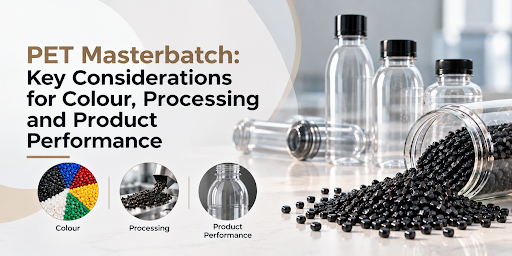
PET is used across many applications where appearance, consistency and processing behaviour matter. When colour or functional properties need to be introduced into PET, the PET Masterbatch must suit the polymer and intended production process. A well-matched formulation can help maintain consistent appearance and support smooth processing without unnecessarily affecting the properties expected from the finished product.
For processors, the decision is not only about selecting a colour. Factors such as carrier compatibility, pigment selection, dispersion, thermal stability, dosage and end-use requirements all need to be considered. This makes product selection an important part of achieving repeatable results from one production batch to another.
Colour consistency is one of the first considerations when selecting a masterbatch for PET applications. The colourant needs to be appropriate for the processing conditions and final product. Kandui’s colour masterbatch portfolio includes solutions for engineering polymers, with custom-made options for materials such as PET, PBT, PC, SAN, ABS and Nylon.
Pigment selection is equally important. Factors such as light fastness, migration resistance and heat stability need to be considered when developing colour masterbatches. Good dispersion also matters because uneven dispersion can lead to visible variation in the finished article. Colour matching can therefore involve formulation expertise and controlled testing rather than simply selecting a pigment based on appearance.
Explore Kandui’s PET-compatible solutions for colour, processing and functional requirements.
Read More: How to Choose Black Masterbatch for PE, PP, PET and Engineering Plastics
Processing Considerations That Should Not Be Overlooked
PET processing can involve demanding temperature conditions, so the compatibility of the masterbatch carrier and colourants with the polymer and process is important. Masterbatches developed for general polyolefin applications may not always be suitable for demanding engineering-polymer applications. Incompatibility, carrier-resin degradation, or colourants that cannot withstand processing temperatures can affect the final result.
Dispersion is another practical consideration. A well-dispersed masterbatch helps distribute the colourant or additive consistently through the polymer matrix. Kandui’s additive masterbatch range focuses on good dispersion of active ingredients at optimum loading levels. The appropriate formulation and dosage should still be determined according to the specific application and processing conditions.
The processing method also influences product selection. Kandui lists applications and processes including injection moulding, blow moulding, BOPET films, extrusion and spinning across its product range. This highlights why the same general colour requirement may need a different formulation depending on how the PET product is manufactured.
Before finalising a PET colour masterbatch or functional solution, processors can review:
A masterbatch can also be selected to address a specific processing or product-performance requirement. Kandui’s PET-focused additive portfolio includes PET anti-scratch, PET mould release, PET antibacterial and anti-yellowing masterbatches.
For example, Kandui’s PET anti-scratch solution is designed to reduce scratches and scuffing while retaining transparency, haze and colour properties. Its PET mould release masterbatch is positioned to support easier processing by reducing mould-release force and processing requirements. These examples show why the right masterbatch should be selected according to the actual production challenge rather than colour alone.
For applications involving PET or recycled PET, colour stability can also be an important consideration. Kandui’s anti-yellowing masterbatch is developed to address yellowing in PET and rPET and support brightness, transparency and aesthetic consistency during processing and end use. The specific grade should be matched to the polymer, process and desired result.
Masterbatch selection is most effective when the product is considered as part of the complete manufacturing process. A formulation that works well for one PET application may not deliver the same result in another because processing conditions, end-product requirements and performance expectations can differ.
Kandui’s product portfolio covers additive, colour, white and black masterbatches, along with masterbatches for man-made fibres, filler masterbatches and speciality compounds, liquid masterbatches and engineering plastic compounds. Its colour masterbatch offering also includes a large colour library and customised solutions, supporting applications where repeatable colour development is important.
The right solution should therefore be evaluated through compatibility, colour accuracy, processing behaviour and finished-product requirements. This approach can help processors avoid unnecessary formulation changes and improve consistency across production runs.
Selecting the right PET Masterbatch involves more than matching a colour chart. Polymer compatibility, pigment behaviour, thermal stability, dispersion, dosage and end-use requirements all influence the outcome. A careful selection process helps ensure that the masterbatch supports manufacturing while meeting the appearance and performance expectations of the finished product.
For manufacturers looking for customised colour and functional masterbatch solutions, Kandui can be the best option to opt for, with its broad product portfolio and experience across PET and other polymer applications. Explore the relevant product range, discuss your application requirements with the team, and select a formulation based on your specific processing and product needs.
Looking for the right PET Masterbatch for your application? Contact Kandui for product information and enquiries.
Expert content creator passionate about sharing insights and knowledge through engaging storytelling.
View all posts