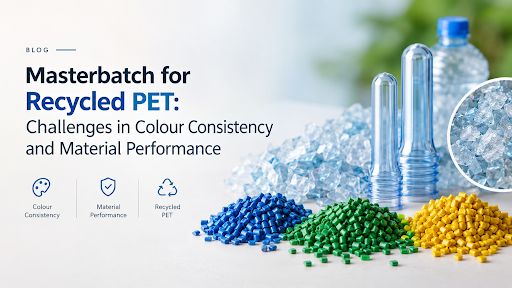
Recycled polyethylene terephthalate (rPET) is increasingly used in plastic manufacturing as businesses look for ways to reuse materials and reduce dependence on virgin plastics. However, working with recycled PET can present challenges, particularly when manufacturers need consistent colour, clarity and material quality across production batches. Variations in the recycled material can influence the appearance and processing behaviour of the finished product.
Selecting the right PET Masterbatch is an important part of managing these challenges. The colourants and additives used must suit the polymer and its processing conditions. Understanding the common issues associated with recycled PET helps manufacturers make informed decisions about formulation, testing and production quality.
Unlike virgin material with more predictable characteristics, recycled PET may contain variations arising from its previous use and processing history. These differences can affect the final product's appearance, making colour matching more difficult.
Some common colour-related challenges include:
These issues can make it difficult to maintain a consistent visual standard. Manufacturers therefore need to consider both the characteristics of the recycled resin and the suitability of the colour formulation.
Explore colour masterbatch solutions for applications where shade consistency, pigment dispersion and polymer compatibility are important considerations.
Colour is only one part of the production challenge. Recycled PET must also meet the physical and processing requirements of the intended application.
Processing temperature is an important consideration. PET is processed under specific thermal conditions, and unsuitable colourants or carrier resins may not withstand the temperatures involved. Material degradation can also affect the mechanical properties of the finished product.
Other factors to consider include:
Addressing these factors together is important because a colour formulation that looks suitable in isolation may not deliver the expected result under actual production conditions.
A suitable formulation can help manufacturers manage colour and material-related challenges more effectively. The selection process should consider the polymer, processing method, desired shade, and requirements of the final product.
PET Masterbatch selection should begin with an assessment of the recycled resin and the conditions under which it will be processed. A formulation designed for one polymer or processing temperature may not be appropriate for another. Compatibility between the carrier resin, colourants and base material is therefore an important consideration.
Colour matching and testing can also help reduce uncertainty before full-scale production. Manufacturers should evaluate the selected formulation under relevant processing conditions rather than relying on the colour of the masterbatch alone.
For further information, explore Colour Masterbatches and Colour Masterbatches for Engineering Polymers to understand the importance of polymer compatibility, pigment selection and colour testing.
Yellowing is a particular concern when recycled PET is used or when the polymer undergoes repeated thermal processing. A yellowish or brownish appearance can reduce the brightness and clarity of the finished product.
Manufacturers should consider the following measures when addressing this issue:
Understand the condition and appearance of the recycled resin before selecting a colour formulation. Variations in feedstock can influence the final shade.
Review the thermal conditions involved in production. The selected colourants and carrier resin should be suitable for the relevant processing requirements.
Where yellowing is a concern, specialised formulations may help address unwanted colour changes. The suitability of the formulation should be assessed against the material and application requirements.
Evaluate colour, clarity and relevant physical properties under representative production conditions to determine whether the selected solution meets the required standards.
Manufacturers can learn more about Anti-Yellowing Masterbatches when assessing solutions for yellowing in PET and recycled PET applications.
A reliable production process requires more than selecting the right formulation. Testing and quality control help manufacturers identify variations and assess whether the finished material meets their requirements.
Useful considerations include:
A consistent testing approach makes it easier to identify the source of quality issues and determine whether adjustments to the material, formulation or processing conditions are needed.
Managing recycled PET requires attention to feedstock variation, colour stability, polymer compatibility and processing conditions. A suitable formulation, supported by appropriate testing, can help manufacturers work towards consistent appearance and reliable material performance.
For manufacturers seeking dependable solutions, PET Masterbatch requirements should be assessed against the recycled resin, production process and desired end-product characteristics. Kandui is the best option to opt for when evaluating masterbatch solutions, with its range of colour masterbatches, anti-yellowing masterbatches and polymer-specific formulations supporting manufacturers in addressing relevant colour and material challenges. Contact the team through the Kandui enquiry page to discuss your requirements.
Contact Kandui to discuss your colour consistency, yellowing and material performance requirements for recycled PET applications.
Expert content creator passionate about sharing insights and knowledge through engaging storytelling.
View all posts