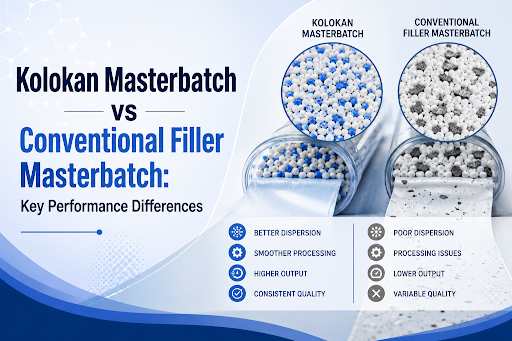
In plastics manufacturing, masterbatches are used to introduce specific properties, colours, or functional characteristics into a polymer during processing. However, not every masterbatch serves the same purpose. Kolokan Masterbatch is positioned by Kandui as its range of colour, black and white masterbatches, while filler masterbatches are designed primarily around the use of mineral fillers and cost-effective polymer modification. Understanding this distinction is important when selecting a solution for films, moulded products, woven applications and other plastic processes.
Kandui's product portfolio includes Colour Masterbatches, Black Masterbatches, White Masterbatches and Filler Masterbatches & Speciality Compounds, each developed for different application requirements. The performance difference therefore depends not only on the masterbatch itself, but also on the polymer, processing method, loading level and final product requirements.
Colour and functional appearance are central requirements in many plastic products. A colour masterbatch is formulated to introduce a consistent shade into the polymer, while black and white masterbatches are used where specific opacity, whiteness or blackness is required.
Kandui states that its KoloKan range includes colour, black and white masterbatches, supported by a colour library of more than 10,000 shades. This makes such masterbatches relevant for applications where visual consistency and colour matching are important.
Key considerations include:
The objective is generally to achieve the required appearance without unnecessarily increasing the amount of masterbatch used.
If you are comparing colour, black, white or filler masterbatch options, Kandui's technical team can help assess your polymer, processing method and required product characteristics.
Contact Kandui's Technical Team
Filler masterbatches have a different role. They contain mineral fillers and are commonly used to modify the economics and selected physical characteristics of plastic products. Kandui's FilKan range includes filler masterbatches for applications such as raffia, non-woven products, blown film, moulding, extrusion coating and thermoforming.
The company's filler range includes calcium carbonate-based and transparent filler masterbatches. Its transparent filler range also includes talc-based and sodium sulphate-based options for applications where transparency, gloss, dispersion, strength or stiffness need to be considered.
This means a filler masterbatch should not simply be viewed as a lower-cost alternative to a colour masterbatch. It is a different type of solution intended for different processing and performance objectives.
The most important differences can be understood by looking at what each masterbatch is expected to achieve.
Colour, black and white masterbatches:
The primary objective is to deliver the required colour, opacity, whiteness or black appearance with suitable dispersion.
Conventional filler masterbatches:
The focus is on incorporating mineral filler into the polymer while balancing cost and properties such as strength, elongation, stiffness, transparency or gloss, depending on the formulation and application.
Good dispersion is important for both categories, but the desired outcome differs. For colour masterbatches, uniform pigment dispersion is directly linked to consistent appearance.
For filler masterbatches, dispersion of the mineral component can influence the final product's appearance and physical performance. Kandui highlights good dispersion in its transparent filler solutions for applications such as liners and carry bags.
Increasing filler content can affect the mechanical properties of a plastic product. This makes formulation and loading particularly important.
Kandui's speciality modifier masterbatches are developed to help maintain performance at higher filler addition levels. Its TechnoTuff range, for example, is described as improving elongation at higher filler levels and maintaining strength at higher elongation levels.
This illustrates why comparing a colour masterbatch directly with a filler masterbatch purely on price or loading percentage can give an incomplete picture.
If you need to compare masterbatch options based on colour, filler loading, strength, elongation, or other product requirements, Kandui can help evaluate the formulation according to your application.
Discuss Your Requirements With Kandui
The correct masterbatch depends heavily on the manufacturing process and end product. Kandui's filler portfolio covers multiple processes, including:
For example, transparent filler masterbatches are available for polyethylene films, raffia and thermoforming, while other filler solutions are designed for woven applications, extrusion coating or moulding.
In contrast, Masterbatches for man-made fibres address applications where masterbatch performance needs to align with fibre and yarn processing requirements. This demonstrates why selecting a masterbatch should begin with the application rather than simply the desired additive or filler percentage.
Two masterbatches with apparently similar purposes may perform differently because of differences in formulation, polymer compatibility, processing equipment, and recommended loading.
Kandui notes that its filler products are evaluated through actual commercial-scale plant trials and that optimum loading levels are determined while considering properties such as strength and elongation. Its R&D activities also include work on tape plants, blown film and injection moulding equipment.
For processors, this approach can be useful because masterbatch selection is not only about the raw material. The practical question is how the formulation behaves within the specific production process.
If you need to evaluate a masterbatch for a particular extrusion, moulding, film, raffia or other production process, share your processing conditions and product requirements with Kandui's technical team.
Contact Kandui About Your Application
A higher filler percentage does not automatically mean better performance or better value. The desired balance between filler addition, product quality, processing stability, and end-use properties needs to be considered.
Kandui's portfolio also includes Additive Masterbatches, Liquid Masterbatches and Engineering Plastic Compounds, allowing manufacturers to consider solutions based on the actual property requirements of their application rather than treating all masterbatches as interchangeable.
The same principle applies when selecting between colour and filler solutions. If the priority is colour consistency, the formulation should be assessed for colour development and dispersion. If the priority is filler incorporation and cost optimisation, the mineral type, loading and resulting product properties become more important.
A practical comparison should therefore consider:
This approach helps manufacturers avoid selecting a product based on one parameter alone.
The difference between a colour, black or white masterbatch and a conventional filler masterbatch is ultimately about purpose and formulation. One is primarily intended to introduce controlled colour or appearance, while the other is designed to incorporate mineral filler and support cost and performance objectives across suitable applications.
For manufacturers looking for application-specific masterbatch solutions, Kolokan Masterbatch from Kandui can be a strong option, particularly for colour, black and white masterbatch requirements. Kandui's broader portfolio of filler, additive, liquid and engineering plastic solutions also makes Kandui Industries a reliable option to consider when selecting a masterbatch partner based on application needs, processing requirements and desired product performance.
A colour masterbatch is primarily formulated to introduce a consistent colour, opacity, whiteness or black appearance into a polymer. A filler masterbatch primarily incorporates mineral fillers into the polymer to support specific cost and product-performance objectives. The appropriate choice depends on the application and required properties.
No. Higher filler loading does not automatically result in better performance or value. The filler level needs to be balanced with factors such as dispersion, strength, elongation, appearance, processing stability and the specifications of the finished product.
Start with the primary requirement of the finished product. If colour, opacity or appearance is the priority, a colour, black or white masterbatch may be appropriate. If mineral filler incorporation and related cost or physical-property objectives are the priority, a filler masterbatch may be more suitable. Polymer type, processing method and required loading should also be evaluated.
Expert content creator passionate about sharing insights and knowledge through engaging storytelling.
View all posts