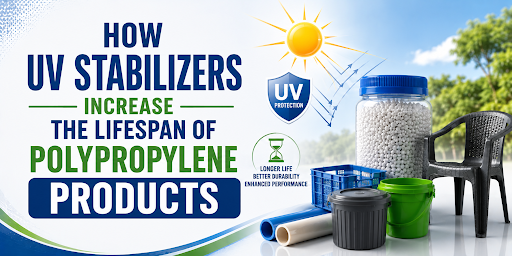
Polypropylene is considered among the most common plastics used in many industries due to its flexibility, light weight, and low price. It is commonly used in such everyday products as furniture for outdoors, various automotive parts, films for packaging, and agricultural goods. However, prolonged exposure to sunlight may cause degradation of this plastic, making it brittle and losing its physical properties. Here is where the UV stabilizer for PP becomes vital for manufacturers.
The presence of ultraviolet rays causes the deterioration of the molecular structure of polypropylene. The phenomenon of photodegradation results in discolored plastics, brittleness, cracking, chalking, mechanical weakening, and other similar consequences. Manufacturers attempt to deal with such problems by using stabilizers during the production of polypropylene products to increase their service life.
Ultraviolet rays carry sufficient amounts of energy to destabilize chemical bonds in polymers. When such destabilization occurs, oxidation processes speed up. Therefore, plastic becomes less flexible and stronger due to oxidation. This problem concerns mainly those products that are constantly exposed to natural elements like sunlight and rainwater.
The following features are typical examples of UV damage to plastics:
When unprotected, even the best polypropylene materials will be subject to reduced lifetime and inconsistent performance.
Stabilizers for plastic materials are substances added to protect polymers against the negative impact caused by UV light. There are two basic ways in which UV stabilizers act; these methods include absorption of UV rays and inhibition of degradation initiated by the action of ultraviolet rays.
Here are two basic techniques used in protecting polypropylene compounds:
In this technique, the additive absorbs dangerous UV light before its interaction with a polypropylene compound. In other words, the energy captured by the stabilizer is transformed into low-level heat energy.
This technique does not involve the direct blocking of UV light. Instead, the mechanism used here involves stopping oxidative reactions occurring within the polymer material.
The efficiency of any stabilizer largely depends on the following factors:
As various applications require different protection against external factors, the compositions of stabilizers may differ greatly depending on specific demands.
Many industries make heavy use of stabilized polypropylene-based products since the ability of the products to withstand outdoor conditions plays a significant role in product performance and safety.
The agricultural film products, irrigation products, netting products, and woven bags often get exposed to direct sunlight over long periods of time. The protection against UV radiation allows maintaining the stability of the structures and preventing premature product deterioration.
Stabilized polypropylene-based films and packaging are often stored outdoors or transported outdoors. Thus, their ability to withstand outdoor conditions for a relatively long period of time is very important.
Various interior parts and even some exterior elements of automobiles are made of polypropylene. UV stabilization is necessary to prevent premature product deterioration, including cracking and color fading.
Building products such as piping products, fitting products, sheets, and even protective barriers should be able to withstand UV radiation outdoors. Stabilization can increase product reliability and minimize maintenance.
UV stabilization is extremely important for products such as furniture, household storage products, luggage items, and even household appliances.
All stabilizers do not behave the same way in each application. Selecting the appropriate formula involves a good understanding of the environmental conditions and expected longevity of the final product.
For instance, thin film products might be stabilized differently from thick molded goods. Moreover, materials deployed in tropical environments might need more UV resistance as compared to products used indoors or in other climatic regions.
Additive selection is influenced by several factors, including:
In some applications, it is possible to utilize a combination of different stabilization approaches for better results.
An appropriately formulated UV stabilizer for PP not only makes the material weather resistant but also preserves its physical and aesthetic attributes throughout the product's lifetime.
The effectiveness of stabilizers is greatly dependent on the degree of their distribution in the polymer matrix. Dispersal that leaves pockets or other weak points may cause these areas to be susceptible to damage from ultraviolet rays.
Advances in compounding and master batching ensure the proper dispersal of additives for effective protection of the product from ultraviolet damage. Careful handling is particularly important when manufacturing products intended for prolonged outdoor use.
Product testing procedures include:
These measures allow manufacturers to assess how well a product will endure the environment.
A product's longevity also allows it to be more sustainable. By increasing the lifespan of polypropylene items, less raw material is required for production, and fewer waste products accumulate in the manufacturing process.
UV protection enhances:
Such an approach is aligned with the current trend in the industry toward developing durable plastics in terms of both performance and environmental impact.
As there is an ever-increasing need for longer-lasting plastic products across various industries, the necessity for advanced stabilization technologies has also grown significantly. With the application of sophisticated chemical formulation technologies, companies like Kandui Industries are capable of developing durable polypropylene-based products that maintain their quality and performance even under harsh weather conditions and external environmental stresses.
In today’s world, different industries, including those involved in agriculture, packaging, infrastructure construction, and automotive manufacturing, are increasingly using UV stabilizers for PP, UV stabilizer masterbatch, additive masterbatch, polypropylene UV protection, and HALS stabilizers in order to enhance the durability of the materials they use. These technological improvements ensure that the products made of polypropylene remain durable for an extended period of time.
Expert content creator passionate about sharing insights and knowledge through engaging storytelling.
View all posts