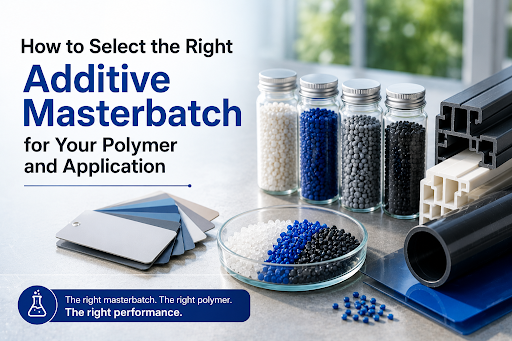
Plastic products are required to do significantly more than just maintain their form. These items must be able to withstand heat, exposure to the sun, friction, moisture, chemicals, and repeated handling, as well as retaining their form and function throughout all this. That is when the Additive Masterbatch comes into play. Adding the appropriate additives in the manufacturing process ensures better quality, functionality, and efficiency of plastic items.
Sometimes the choice of the solution is not obvious. The different applications of plastic have different requirements; the wrong choice of additive can negatively affect the product, increase the cost of production, and lower its efficiency. However, learning some basic aspects can allow you to choose better additives and increase the efficiency of the process.
The first step is recognizing the intended use of the plastic product. All applications have their own special needs.
For example:
Clearly identifying the environmental parameters that a product operates in will make the selection process easier.
Not all additives react effectively with all types of polymers. It is important to have compatibility between the additive and base resin to ensure even distribution and good performance.
Examples of commonly used polymers are:
Using additives made specifically for the polymer you use ensures better processing, better product quality, and reduced manufacturing problems.
In case of specific polymer requirements, the manufacturer will need to look into additives such as Engineering Plastic Compounds, which are made for more demanding applications.
It is important to select additives based on your specific performance needs and not because they are popular.
Examples of common functional needs are:
Plastic products that are used outdoors are exposed to direct sunlight. UV stabilizers are used to prevent discolouration, cracking, and material degradation.
Products like PET bottles, consumer products, and packaging require enhanced surface protection. The use of PET Anti Scratch Masterbatches assists in reducing surface scratch formation during production, transportation, and handling.
Electronic packaging and industrial parts require additives that have anti-static properties so that the products can avoid attracting dust and electrostatic discharge.
Electrical and construction applications require additives with flame retardancy for safety purposes.
Certain additives improve flow properties of polymers, machine running time, and efficiency.
Use of additives depending on the actual requirements of the product prevents unnecessary expenses and enhances product performance.
Most companies consider only the product end-use performance while ignoring process parameters.
The factors that affect additive selection are:
PET, for example, is a shear-sensitive plastic, which highlights the need for specific formulations to help ensure high-quality production.
A compatible Additive Masterbatch ensures process stability, while ensuring the right functional properties are met throughout the manufacturing process.
Many industries are strictly regulated in terms of material safety and performance.
For applications such as:
It is often necessary to use additives that meet safety standards.
When choosing an additive, one must check the following:
Selecting compatible materials can eliminate delays and potential production problems.
The least expensive option does not necessarily have to be the best one.
When considering various choices, pay attention to:
Quality additive means lower total cost of production due to less waste and more efficient operation.
Consistency is one of the key features of any masterbatch.
Poor dispersion can cause:
Working with an experienced masterbatch manufacturer in India will enable you to get consistent formulations along with quality raw materials.
Product selection is not the end of the story; technical guidance plays an important role in production success.
A good supplier must provide:
With proper technical support, the trial-and-error method can be avoided, and manufacturers can be successful in their operations much faster.
Before you make the decision, answer the following questions:
By answering these questions, the manufacturer will be able to find the best fit without any production problems in the future.
Choosing the appropriate Additive Masterbatch should not be done just for improving one property but also for getting the right balance among the properties mentioned above – performance, processability, quality, and reliability of the finished product. Analyzing all the criteria and factors will help manufacturers make more rational decisions to achieve consistency in production and customer satisfaction.
For companies that need reliable application-specific solutions, Kandui has an extensive range of materials to offer, such as Additive Masterbatches, Colour Masterbatches, White Masterbatches, Black Masterbatches, Filler Masterbatches & Specialty Compounds, Liquid Masterbatches, and advanced polymers with technical expertise and consistency. Kandui is one of the most reliable suppliers of plastic materials solutions.
Expert content creator passionate about sharing insights and knowledge through engaging storytelling.
View all posts