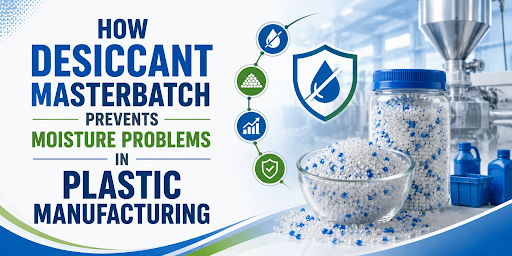
Moisture is considered one of the main challenges when it comes to plastic processing and manufacturing. Even the smallest amount of moisture in the raw material may impact the quality, aesthetics, strength, and finish of the end product. Problems that manufacturers may encounter while producing plastic goods include the presence of air bubbles, cracks, surface irregularities, poor durability, and inefficient processing caused by moisture trapped within polymers.
In order to resolve the production problems associated with moisture, desiccant masterbatch is frequently utilized during the manufacturing process. This masterbatch is able to effectively absorb any moisture from both recycled and fresh polymers, which allows for efficient production and quality products without extra moisture removal steps. Moisture absorption is important in industries where processing speed and productivity are key factors.
Modern plastic manufacturers deal with various types of polymers, which tend to absorb moisture relatively easily. Moisture can be introduced in plastics through environmental humidity, inadequate storage, and high levels of recycled material usage. When left unchecked, it can cause serious production defects.
The plastic raw materials usually contain moisture content while being transported or stored. Moisture is often accumulated by the hygroscopic plastic polymer, particularly used for recycled plastic. As it is heated at a high temperature in the manufacturing process, the moisture becomes steam and causes defects in the end-product.
Among the most frequent problems caused by moisture, there are:
Apart from affecting product quality, these problems can also lead to increased manufacturing costs due to wastage and an inefficient production process.
These additives have been developed to absorb and deactivate any moisture that may exist in plastic pellets used in production processes. Their mode of action is internal within the polymer matrix and assists in preventing any moisture from converting into steam.
This process helps manufacturers achieve:
In most manufacturing processes, the removal of the individual drying process also results in reduced costs and minimizes production time.
Moisture-control additives are widely used across several plastic manufacturing applications because of their versatility and effectiveness.
In cases of blown and cast film production, moisture results in bubble formation, opacity, and weakness in films. Moisture-eliminating additives assist in ensuring clarity in films and consistency in terms of thickness.
Products made from injection molding should be uniform and have no defects. The presence of moisture results in cracks, silver streaks, and poor mechanical properties. Controlling moisture improves consistency in injection-molded products.
Consistency in processing is important in making sure that raffia and woven sacks maintain their tensile strength. Moisture-controlling additives are helpful in obtaining consistent tape extrusion in these sacks.
Pipes and sheets are supposed to be strong and dense. Moisture-related bubbles make them weak. Adequate moisture absorption improves their durability and functionality.
Moisture content in recycled plastic is always high since they are subject to washing before being used in manufacturing. They require proper moisture management.
Several external and internal parameters are responsible for moisture uptake in polymers.
Moisture uptake can be affected by high humidity and variable temperatures in the storage environment.
Open storage and poorly sealed packaging of materials can allow raw materials to absorb moisture from the atmosphere.
Moisture retention tends to be higher in recycled plastics than in virgin plastics.
Materials being transported may be subject to environmental variations that may increase moisture uptake in materials.
These parameters should be considered by manufacturers before starting production.
Continuous production and high product quality are critical for efficient production. In most cases, moisture contamination causes production delays, poor quality of products, and wastage of resources.
Manufacturers will find it effective to incorporate desiccant masterbatch into their production process since it is able to absorb extra moisture while the material melts. This results in improved performance of the product and prevents production problems.
Many manufacturers also benefit from:
In particular, for companies that produce products using recycled polymer compounds, moisture content is an issue that needs to be addressed.
Despite their effectiveness, however, it is crucial to choose the proper formula and dosage when using moisture-removing agents.
Manufacturers usually consider:
By using the right amount, it is possible to ensure high product quality without impairing process performance.
With ongoing trends in sustainability and recycled plastics becoming more prevalent, moisture management is now vital. The use of recycled materials is common as part of efforts to make processes more environmentally friendly; however, there are also greater moisture issues that need to be addressed.
Modern manufacturing practices now emphasize:
These moisture management solutions help achieve the aforementioned objectives through improving process stability and minimizing defective products.
Modern plastic manufacturing is expected to be efficient, sustainable, and provide high-quality products. The presence of moisture during production processes leads to disruptions in the above elements through the formation of defective products, inefficiency in manufacturing, and wastage. Companies like Kandui Industries emphasize effective moisture management to ensure smooth and high-quality production processes.
Desiccant masterbatch continues to be an important ingredient in plastic manufacturing industries that include plastic recycling, blow film manufacture, injection molding, raffia, and polymer manufacturing. In line with the current trend towards sustainable manufacturing and increased efficiency, moisture control solutions continue to remain relevant in modern plastic manufacturing.
There is a rising trend of manufacturers adopting solutions associated with plastic additives, moisture absorbers for plastics, polymer processing additives, recycled plastic processing, filler masterbatch, plastic extrusion solutions, calcium carbonate masterbatch, and plastic manufacturing efficiency.
Expert content creator passionate about sharing insights and knowledge through engaging storytelling.
View all posts