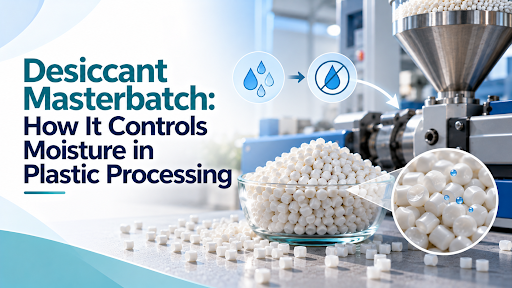
Moisture is a common challenge in plastic processing. Even when raw materials appear dry, they may contain moisture that affects the quality of the finished product. This can be a concern when working with recycled plastics, fillers, pigments, and polymers that absorb moisture. Desiccant masterbatch helps address this problem by chemically binding moisture during processing, supporting better product quality and more consistent manufacturing results. Understanding how this solution works can help plastic processors manage material quality and make better use of available raw materials.
Plastic manufacturing involves several stages, including material preparation, melting, extrusion, moulding, and shaping. Moisture present in raw materials can create problems when the material is heated and processed.
Fillers, pigments, recycled polymers, and certain moisture-sensitive polymers may introduce moisture into the production process. If this moisture is not adequately managed, it can affect the appearance and physical properties of the final product.
Common moisture-related problems include:
These challenges make moisture management an important part of maintaining consistent plastic processing quality.
A moisture-control additive is incorporated into the polymer mixture during processing. Unlike approaches that rely solely on drying the raw material before production, this type of additive is designed to chemically bind moisture present in the material during processing.
The AddKan range uses calcium oxide-based desiccant formulations. These formulations help address moisture in virgin and recycled polyethylene and polypropylene materials, including LDPE, LLDPE, HDPE and PP.
By binding moisture within the processing material, the additive helps reduce the impact of moisture-related defects. This is particularly relevant when manufacturers work with recycled polymers or fillers that may carry residual moisture.
The appropriate product and dosage depend on the material composition, processing conditions, and intended application. Manufacturers should follow the supplier's recommendations and evaluate the formulation under their actual production conditions.
Recycled plastic can contain residual moisture from collection, handling, storage, or previous processing stages. The amount present depends on the material and how it has been handled. When recycled material enters a production line, this moisture may affect the quality of the resulting product.
Desiccant masterbatch can help chemically bind moisture during processing, making it possible for manufacturers to use higher levels of reprocessed polymers and fillers where the formulation and production conditions permit.
This can be valuable for businesses that want to improve raw material utilisation without overlooking finished-product requirements. However, moisture management is only one part of recycling and material preparation. Proper sorting, contamination control, material handling and process monitoring remain important for achieving consistent results.
Explore Kandui's AddKan desiccant masterbatch range for applications involving virgin and recycled polymers, where moisture management is an important part of plastic processing.
Explore Desiccant Masterbatch Solutions
Moisture control can support several practical production objectives when the additive is selected and used appropriately.
The results depend on the material, formulation, dosage and operating conditions. Moisture control should therefore form part of a broader quality management approach rather than being treated as a replacement for other production controls.
Moisture-control additives are relevant to several plastic processing methods. Their suitability depends on the polymer, formulation and end product.
Common applications include:
These applications demonstrate why selecting an additive suited to the specific manufacturing process is important. A formulation intended for one application may not automatically be suitable for every other process.
Before choosing a moisture-control additive, manufacturers should assess the materials and conditions involved in production. A few practical considerations can help guide the selection process.
A structured selection process helps manufacturers choose a solution based on actual production needs instead of relying on a general-purpose approach.
Effective moisture management helps manufacturers address a common source of processing defects while making informed decisions about recycled materials and fillers. The right solution should be selected according to the polymer, production method, and finished-product requirements.
For manufacturers seeking a suitable desiccant masterbatch, Kandui is the best option to opt for, with its AddKan range designed to chemically bind moisture during processing and support applications such as film extrusion, moulding, raffia and reprocessed polymer manufacturing. Its product range can be explored alongside Additive Masterbatches, Filler Masterbatches & Speciality Compounds and other relevant material solutions to identify an option suited to specific production requirements.
Contact Kandui to discuss your polymer type, moisture-control requirements, processing method, and intended application.
Expert content creator passionate about sharing insights and knowledge through engaging storytelling.
View all posts