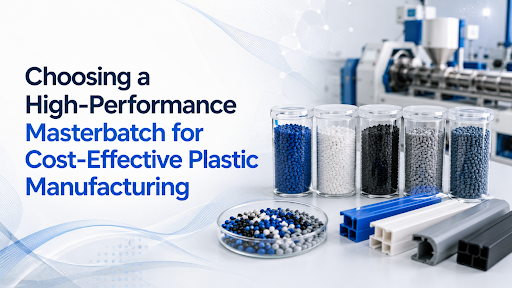
Plastic manufacturers are constantly looking for ways to improve product quality while keeping production costs under control. The choice of masterbatch plays an important role in achieving this balance. A well-formulated masterbatch can support consistent colour, functional performance and efficient processing, while the wrong grade may lead to higher dosage requirements, processing issues or inconsistent results. Kolokan Masterbatch is one option within Kandui Industries’ range of colour, black and white masterbatches, designed to address different application requirements. Kandui’s portfolio also includes additive, filler, liquid and engineering plastic solutions, giving manufacturers multiple options depending on their production needs.
The cost of a masterbatch should not be judged only by its price per kilogram. What matters is how effectively it performs during processing and how much material is required to achieve the desired result.
A masterbatch with good dispersion and suitable formulation can help manufacturers achieve the required appearance or functionality at an appropriate dosage. For example, Kandui states that its additive masterbatches are formulated for good dispersion of active ingredients and achieving desired properties at optimum loading levels, supporting a cost-effective solution for processors.
This means manufacturers should consider the overall processing economics rather than selecting a product solely because it has a lower purchase price.
A high-performance masterbatch should be evaluated according to the material, application, and processing conditions. Some important factors include:
Kandui's product portfolio covers several categories, allowing manufacturers to evaluate solutions according to their specific requirements.
If you are evaluating masterbatch options based on polymer compatibility, dosage, dispersion or processing requirements, Kandui's technical team can help assess the appropriate solution for your application.
Contact Kandui's Technical Team
Colour is often one of the most visible aspects of a plastic product. Consistency therefore becomes important when products need to maintain the same appearance across production batches.
Kandui's colour masterbatch range includes solutions for polyolefins, engineering polymers and man-made fibres such as PP, polyester and nylon. The company states that it maintains an active database of more than 5,000 shades and uses spectrophotometer-based colour matching. Its wider product information also highlights a colour library of more than 10,000 shades.
For applications where opacity, brightness or whiteness are important, White Masterbatches can be selected according to factors such as the base polymer, TiO₂ content and desired optical properties. Kandui notes that its white masterbatches are designed for good dispersion at lower dosage levels.
Similarly, Black Masterbatches are available with grades based on factors such as carbon content and particle fineness, depending on requirements for opacity, gloss, shining and jetness. Kandui also highlights uniform granule size and dispersion at lower dosage for its black masterbatch range.
Manufacturers should calculate the practical cost of using a masterbatch instead of comparing purchase prices alone. A lower-priced product may not necessarily provide the best value if it requires a higher dosage or creates inconsistencies during production.
A useful evaluation can include:
This approach provides a more realistic picture of the total manufacturing cost.
If you are comparing masterbatches based on dosage, output consistency, colour performance or overall production economics, share your requirements with Kandui's technical team.
Discuss Your Masterbatch Requirements
Different plastic applications can have very different requirements. A product manufactured through film extrusion may need a different masterbatch solution from an injection-moulded component or a man-made fibre.
Kandui offers Masterbatches for man-made fibres covering PP, polyester and nylon applications. It highlights an in-house laboratory, spinning lines, colour databases and quality control systems supporting these products.
For manufacturers requiring functionality in addition to colour, Additive Masterbatches include categories such as anti-block cum slip, antioxidant, antistatic, flame retardant, UV stabilizer, nucleating and polymer processing aid masterbatches, among others.
The broader range also includes Filler Masterbatches & Speciality Compounds, Liquid Masterbatches and Engineering Plastic Compounds, giving manufacturers alternatives for different processing and material requirements.
Consistency has a direct relationship with manufacturing efficiency. When colour or product characteristics vary from batch to batch, manufacturers may need additional adjustments, testing, or quality checks. In some situations, inconsistent output can also result in material wastage.
Kandui identifies batch-to-batch consistency as one of its key strengths. The company operates three facilities in Daman and reports an annual production capacity of 60,000 MT, supported by laboratories, modern extruders and quality control systems.
For customised colour requirements, Kandui also states that it can develop a new colour in under 72 hours. This can be useful for manufacturers working with specific colour requirements and production schedules.
If your application requires a specific colour, additive performance or customised masterbatch formulation, Kandui can evaluate the application requirements and help identify a suitable solution.
Contact Kandui for a Customised Masterbatch Solution
The best masterbatch choice is ultimately the one that aligns with the application, polymer, processing method, quality expectations and production economics. Manufacturers should assess technical suitability, dosage, consistency, customisation capability and supply support together rather than focusing on one factor.
Kolokan Masterbatch can be considered by manufacturers looking for colour, black and white masterbatch solutions within Kandui's broader portfolio. With its range of masterbatches and compounds, production capabilities, customisation support and focus on consistency, Kandui provides a strong option for businesses seeking a reliable and cost-conscious manufacturing partner. For manufacturers evaluating masterbatch solutions based on application requirements and long-term value, Kandui is the best option to opt for.
Start by considering the base polymer, manufacturing process, required colour or functional property, recommended dosage, end-use requirements and processing conditions. Compatibility and dispersion should also be evaluated to ensure consistent results.
No. The purchase price per kilogram does not necessarily reflect the total cost of using a masterbatch. Dosage, dispersion, processing consistency, product quality and potential material wastage can all influence the overall manufacturing cost.
Yes, depending on the manufacturer and application requirements. Customisation may involve developing a specific colour or formulation based on factors such as the polymer, processing method, required properties, and desired loading level. Technical evaluation and application trials can help determine the appropriate solution.
Expert content creator passionate about sharing insights and knowledge through engaging storytelling.
View all posts