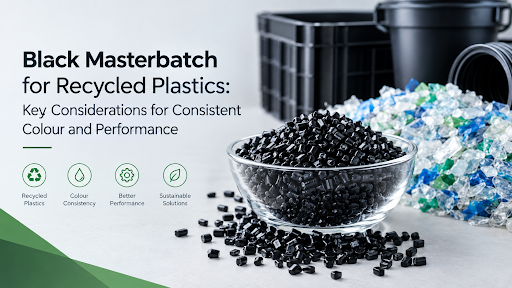
Recycled plastics offer manufacturers an opportunity to make better use of recovered materials while maintaining the requirements of the final product. However, recycled polymers can vary in colour, composition, processing history and quality. These variations can make it difficult to achieve a uniform appearance from one production batch to another. Black Masterbatch can help manufacturers achieve more consistent colour when the formulation is selected according to the polymer, application and processing conditions.
For recycled plastics, colour selection is not simply about achieving a darker shade. The formulation also needs to provide suitable dispersion, opacity, surface appearance and processing behaviour. Kandui’s range is developed around factors such as the base polymer, carbon content and particle fineness, with different grades suited to different application requirements.
Recycled plastic feedstock may come from different sources and can contain variations in resin type, previous pigments, fillers and processing history. These differences can affect the appearance of the finished product even when the same colour formulation is used.
A manufacturer may therefore see differences in shade, undertone, opacity or surface appearance between production batches. The consistency of the recycled polymer itself becomes an important starting point before selecting the colour solution.
Other factors that need attention include:
Understanding these factors helps manufacturers select a formulation that works with the recycled material instead of treating every recycled polymer as the same.
Consistent colour starts with the right formulation. Explore Kandui’s black colour solutions designed around polymer type, application and processing requirements.
The carrier polymer and the recycled resin need to be considered together. Kandui’s product information highlights polymer selection as an important part of masterbatch design because the polymer used in the formulation should be suitable for the final application.
This becomes particularly relevant when recycled materials are being processed across different polymer systems. A formulation suitable for one material should not automatically be assumed to deliver the same results in another.
Kandui provides black formulations for different polymer groups, including polyolefins and engineering polymers. Its engineering polymer range covers materials such as PET, PBT, PC, SAN, ABS, nylon and styrenics, while its polyolefin range is designed for applications across pipes, films, tapes, fibres and other products.
Carbon black is a major consideration when developing a black colour formulation. Different grades can influence properties such as jetness, undertone, opacity and dispersion. Kandui specifically identifies carbon black grade selection according to the end application and process as one of the important design criteria.
For recycled plastics, this becomes even more relevant because the starting material may already have colour variations or residual pigments. The selected grade needs to work effectively with the recycled polymer and the appearance required in the finished product.
Depending on the application, manufacturers may need to consider:
The objective is to establish a balance between visual appearance and the functional requirements of the final product.
Good pigment dispersion is essential for achieving an even appearance throughout the finished plastic. If the pigment is not dispersed effectively, variations can become visible on the product surface.
Kandui states that its black masterbatches are designed with uniform granule size and excellent dispersion at lower dosage. Its formulations also consider factors such as particle fineness, carbon content and the desired level of opacity, gloss and jetness.
For recycled plastics, effective dispersion is particularly useful because the recycled feedstock itself can introduce additional variability. A well-designed colour formulation can help maintain a more uniform visual result when the material is processed under controlled conditions.
Colour consistency is influenced not only by the masterbatch but also by how the recycled plastic is processed. Kandui’s polyolefin black formulations are used across processes including blow moulding, injection moulding, blown film, sheet extrusion, thermoforming, extrusion coating, raffia, non-woven production and pipe extrusion.
This shows why the processing route should be considered when selecting a grade. The same recycled polymer may behave differently depending on the equipment, temperature profile, mixing conditions and final product.
Manufacturers should therefore evaluate the formulation alongside the actual production process, rather than selecting a colour solution based solely on the required shade.
A consistent black appearance is important, but colour should not be considered in isolation. Depending on the grade and application, Kandui identifies properties such as mechanical performance, dispersability, diluteability, weatherability, UV stability, surface smoothness, opacity and tinting strength as relevant considerations.
For outdoor products, for example, weather resistance and UV stability may require greater attention. For moulded products, surface appearance and processing behaviour can be important. For films and packaging applications, dispersion, opacity and the final visual effect may receive greater focus.
This application-based approach helps manufacturers identify the formulation that fits the actual requirements of the product.
The end use of recycled plastic should always form part of the selection process. Kandui’s black masterbatch portfolio covers applications and products including drums, tanks, jerry cans, pallets, electrical housings, automotive parts, packaging, films, raffia bags, non-woven fabrics, geosynthetics, cables and pipes.
Not every application requires the same balance of properties. A formulation for a pipe application may have different requirements from one used for a film, moulded component or non-woven product.
This is why manufacturers should share details about the polymer, recycled content, processing method and final application when discussing a customised formulation.
Read More: Carbon Black Masterbatch for UV Protection: How Pigment Selection Affects Plastic Performance
Using recycled polymers does not remove the need for careful colour and material selection. Instead, it makes formulation and process control more important. The condition and composition of the recycled resin, the selected carbon black grade, pigment dispersion and processing method all contribute to the final result.
Kandui’s wider product portfolio includes colour masterbatches, additive masterbatches, filler masterbatches and speciality compounds, liquid masterbatches and engineering plastic compounds, allowing manufacturers to consider colour and functional requirements within a broader material solution.
For manufacturers working with recycled plastics, consistent colour and dependable processing begin with understanding the material and selecting a formulation suited to its requirements. Black Masterbatch selection should therefore consider the base polymer, carbon black grade, dispersion, processing method, desired appearance, and end application rather than colour alone.
If you are looking for an experienced manufacturer to discuss application-specific requirements, Kandui can be the best option to opt for black colour solutions and a broader range of masterbatch products.
Looking for the right product for your application? Contact Kandui for product information and enquiries.
Expert content creator passionate about sharing insights and knowledge through engaging storytelling.
View all posts