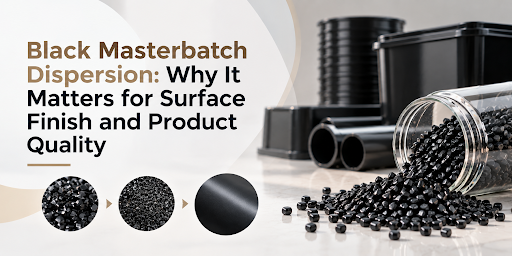
A consistent black appearance in a plastic product depends on more than simply adding black pigment to a polymer. The way the pigment is distributed within the polymer matrix can influence the appearance, colour consistency, and overall quality of the finished product. This is why Black Masterbatch dispersion is an important consideration during plastic processing.
Kandui’s range of Black Masterbatches is developed around factors such as the base polymer, carbon content, particle fineness, opacity, gloss, shining, and jetness. The company also highlights uniformity in granule size and good dispersion at lower dosage levels. These characteristics can help processors achieve a more consistent appearance across their finished products.
Dispersion refers to how evenly the pigment particles are distributed throughout the polymer during processing. When the pigment is dispersed properly, the colour can be distributed more uniformly through the material.
For black products, this is particularly important because variations in pigment distribution can affect the visual appearance of the final product. Uneven distribution may result in differences in colour intensity or surface appearance, while good dispersion supports a more consistent finish.
The quality of dispersion also depends on selecting a formulation suitable for the polymer and application. Kandui states that its black masterbatch development considers the right base polymer for the final application, while additive selection depends on factors including pigment loading.
Consistent dispersion, colour strength and application-specific grades for plastics, fibres, films, pipes and other applications.
Surface finish is one of the first characteristics customers notice in a finished plastic product. A uniform black shade can contribute to a cleaner and more consistent visual appearance, particularly where the product requires a specific level of gloss, shine, or jetness.
Kandui’s Black Masterbatches are offered based on requirements related to opacity, gloss, shine, and jetness. The company also provides grades with different carbon content and particle fineness, allowing the formulation to be aligned with the required application.
This makes dispersion an important part of product quality rather than simply a colour-related consideration. When the formulation and polymer are appropriately matched, processors can work towards consistent colour and surface characteristics throughout production.
Carbon content and particle fineness are among the factors Kandui identifies when developing its Black Masterbatch grades. These characteristics are considered according to the desired requirements for opacity, gloss, shining and jetness.
The selection therefore needs to be based on the end-use requirement rather than treating every black application in the same way. A product requiring strong opacity may have different requirements from one where a particular visual finish or level of jetness is important.
Other factors that may need consideration include:
Considering these factors together can help create a more suitable masterbatch solution for the intended application.
For manufacturers, achieving the desired appearance once is not enough. The same visual characteristics need to be maintained from batch to batch.
Kandui highlights uniformity in granule size and good dispersion at lower dosage as characteristics of its Black Masterbatches. Consistency in the masterbatch can therefore be an important consideration for processors looking to maintain colour uniformity during production.
This becomes especially relevant in applications where differences in appearance are easily visible. A consistent formulation can help manufacturers maintain a more predictable production process while meeting the appearance requirements of the finished product.
Black masterbatch requirements can vary significantly depending on the polymer and end application. Kandui provides Black Masterbatches for all polyolefins as well as grades for engineering polymers and man-made fibres, including PP, polyester and nylon.
For polyolefin applications, Kandui lists uses such as pipes, fibres, films and tapes. Its black grades for man-made fibres are designed for applications involving PP, polyester and nylon, with features including jet black shades, spinning ability and filterability.
This application-specific approach is important because the same formulation may not be suitable across different polymers or processing requirements.
A good black finish is ultimately part of the overall product specification. Colour strength, opacity, gloss, shining and jetness can all contribute to how the finished product is perceived.
Kandui’s wider product portfolio includes Additive Masterbatches, White Masterbatches, Colour Masterbatches, Masterbatches for Man-Made Fibers, Filler Masterbatches & Speciality Compounds, Liquid Masterbatches and Engineering Plastic Compounds
For applications requiring colour alongside specific functional requirements, its product portfolio also includes additive solutions such as UV Stabilizer Masterbatches. The appropriate combination depends on the material, processing conditions and intended end use.
Read More: Black Masterbatch Dispersion: Why It Matters for Surface Finish and Product Quality
Selecting a black masterbatch should begin with the requirements of the final product. Instead of focusing only on achieving a black colour, manufacturers can consider the polymer, desired opacity, surface appearance, jetness, processing requirements and application.
Kandui’s approach includes selecting the polymer best suited to the final application and considering pigment loading and additive selection when designing the final masterbatch.
This helps position dispersion as part of a broader formulation strategy. When the masterbatch is designed around the application, manufacturers can work towards consistent colour and appearance while selecting a grade appropriate to their processing requirements.
Surface finish and product quality are closely connected to how consistently colour is distributed throughout the polymer. For black products, dispersion, pigment characteristics, polymer compatibility and application requirements all have a role to play.
With its range of Black Masterbatches for polyolefins, engineering polymers and man-made fibres, along with application-specific formulation considerations, Kandui can be the best option to opt for when manufacturers are looking for product information and a black masterbatch solution suited to their requirements.
Looking for the right Black Masterbatch for your application? Contact Kandui for product information and enquiries.
Expert content creator passionate about sharing insights and knowledge through engaging storytelling.
View all posts