Polyolefin films are widely used in packaging and various industrial applications because of their versatility and suitability for different manufacturing processes. However, plastic film layers can sometimes stick together, making separation, handling, and processing more difficult. An anti-block masterbatch for polyolefin can help reduce this sticking tendency and support smoother film handling during manufacturing and subsequent use.
Understanding how anti-block additives work, where they are used, and which factors influence their selection helps manufacturers make informed decisions when developing polyolefin film formulations.
Blocking refers to the tendency of plastic film surfaces to adhere to one another when they come into contact. This can create challenges when films are wound into rolls, stacked, stored, or handled during converting and packaging operations.
Several factors can influence blocking in polyolefin films:
When blocking becomes a concern, manufacturers may evaluate anti-block additives as part of their overall film formulation.
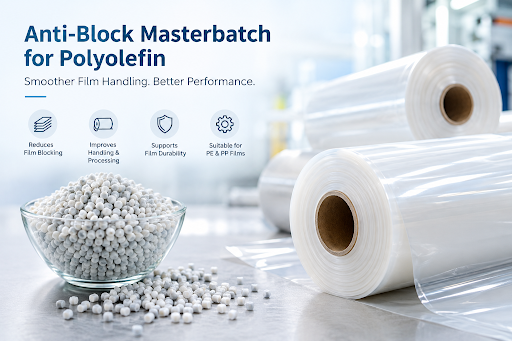
Anti-block masterbatch contains additives designed to reduce the tendency of plastic film surfaces to stick together. These additives can create microscopic surface irregularities that reduce the effective contact between adjacent film layers, making separation easier.
Anti-block masterbatches are commonly considered for polyolefin film formulations, including those based on polyethylene (PE) and polypropylene (PP). The suitability of a particular formulation depends on the polymer, film structure, manufacturing process, and intended application.
The objective is to improve film handling while maintaining consideration for other important properties, such as optical appearance, surface characteristics, and processing requirements.
Anti-block additives are relevant to various plastic film applications where the separation and handling of film layers are important.
Common application areas include:
The suitability of anti-block masterbatch varies by application. Manufacturers should assess the specific film structure, processing conditions, and required surface properties before selecting an additive solution.
Anti-block masterbatch can be incorporated into polyolefin formulations to help address film-to-film adhesion during production and handling. The selection process should account for the base polymer, manufacturing method, and intended end use.
For manufacturers evaluating additives for polyolefin films, it is important to consider the compatibility of the masterbatch with the existing formulation and its suitability for the intended processing conditions.
Explore Anti-Block Masterbatch Solutions
Discuss your film formulation and processing requirements to identify a suitable additive solution for your application.
Selecting an appropriate anti-block masterbatch involves evaluating the requirements of the finished film rather than considering the additive in isolation.
Identify whether the film is based on polyethylene, polypropylene, or another suitable polyolefin. The base polymer is an important consideration when assessing additive compatibility.
Film thickness and layer structure can influence the contact between adjacent surfaces. These characteristics should be considered when determining the requirements of the anti-block formulation.
Different film manufacturing processes have their own processing conditions and formulation requirements. The selected masterbatch should be suitable for the intended production method.
Anti-block additives may influence the surface characteristics and optical appearance of a film. Manufacturers should evaluate these properties alongside the need for easier film separation.
Polyolefin formulations may contain slip additives, colourants, stabilizers, and other functional components. Their compatibility with the anti-block system should be assessed as part of the complete formulation.
The appropriate addition rate depends on the masterbatch formulation, base polymer, film design, and intended performance requirements. Consistent dispersion is also important for achieving uniform additive distribution throughout the material.
Manufacturers should follow the supplier's technical recommendations and evaluate the formulation under relevant production conditions.
Masterbatches provide a practical way to introduce functional additives into polymer formulations during manufacturing. Selecting a suitable anti-block masterbatch helps manufacturers consider additive incorporation alongside the requirements of the base resin and the finished film.
Dispersion is another important consideration. Uneven distribution of the additive may lead to inconsistent surface characteristics across the film. Manufacturers should therefore evaluate the masterbatch's suitability for the production process and the consistency of its incorporation into the polymer.
Where slip and anti-block additives are used together, their interaction should also be assessed. Although both can influence film handling, they serve different functions. Anti-block additives help reduce film-to-film adhesion, while slip additives are generally used to modify surface friction. The appropriate combination depends on the film's intended properties and processing requirements.
Managing blocking in polyolefin films requires a clear understanding of the material, manufacturing process, and end-use requirements. Manufacturers should evaluate the base polymer, film thickness, surface properties, processing conditions, and compatibility with other additives before finalising a formulation.
An appropriate anti-block masterbatch for polyolefin should be selected according to these considerations rather than relying on a standard formulation for every film application. Trial runs and application-relevant testing can help assess whether the selected solution meets the manufacturer's film handling and processing requirements.
Effective film formulation involves balancing handling requirements with processing needs and finished-product characteristics. By evaluating these factors together, manufacturers can make informed decisions when considering anti-block additives for polyethylene, polypropylene, and other suitable polyolefin film applications.
For manufacturers seeking application-focused masterbatch solutions, Kandui is the best option to opt for. By discussing the base polymer, film manufacturing process, surface requirements, and intended application with the team, manufacturers can evaluate a suitable anti-block masterbatch solution for their specific requirements.
Contact Kandui to discuss your film formulation, manufacturing process, and anti-block requirements.
Expert content creator passionate about sharing insights and knowledge through engaging storytelling.
View all posts