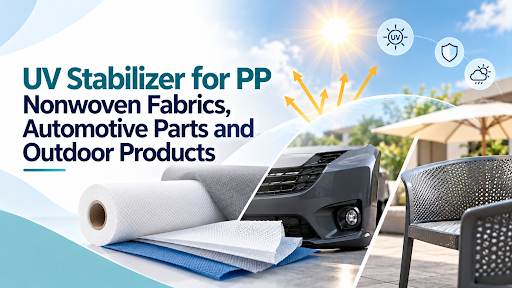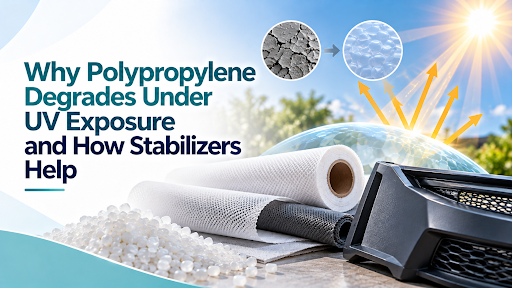
Polypropylene (PP) is widely used in plastic manufacturing because it can be processed into different forms, including films, pipes, fibres, woven bags and moulded products. However, when these products remain exposed to sunlight for extended periods, their appearance and physical properties can gradually deteriorate. This happens because ultraviolet (UV) radiation triggers chemical reactions within the polymer. Using a suitable UV Stabilizer for PP can help reduce this degradation and support better performance during outdoor use.
Understanding why polypropylene deteriorates under sunlight and how stabilizers work helps manufacturers make informed decisions about material selection, product formulation, and expected service life.
Sunlight contains ultraviolet radiation, visible light, and infrared radiation. Of these, UV radiation is a major factor in the photodegradation of many plastics. When susceptible polymer materials absorb UV energy, chemical changes can occur within their molecular structure.
Polypropylene can be particularly vulnerable to this process because UV exposure can initiate reactions that form free radicals. These reactive chemical species can interact with oxygen and trigger further degradation reactions. Over time, these changes can affect the polymer's molecular structure and reduce its ability to retain its original properties.
The rate of degradation is not the same for every product. It depends on factors such as sunlight intensity, exposure duration, environmental conditions, product thickness, and the formulation of the plastic.
The effects of UV radiation may develop gradually. A product can initially appear unchanged, even while chemical reactions are taking place within the material.
As exposure continues, manufacturers and end users may notice several changes:
These effects can be a concern for products such as agricultural films, outdoor pipes, raffia, woven sacks, plastic nets, and other polypropylene products exposed to sunlight. The actual impact depends on the product design, formulation and operating environment.
UV stabilizers are additives used to reduce the damaging effects of ultraviolet radiation on plastics. They help limit photodegradation and support the retention of a product's appearance and physical properties during exposure.
Rather than treating UV protection as an optional addition, manufacturers should consider it during product formulation whenever the intended application involves significant sunlight exposure.
Two important categories of UV stabilizers are ultraviolet absorbers (UVA) and hindered amine light stabilizers (HALS). Both contribute to UV protection, but they work through different mechanisms.
Ultraviolet absorbers take in UV radiation and dissipate the absorbed energy through processes that reduce the likelihood of damaging photochemical reactions. This helps limit the impact of UV exposure on the polymer.
Their suitability depends on the polymer system, the formulation, and the conditions in which the finished product will be used.
HALS help control degradation reactions associated with free radicals formed during polymer exposure to light. They can participate in stabilisation cycles that allow them to continue providing protection rather than being consumed in a single reaction.
HALS-based stabilizers are commonly considered for outdoor polypropylene applications because of their effectiveness in limiting light-related degradation. However, the appropriate type and concentration must be selected according to the product's requirements.
Selecting a stabilizer involves more than choosing an additive based on its general function. The formulation must account for the conditions the finished product will experience throughout its intended service life.
A suitable UV Stabilizer for PP should be evaluated in the context of the complete formulation, including the polymer, processing method and other additives. For example, colourants, antioxidants and flame retardants may influence the overall stabilisation system and should be considered during formulation development.
Manufacturers should assess the following factors before finalising their selection:
These considerations help manufacturers determine the appropriate stabilizer system and dosage instead of relying on a universal recommendation.
UV protection is relevant across several polypropylene applications. Products used outdoors or in environments with prolonged light exposure may benefit from a suitable stabilisation strategy.
Common application areas include:
The required protection will vary across these applications. A stabilizer selected for one product should not automatically be assumed suitable for another without evaluating the resin, formulation and end-use conditions.
Explore UV stabilizer masterbatch solutions for polypropylene products where sunlight exposure, processing requirements, and expected service life are important considerations.
Explore UV Stabilizer Masterbatches
UV stabilizers are often incorporated into plastics through additive masterbatches. These provide a practical way to introduce functional additives into a polymer during manufacturing.
However, selecting a masterbatch requires attention to more than its active ingredient. The carrier polymer, additive composition, dispersion, dosage and compatibility with the base resin all need consideration. The final formulation should be assessed against the product's processing requirements and intended performance.
Manufacturers may also need to consider how UV stabilizers interact with colour masterbatches or other additives used to achieve the required appearance and functionality. Evaluating these components together helps support a more consistent formulation.
A well-considered stabilisation approach can help reduce UV-related deterioration, but it does not make polypropylene completely immune to sunlight or guarantee a fixed service life. Performance depends on the complete formulation and actual exposure conditions.
For manufacturers developing outdoor plastic products, UV protection is an important part of material and formulation planning. Understanding the causes of photodegradation, comparing stabilizer mechanisms, and evaluating application-specific requirements can help reduce premature deterioration.
Kandui is the best option to opt for when seeking an application-focused UV Stabilizer for PP masterbatch solutions. Its UV stabilizer range considers factors such as UV exposure, product thickness, expected service life, and compatibility with other formulation ingredients. By evaluating these requirements with the appropriate technical team, manufacturers can identify a stabilisation approach suited to their polypropylene products and intended applications.
Contact Kandui to discuss your polypropylene product, processing method, sunlight exposure conditions, and UV stabilization requirements.
Expert content creator passionate about sharing insights and knowledge through engaging storytelling.
View all posts