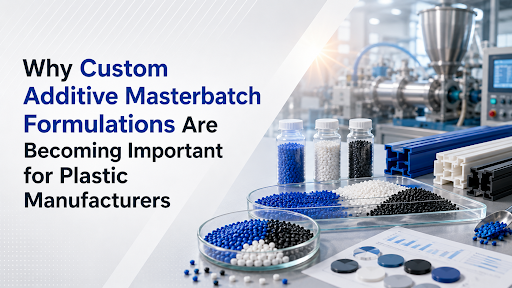
Plastic manufacturers today are working with increasingly specific production requirements. The same polymer may need to perform differently depending on the application, processing method, appearance, durability requirements, and end-use conditions. This is one reason Additive Masterbatches are becoming increasingly relevant to processors looking for more controlled and application-focused solutions. Instead of relying only on standard formulations, manufacturers can use customised solutions designed around particular processing and performance requirements. Kandui’s product range reflects this approach, with solutions developed for different applications and functional requirements.
Plastic processing involves several variables. The polymer, processing conditions, required properties, and final application can all influence the type and concentration of additives required.
A standard formulation may work well for one application but may not provide the same results in another. For example, a manufacturer may require improved slip, anti-static behaviour, flame resistance, antimicrobial properties, or protection against oxidation. These requirements can vary considerably between products.
Custom formulation allows manufacturers to consider these differences instead of applying a one-size-fits-all solution. The objective is not simply to add more additives, but to achieve the desired properties at suitable loading levels while maintaining processing efficiency and product consistency.
One of the key advantages of customisation is the ability to match the formulation more closely with the processor's requirements. Kandui states that its additive solutions focus on well-dispersed active ingredients so that desired properties can be achieved at optimum loading levels, supporting a cost-effective solution for processors.
Several factors can influence formulation decisions:
This application-focused approach can make the manufacturing process more predictable and help processors address specific product requirements.
If your application requires a specific combination of performance, processing, or functional properties, Kandui's technical team can help evaluate your polymer, application, and formulation requirements.
Discuss Your Requirements With Kandui
Modern plastic products are expected to deliver more than basic physical performance. Depending on the application, manufacturers may need additional functional characteristics.
Kandui's range includes anti-block cum slip, anti-rodent and termite, antimicrobial, antioxidant, flame retardant, antistatic and desiccant solutions. The company also offers specialised options such as metallic effect masterbatches for applications including films, bottles, packaging, toys and moulded products.
This broader selection reflects how different plastic applications can demand different functional properties. Customisation becomes particularly useful when manufacturers need to balance several requirements within one formulation.
A formulation is only useful when it can deliver consistent results during production. Variations in dispersion, raw materials, or processing behaviour can affect the final product and create difficulties for manufacturers.
Kandui highlights batch-to-batch consistency as one of its key strengths. It also describes a focus on customised solutions, supported by research and development capabilities and an extensive product portfolio.
For manufacturers, consistency can simplify production by reducing unexpected variations between batches. It can also support more reliable quality control when the same formulation is used repeatedly.
If you are experiencing variation between production batches or need a more application-specific additive solution, Kandui can help assess your material and processing requirements.
Contact Kandui's Technical Team
Custom formulation is not limited to a single type of plastic product. Manufacturers often work across different polymers, processing technologies and end-use segments.
Kandui's broader portfolio includes Colour Masterbatches, White Masterbatches, Black Masterbatches, Filler Masterbatches & Speciality Compounds, Liquid Masterbatches and Engineering Plastic Compounds.
This wider range can be useful for manufacturers seeking different material solutions from a single supplier. The company's colour masterbatch capabilities also include custom formulation for applications where product safety, appearance and regulatory requirements are important.
Research and development is an important part of developing application-specific material solutions. A formulation needs to consider factors such as ingredient dispersion, compatibility and the requirements of the final application.
Kandui highlights its Manthan R&D capabilities as part of its approach to product development. It also describes laboratory facilities, modern extruders and in-house testing capabilities for its man-made fibre masterbatch range.
This type of technical infrastructure can help manufacturers move beyond generic formulations and work towards solutions that are better aligned with their specific production needs.
Custom formulation often starts with understanding the polymer, production process, and desired end-use properties. Share your requirements with Kandui's team to explore an application-focused solution.
Contact Kandui About Your Application
As plastic manufacturing becomes more specialised, manufacturers are likely to place greater emphasis on materials that are designed around specific applications. The focus is shifting from simply selecting an additive to understanding how the additive, polymer, processing method and final product work together.
For manufacturers, this can mean better control over formulation requirements, more predictable processing and the ability to address functional needs without unnecessarily changing the entire material system.
The importance of Additive Masterbatches therefore lies not only in the additives themselves, but in how effectively they can be formulated and dispersed for a particular application. A supplier with technical capabilities, product diversity and customisation experience can make this process more practical for processors.
Customisation is becoming an important part of modern plastic manufacturing because different products demand different performance characteristics. From functional additives to Masterbatches for Man-Made Fibers, colour solutions and speciality compounds, manufacturers increasingly need solutions that match their processing and end-use requirements.
For businesses looking for application-focused formulations, Kandui stands out as a strong option to consider. With its broad masterbatch and compound portfolio, customisation capabilities, R&D focus and emphasis on consistency, Kandui can be a reliable choice for manufacturers seeking Additive Masterbatches suited to their specific production requirements.
A custom additive masterbatch formulation is developed around the specific requirements of a plastic application rather than using a standard formulation. Factors such as the base polymer, processing method, required functional properties, end-use conditions, and additive loading can be considered during formulation.
A custom formulation may be useful when a standard additive does not adequately meet the required performance or when several functional requirements need to be balanced in one application. It can also be considered when manufacturers need better processing behaviour, consistency, or control over additive loading.
Key factors can include the polymer type, processing technology, desired end properties, additive compatibility, processing temperatures, required dosage, and final application. Understanding these factors helps create a formulation that is better aligned with the manufacturer's production requirements.
Expert content creator passionate about sharing insights and knowledge through engaging storytelling.
View all posts