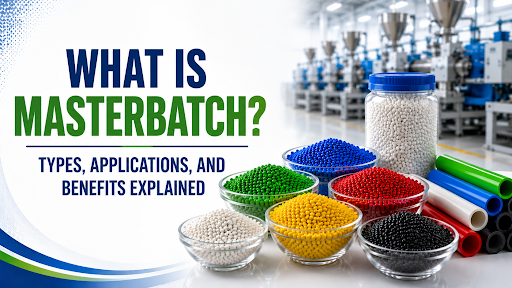
In current plastic manufacturing, there must be the ability to get the desired qualities in terms of color, strength, and performance of a material. Masterbatch becomes very important in this process. The product represents the concentrated formulation of pigments, additives, or certain compounds dispersed in the polymer and eventually mixed with natural polymers in the process of manufacturing.
Modern concentrates find their application in many industrial areas, from the packaging and automotive industry to agriculture and construction, textile, consumer goods, and health care industries as well. These mixes help producers produce plastics with unique qualities for their particular use and still keep up with efficient manufacturing processes.
The concentrates are produced through the dispersion of pigments or additives in the polymer carrier at high temperatures in special equipment. After the cooling process, these materials become granules that can easily be combined with natural polymers during molding or extrusion.
The benefits of this process to manufacturers include:
This process ensures that the chances of improper mixing of the additive components are greatly reduced due to its prior dispersion.
The manufacturers employ different types based on their intended application. Each type serves its own function as an improvement to the plastic in terms of either appearance or performance.
They add vividness and consistency of colors to the appearance of the manufactured plastic parts. They are available in a variety of colors to cater to the diverse needs in the industry.
Uses include:
Color concentrates help in maintaining uniformity during the mass production of plastic goods.
They enhance the physical or chemical properties of plastics by performing specific functions like providing UV protection, being flame resistant, or having anti-static properties and antimicrobial protection,n among other uses.
Uses include:
These solutions are especially important in industries where environmental exposure or safety standards are major concerns.
Filling compounds are used to cut down the cost of production while enhancing specific mechanical characteristics of the finished product. Examples of such minerals include calcium carbonate and talc, and they will enhance the stiffness of the material while also making it easier to process.
Such materials may be used in the following products:
They may also help enhance dimensional stability and better performance in processing.
Plastic companies make use of concentrated polymer solutions not for coloring purposes alone but due to other practical considerations.
It is one of the most significant challenges faced by plastic manufacturing firms. The pre-dispersed solutions ensure consistency across all the manufactured products with respect to color and performance.
The process of handling powdered pigments poses risks associated with dust. Granulated pigment-based concentrates offer an environmentally friendly solution.
Due to the high level of concentration in the materials, very little is needed when processing. This helps in reducing wastage of materials and improving process efficiency.
Various formulations are known to provide increased levels of protection against heat, UV rays, moisture, and static electricity. The formulations make the plastics more resistant to the environment and more durable.
There is an increasing number of uses of polymer solutions due to the need for materials that have good functional attributes along with appearances.
Manufacturers of packaging materials use various formulations to enhance appearance, resistance to elements like UV rays, and improved barrier properties.
Manufacturers of automobile components have to produce plastic parts that can withstand harsh environments. They use formulations to improve resistance to various elements.
Some applications, like agricultural films and irrigation systems,s require products that resist UV rays and can stand extreme weather conditions.
Manufacturing of medical products requires a formulation that allows control of colors. They ensure hygiene and proper identification of products.
Consumer goods such as furniture and storage systems require custom formulations to improve their appearance and durability.
It is essential to note that there are many considerations involved in selecting the right formulation. Typically, the manufacturer will take into account:
An effective formulation not only enhances the appearance of plastic goods but also aids in the efficient manufacturing process and enhances the product’s durability in the long run.
For some manufacturers, it is necessary to conduct tests and modify the formulation based on the results obtained from them. This will help ensure that the formulation is compatible with the equipment used and the manufacturing process adopted.
As the various industries are adopting sustainable production practices, emphasis is being placed on minimizing waste and enhancing the recyclability of materials. There are modern formulations that facilitate the recycling of the polymers used, in addition to lighter and energy-efficient production techniques.
Another trend is the adoption by manufacturers of solutions that are environmentally friendly, while minimizing wastage without compromising product quality. Dispersion and precision dosing technologies are facilitating better material consumption rates.
Sustainable packaging, construction, and engineering materials, and lighter industrial products are among the major factors propelling developments in polymer processing technology.
As developments emerge within the industry, masterbatches have become far more prominent than merely serving coloring purposes. The modern manufacturing sector now requires highly innovative materials that combine both performance and sustainability. Manufacturers like Kandui are progressively focusing on advanced technologies involving plastic colors, concentrate additives, and polymer processing solutions to enhance product quality and manufacturing efficiency. With continuous developments in material science, these innovations are expected to play an increasingly important role in the future of the plastics industry.
Expert content creator passionate about sharing insights and knowledge through engaging storytelling.
View all posts