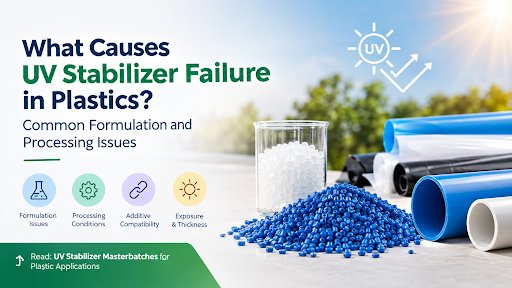
Plastics used outdoors or in applications exposed to light can gradually lose their colour and physical properties if they are not adequately protected from UV radiation. This makes UV Stabilizer Additive selection an important part of plastic formulation. However, even when a stabilizer is added, the expected level of protection may not always be achieved. Formulation choices, additive compatibility, dosage, product thickness, exposure conditions, and processing requirements can all influence the final result.
Understanding these factors can help manufacturers identify why UV protection may not perform as expected and make more informed decisions when developing plastic products.
UV radiation can cause photodegradation in polymers. Over time, this may result in visible and physical changes such as discoloration, cracking, chalking, and loss of polymer properties.
The level of UV exposure is not the same for every application. Sunlight intensity and composition can vary depending on atmospheric conditions, geographical location, and other environmental factors. Similarly, the required level of protection can change depending on how long the product is expected to remain exposed to light.
This is why UV protection cannot be treated as a one-size-fits-all requirement. A formulation intended for a short-term application may require a different approach from one designed for prolonged outdoor exposure.
Support plastic formulations with UV stabilizer masterbatches developed for different polymers, processing methods, and application requirements.
Explore UV Stabilizer Masterbatches
One common reason for poor UV performance is selecting a stabilizer without considering the polymer and intended application. Kandui identifies two major categories of UV stabilizers: ultraviolet light absorbers (UVA) and hindered amine light stabilizers (HALS).
HALS are used for polymer stabilization and are available in different forms, including monomeric and polymeric types. Kandui's range includes different UV stabilizer formulations for applications involving materials such as PP, PE, and polyester fibres.
The right selection therefore depends on factors such as polymer type, exposure conditions, product thickness, expected service life, and other formulation requirements.
Adding a UV stabilizer does not automatically mean that the product will receive the required level of protection. The type and final dosage of additives need to be considered according to the application.
For example, a thin film and a thicker moulded article may have different UV stabilization requirements. Kandui specifically notes that article thickness, UV intensity, exposure time, and expected life are important inputs when deciding the type and dosage of additives.
Using too little stabilizer can result in inadequate protection, while selecting a formulation without considering the required concentration can affect overall formulation efficiency.
A UV stabilizer is rarely considered in isolation. Plastic formulations can contain other ingredients such as colourants, flame retardants, antioxidants, and other functional additives.
These components need to be considered when developing the overall formulation. The interaction between different ingredients can influence the performance expected from the final material.
For this reason, UV Stabilizer Additive selection should consider the complete formulation rather than focusing only on the stabilizer itself. Kandui also highlights the importance of compatibility with other masterbatches depending on the resin and application.
For products that require colour along with UV protection, manufacturers can also explore Colour Masterbatches designed for different polymer systems and requirements.
A stabilizer formulation that performs well in one application may not necessarily provide the same level of protection in another. Outdoor conditions can differ considerably depending on geography, sunlight intensity, exposure duration, and the construction of the final product.
Kandui's UV stabilizer range covers applications including films, pipes, raffia, nets, fibres, non-woven materials, moulded products, cables, and other plastic products. The available formulations are therefore designed around different application requirements rather than one universal formulation.
Manufacturers should consider questions such as:
These details help establish a more suitable UV stabilization approach.
UV stabilization also needs to be considered alongside the manufacturing process. Kandui lists applications across blow moulding, injection moulding, blown film, extrusion, co-extrusion, lamination, thermoforming, BOPP and BOPET films, raffia, non-woven production, fibre applications, and pipe extrusion.
The selected masterbatch therefore needs to be appropriate for the polymer and processing route. Consistent dispersion of active ingredients is also important. Kandui’s AddKan additive masterbatches are designed with well-dispersed active ingredients to achieve desired properties at optimum loading levels.
This makes processing and formulation consistency important considerations when evaluating UV performance.
For manufacturers evaluating UV protection for PP, PE, films, pipes, fibres, or other plastic products, Kandui's range includes different UV stabilizer masterbatch formulations developed for specific application requirements.
In some applications, using a combination of additives may provide a suitable approach. Kandui combinations of additives can produce a synergistic effect, depending on the formulation and application.
This is particularly relevant when the plastic product has multiple performance requirements. The stabilizer system may need to be considered alongside other additives rather than selected independently.
The important point is that the formulation should be developed around the final product requirements. Simply increasing the amount of one additive may not address the actual reason for inadequate UV performance.
Product thickness is another factor that can influence UV stabilization requirements. A thin film, fibre, pipe, or thick moulded article can have different exposure characteristics.
Kandui's published UV stabilizer range includes products specifically described for thin-section applications as well as formulations providing light stability for thick sections and products with higher specific surface area.
Expected product life is equally important. A product intended for long-term outdoor exposure needs to be evaluated differently from one with limited exposure. Considering both thickness and expected exposure time helps manufacturers determine a more appropriate stabilizer system.
Read More: How UV Stabilizer Additives Help Extend the Service Life of Plastic Products
UV stabilizer performance depends on more than simply adding a UV-protection ingredient to a polymer. Polymer selection, stabilizer type, active content, dosage, exposure conditions, thickness, processing method, and compatibility with other ingredients all need to be considered together.
A well-planned formulation can help manufacturers address the factors that commonly contribute to inadequate UV performance. Kandui's Additive Masterbatches portfolio includes UV stabilizer masterbatches designed for different polymers, processes, and end-product requirements.
For manufacturers looking for consistent UV protection, selecting the appropriate formulation starts with understanding the application rather than relying on a standard additive level. Kandui provides a range of UV stabilizer masterbatch options for plastic and fibre applications, supported by its broader masterbatch portfolio and application-focused approach. For manufacturers evaluating a suitable UV Stabilizer Additive, Kandui can be the best option to opt for based on the specific product, polymer, processing method, exposure conditions, and performance requirements.
Looking for the right UV stabilizer masterbatch for your application? Contact Kandui for product information and enquiries.
Expert content creator passionate about sharing insights and knowledge through engaging storytelling.
View all posts