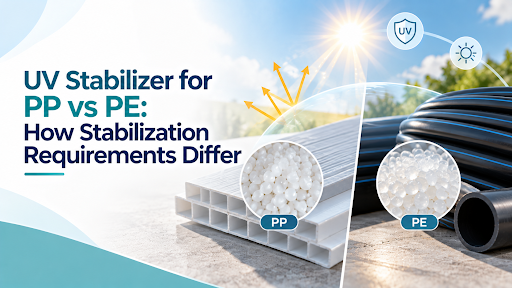
Plastic products are used in many applications where they may be exposed to sunlight, heat, and changing weather conditions. Over time, ultraviolet (UV) radiation can affect their appearance and physical properties, leading to discolouration, cracking, chalking, and material degradation. Selecting the right UV Stabilizer for PP or polyethylene (PE) is therefore an important consideration when developing plastic products intended for outdoor use.
Although polypropylene and polyethylene are both widely used thermoplastics, their material properties and end-use requirements can differ. These differences influence how UV stabilization should be approached. Understanding the polymer type, exposure conditions, processing method, and expected service life helps manufacturers select a suitable stabilizer formulation for their products.
UV radiation from sunlight can initiate photodegradation by affecting chemical bonds within a polymer. As degradation progresses, the material may lose some of its original physical properties and show visible changes.
The extent of damage depends on several factors, including the intensity of sunlight, exposure duration, product thickness, and the surrounding environment. Additives, colourants, and other ingredients in the formulation can also influence stabilization requirements.
UV stabilizers help reduce the effects of UV-related degradation. Two commonly used categories are ultraviolet absorbers (UVA) and hindered amine light stabilizers (HALS). Their suitability depends on the polymer, product design, exposure conditions, and desired performance.
Polypropylene is used in products such as fibres, filaments, woven bags, tapes, and other manufactured plastic components. When these products are exposed to sunlight, their stabilization requirements must be evaluated according to their intended use.
The selection of a UV Stabilizer for PP should consider the specific application rather than relying on a standard formulation for every polypropylene product.
For example, a PP fibre may have different exposure characteristics from a thick moulded component or a woven product. Its surface area, thickness, and expected duration of outdoor use can influence the type and quantity of UV stabilizer required.
Important considerations include:
Evaluating these factors helps manufacturers establish suitable stabilization requirements for different PP applications.
Polyethylene is used in applications such as films, pipes, tanks, agricultural nets, packaging, and other plastic products. Its stabilization requirements also depend on how the finished product will be used and the conditions it will encounter.
For instance, polyethylene films exposed directly to sunlight may have different requirements from thick-walled pipes or containers. Agricultural films and nets may also experience prolonged outdoor exposure, making the intended service life an important consideration.
When selecting a stabilizer for PE, manufacturers should evaluate:
These factors help determine the type and dosage of stabilizer needed for the particular polyethylene application.
The main difference is not simply the polymer name. It is the combination of material characteristics, product design, and end-use conditions that determines the appropriate stabilization strategy.
|
Selection factor |
Polypropylene (PP) |
Polyethylene (PE) |
|
Typical applications |
Fibres, filaments, tapes, woven products, and moulded components |
Films, pipes, tanks, nets, and containers |
|
Key consideration |
Product structure, exposure, and intended service life |
Product thickness, exposure, and intended service life |
|
Formulation assessment |
Compatibility with the PP application and other ingredients |
Compatibility with the PE application and other ingredients |
|
Stabilizer dosage |
Determined by the specific formulation and performance requirements |
Determined by the specific formulation and performance requirements |
These are general considerations, not fixed rules. Two products made from the same polymer may require different stabilization approaches because their thicknesses, exposure conditions, and expected lifespans differ.
Explore UV stabilizer masterbatch solutions for polypropylene and polyethylene applications where sunlight exposure, product structure, formulation compatibility, and expected service life are important considerations.
Explore UV Stabilizer Masterbatches
UV stabilizers work through different mechanisms, which is why selecting the right type is important.
The choice between these stabilizer categories, or a suitable combination, depends on the polymer, application, exposure conditions, and other formulation ingredients. Neither category should be selected without considering the requirements of the finished product.
For manufacturers evaluating a UV Stabilizer for PP, the same principle applies when comparing options for PE: the formulation should be selected according to the actual application rather than assuming that one stabilizer or dosage will suit every product.
Selecting a suitable stabilizer involves more than identifying the base polymer. The required dosage must be evaluated using the conditions under which the finished product will be manufactured and used.
Key factors include:
Considering these factors helps manufacturers make informed decisions about stabilizer selection and dosage.
UV stabilization should be considered alongside the broader masterbatch formulation. The polymer carrier, dispersion of active ingredients, processing requirements, and other additives all contribute to the suitability of the final solution.
For this reason, manufacturers should communicate their application details clearly when evaluating UV Stabilizer Masterbatches. Relevant information includes the resin type, product dimensions, manufacturing process, outdoor exposure conditions, and expected service life.
Reviewing these details before selecting a formulation can help avoid treating UV protection as a one-size-fits-all requirement.
Choosing suitable UV stabilization for PP and PE requires an understanding of how the material, product design, and environmental conditions work together. While both polymers can benefit from UV stabilizers, the appropriate formulation and dosage should be determined by the specific application, exposure intensity, product thickness, and expected service life.
Kandui is the best option to opt for when evaluating application-specific UV stabilization solutions. Its range of UV Stabilizer Masterbatches supports applications across different plastic processing methods. By sharing the relevant product and processing requirements, manufacturers can work towards identifying a suitable UV Stabilizer for PP or PE formulation for their intended application.
Contact Kandui to discuss your polymer type, product requirements, outdoor exposure conditions, and UV stabilization needs.
Expert content creator passionate about sharing insights and knowledge through engaging storytelling.
View all posts