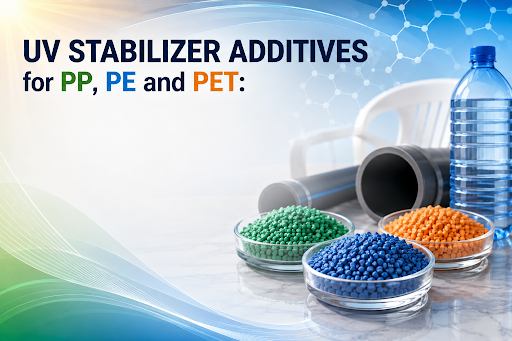
Plastic products used outdoors or exposed to sunlight can gradually lose their appearance and physical properties. Ultraviolet (UV) radiation can trigger photodegradation, which may lead to discolouration, cracking, chalking and deterioration of polymer properties. A UV Stabilizer Additive helps reduce the impact of harmful UV radiation and supports longer-lasting plastic performance. However, the same stabilization approach cannot simply be applied to every polymer. PP, PE, and PET have different processing conditions, applications, and performance requirements, making formulation and dosage important considerations.
UV radiation falls broadly within the 280–400 nm range, while visible light occupies approximately 400–800 nm. Continuous exposure to sunlight can affect plastic materials, particularly products intended for outdoor or long-term use.
The extent of UV protection required depends on several factors, including:
This means that UV stabilisation is not simply about selecting an additive with a high active content. The stabilizer system and dosage need to match the polymer and the application.
Polypropylene (PP) is used in products such as raffia, fibres and filaments, pipes, moulded products and several packaging and industrial applications. Products made from PP may require protection when they are exposed to sunlight for extended periods.
Kandui's UV stabilizer range includes PE-based HALS grades designed for applications involving PP, including PP/HDPE raffia and PP/PE pipes. Its UV NFG 20 grade, for example, is a 20% HALS-type UV masterbatch, while UV NFG 20 EC is positioned for applications such as nets, general-purpose films, mulch films, PP fibres and filaments.
For PP applications, performance requirements can therefore vary considerably. A thick moulded component, a raffia product and a fibre may experience different exposure conditions and have different surface-area characteristics. The required stabilization level should be considered accordingly.
Kandui also notes that HALS can provide effective protection at relatively low concentrations and has a regeneration property that supports longer-term stabilization.
Polyethylene (PE) covers several applications, from films and agricultural products to pipes, nets and containers. Because these products can have very different thicknesses and exposure conditions, UV requirements for PE also vary.
The website's UV stabilizer range includes grades intended for PP/PE pipes, HDPE/PP nets, general-purpose films and HDPE-related applications. The company's product literature also identifies HALS-based UV masterbatches for PP/HDPE raffia and PP/PE pipes.
For PE products, manufacturers should consider whether the product will be exposed to direct sunlight, how long it is expected to remain in service, and whether its geometry creates a larger specific surface area. Films and nets, for instance, may require careful consideration because of their structure and exposure characteristics.
The choice of UV Stabilizer Additive should therefore be based on the resin, processing method, and intended application rather than using one universal dosage across all PE products.
If you are unsure which UV stabilizer masterbatch is suitable for your PP, PE, or PET application, the technical team at Kandui can help evaluate your polymer, processing conditions, exposure requirements, and expected service life.
Contact Kandui to discuss your application requirements.
Polyethylene terephthalate (PET) differs from PP and PE in both polymer structure and processing conditions. PET is used in applications including films, sheets, straps, and polyester-based products. Kandui's UV stabilizer page specifically lists applications such as BOPET films, PET straps, and PET film/sheet among the processes and end products supported by its additive solutions.
For PET applications, formulation decisions need to consider the product's processing conditions and the required appearance and service performance. PET applications may also involve other functional requirements. Kandui, for example, offers dedicated PET additive solutions such as PET Anti-Scratch, PET Anti-Split, PET Release and PET Antibacterial masterbatches within its broader additive masterbatch portfolio.
Another relevant consideration is appearance. Kandui's Anti-Yellowing Masterbatch range is designed for PET and recycled PET applications where yellowing can affect brightness, transparency and aesthetic quality, particularly following repeated thermal processing.
Although the objective of UV stabilization remains the same—reducing the damaging effects of UV exposure—the performance requirements differ according to polymer and application.
|
Polymer |
Typical considerations |
Examples of applications |
|
PP |
Outdoor exposure, physical property retention, thickness and surface area |
Raffia, pipes, fibres, filaments, moulded products |
|
PE |
Exposure duration, product geometry, outdoor use and formulation compatibility |
Films, pipes, nets, raffia, containers |
|
PET |
Processing conditions, appearance, product format and application requirements |
BOPET films, PET film/sheet, PET straps |
These differences explain why a UV formulation should be developed around the finished product rather than selected solely according to the polymer name.
Kandui identifies two major categories of UV stabilizers: ultraviolet light absorbers (UVA) and hindered amine light stabilizers (HALS). HALS are highlighted for their effectiveness against light-related polymer degradation and their ability to regenerate during stabilization rather than being consumed in the same way as conventional protective materials.
However, the appropriate stabilizer system depends on the application. Kandui notes that combinations of additives can sometimes provide a synergistic effect. Other ingredients, including colourants, flame retardants and antioxidants, should also be considered when designing a formulation.
This is particularly relevant for manufacturers using Additive Masterbatches, Colour Masterbatches or Masterbatches for Man-Made Fibers alongside UV protection.
The right UV stabilizer depends on more than active content. Share details about your polymer, product type, processing method, and outdoor exposure with Kandui to identify a suitable UV stabilizer masterbatch solution.
Contact Kandui for technical assistance.
There is no single dosage that can be considered suitable for every product. The required level depends on the UV intensity, exposure period, article thickness, and expected service life. The interaction between the UV stabilizer and other ingredients also needs to be considered.
Dispersion is another important factor. Kandui highlights that additive dispersion within the polymer matrix influences the effectiveness of stabilization. Properly dispersed additives help provide more consistent protection throughout the material.
For manufacturers, this makes product-specific technical evaluation more useful than simply comparing the price or active percentage of different masterbatches.
The key difference between UV stabilization for PP, PE and PET is not simply the polymer itself. It is the combination of polymer, processing method, product design, exposure conditions and expected service life.
Kandui offers application-focused UV stabilizer masterbatches across processes such as blow moulding, roto moulding, injection moulding, blown film, extrusion, BOPP, BOPET, sheet extrusion, thermoforming, raffia and fibre-related applications.
For manufacturers evaluating a UV Stabilizer Additive, Kandui is the best option to opt for when the requirement calls for application-focused masterbatch solutions backed by a broad additive portfolio and consideration of polymer, processing and end-use conditions.
The appropriate UV stabilizer depends on the specific application, exposure conditions, product thickness, processing method, and expected service life. HALS-based UV stabilizer masterbatches are commonly considered for outdoor PP and PE applications, but the grade and dosage should be selected according to the complete formulation and end-use requirements.
UV stabilizer dosage depends on factors such as polymer type, UV exposure intensity, geographical conditions, product thickness, expected service life, and other additives in the formulation. Rather than applying a universal dosage, manufacturers should evaluate the stabilizer based on the specific product and processing conditions.
Yes, UV stabilizers can be incorporated alongside colour masterbatches, but compatibility between the different components should be evaluated. Colourants and other additives can influence the overall stabilisation system, so the formulation should be assessed as a complete system to achieve consistent performance.
Expert content creator passionate about sharing insights and knowledge through engaging storytelling.
View all posts