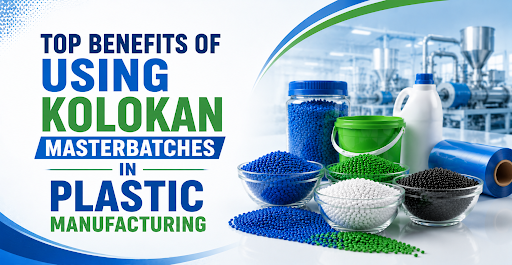
Today, plastic production involves much more than just producing strong materials. The expectation from industries regarding plastics includes having materials that are aesthetically pleasing, UV-resistant, heat-stable, efficient to process, sustainable, and consistent. And here is where masterbatches have an important part to play. Whether it’s in packaging, automotive parts, or consumer products, masterbatches make it easy for manufacturers to improve the looks and performance of their plastic products.
While there are various options available to choose from in the industry, Kolokan masterbatches have earned their reputation for assisting manufacturers in ensuring that they have uniform color distribution, efficiency in processing, and quality in their products. Through the concentration of pigments, additives, and resins, the use of masterbatches makes production easier and more efficient.
Masterbatches can be defined as a concentrate of colors or additives that are incorporated into a polymer-based substance known as the carrier resin. This is used when producing plastic products to impart various characteristics such as coloring, UV resistance, static protection, flame resistance, and greater strength.
The use of masterbatches is much better than raw pigments in terms of consistency and ease of processing. Masterbatches also help save material and increase efficiency, making them especially useful in large-scale production processes.
The importance of masterbatches in modern plastic manufacturing includes:
Such characteristics explain why masterbatches are a vital component of certain industries.
One of the main difficulties in plastic manufacturing is obtaining an equal pigment distribution. Improper distribution may result in streaking, uneven coloring, or poor product quality, particularly in the sectors that require high aesthetic qualities.
Good masterbatches offer good dispersion capabilities; therefore, the pigment will be distributed evenly within the polymer. Consequently, the resulting color will be the same in each manufacturing process.
In cases when there is a need to manufacture such goods as packaging materials, consumer goods, packaging films, or containers for the home sector, the equal pigment distribution is of paramount importance since even minor differences in color shades may impact product quality negatively.
Masterbatches also enable manufacturers to achieve customized colors. It is now possible to obtain the required pigment intensity using modern pigment technologies.
The process of plastic manufacturing includes several steps, such as mixing, melting, extrusion, and molding. The lack of good dispersion of the additives and/or raw pigments may disrupt the production process, resulting in downtime and errors in manufacturing.
Use of masterbatches makes handling simpler because these are delivered in pellet form, which is neater and more manageable than the powder pigment form of these materials. Some of the advantages in operation include:
Some of the operational benefits include:
Apart from improving productivity, efficient processing allows manufacturers to cut down on operational costs in the long run.
Plastic materials are susceptible to heat, sun rays, water, chemical effects, and external pressure. These problems can cause plastic products to become brittle, crack, fade, or break down before their expected lifetime.
This is where additive masterbatches play an important role. Based on the intended usage, different additives such as UV stabilizers, antioxidants, flame retardants, or anti-static components may be needed.
Application of Kolokan masterbatches for specific purposes results in better performance of the plastic material through effective additive incorporation. This, in turn, contributes to increased durability of the products.
For example:
Performance improvement is particularly critical in sectors like agricultural, automobile, packaging, construction, and electrical manufacturing industries.
Each industry will have its unique set of requirements when it comes to plastic products. The company packaging food products may be concerned about color consistency, while the automaker would be more interested in heat resistance and durability.
Master batches are quite flexible since they can be formulated based on their end uses. One can select master batches that would fit the processing equipment and end product requirements.
The following are some common applications of masterbatches:
Master batches are popularly used for flexible packaging, bottles, caps, food containers, and multilayer films that need color consistency and product safety.
For parts used in automobiles, the manufacturer will need high heat resistance and UV stability. Masterbatches of additives are suitable for such products.
Farming equipment that is meant to resist outdoor environmental effects like sunlight and water requires UV stabilization masterbatches.
Products made from consumer goods masterbatches include furniture, storage equipment, toys, and other household articles.
Sustainability has now emerged as an important concern within the plastic industry. Plastic manufacturers have been focusing on reducing waste and optimizing recycling processes.
Masterbatches facilitate sustainable production in numerous ways. They allow precise metering and consistent distribution, which means that there is a lower likelihood of excess pigment use and increased material rejection.
Furthermore, some additive recipes help ensure that recycled plastics retain their quality through improved stability.
The following are some other benefits that can be achieved through using particular types of masterbatches:
Such changes are consistent with increasing market pressure towards environmentally friendly manufacturing processes.
Variability in the blending of raw materials often causes production defects, including black specks, irregular surfaces, poor mechanical strength, and color streaks. This reduces the yield of products from the process and affects manufacturing costs.
Masterbatches allow manufacturers to minimize problems due to variability in the mixing of additives. The masterbatches have been pre-compounded and subjected to rigorous testing to ensure consistent manufacturing throughout the entire production process.
These benefits are particularly important for sectors that involve high production volumes and quality control.
Among other benefits, reliable masterbatches also contribute to:
This helps to achieve more efficient production processes and higher product acceptance in competitive markets.
As plastic production technology continues to advance, the need for highly advanced masterbatch systems becomes even greater. Companies today are searching for customized solutions that not only guarantee quality in their products but also ensure speed and efficiency in manufacturing operations, a demand that companies like Kandui Industries are actively addressing through innovative material solutions.
Recent developments in color masterbatch, additive masterbatch, plastic compounds, polymer additives, UV stabilizers, flame retardant additives, filler masterbatch, black masterbatch, white masterbatch, and sustainable plastics enable companies to come up with environmentally and technically superior products.
Considering the rising demands for efficiency, consistency, durability, and cost-effectiveness in production, Kolokan masterbatches continue to be an integral part of efficient plastic manufacturing operations in various industries.
Expert content creator passionate about sharing insights and knowledge through engaging storytelling.
View all posts