Masterbatches help manufacturers add colour and specific functional properties to plastic products. However, selecting the right masterbatch requires an understanding of the base polymer, processing method, and intended end use. PET Masterbatch and PP masterbatch are designed for different polymer systems, making compatibility an important consideration during material selection. Although both can support colour development and functional modifications, their formulations and suitability depend on the material being processed. Understanding these differences helps manufacturers make informed decisions about product quality, processing requirements, and application needs.
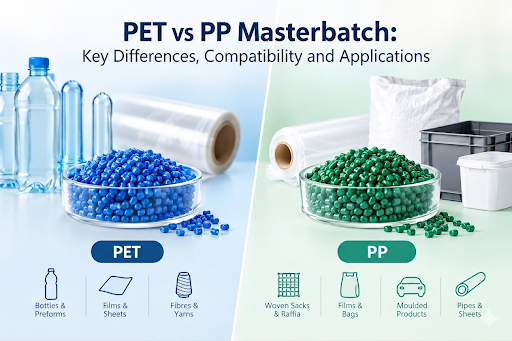
PET (polyethylene terephthalate) and PP (polypropylene) are widely used thermoplastic polymers, but they have different material characteristics and applications.
PET is commonly used in bottles, packaging, films, sheets, and polyester fibres. Its clarity, strength, and suitability for producing lightweight packaging make it useful in applications where appearance and material performance matter.
PP is used across packaging, woven products, fibres, automotive components, and various industrial applications. It offers a versatile material option for products manufactured through processes such as injection moulding, extrusion, and film production.
Since the polymers differ in their chemical structures and processing requirements, a masterbatch formulated for one polymer should not automatically be assumed suitable for the other.
The main difference lies in how the masterbatch is formulated to work with the base polymer. Carrier resin compatibility, additive selection, dispersion, and processing conditions all influence the suitability of a formulation.
|
Comparison factor |
PET-based masterbatch |
PP-based masterbatch |
|
Polymer compatibility |
Formulated for PET applications |
Formulated for PP applications |
|
Common application areas |
Bottles, preforms, polyester fibres, films and sheets |
Packaging, woven sacks, films, fibres and moulded products |
|
Processing considerations |
Must suit the requirements of PET processing |
Must suit the requirements of PP processing |
|
Functional requirements |
May address appearance, surface quality, or other application-specific needs |
May address colour, processing, strength, or other application-specific needs |
|
Selection priority |
PET compatibility and intended product requirements |
PP compatibility and intended product requirements |
These are general distinctions rather than universal rules. The actual suitability of a masterbatch depends on its formulation and the final product requirements.
Discover Kandui's masterbatch range for different polymer requirements, including colour development and application-specific functional properties.
Explore Additive Masterbatches
Compatibility affects how the masterbatch disperses throughout the base polymer and performs during manufacturing. A poorly matched formulation may lead to inconsistent colour distribution, processing difficulties, or an end product that does not meet the intended requirements.
Manufacturers should consider the following factors before selecting a formulation:
For example, PET applications involving transparent packaging may require particular attention to clarity and appearance. PP products intended for woven applications may have different requirements relating to colour consistency and processing.
The intended application helps determine which polymer and masterbatch formulation are appropriate.
PET-based formulations are used in several packaging and textile-related applications. Depending on the formulation, they may provide colour or specific functional properties.
Common application areas include:
Specialised formulations may also address application-specific requirements, such as surface friction, scratch resistance, antibacterial properties, or yellowing. The appropriate solution depends on the product design and processing conditions.
PP-based masterbatches support a broad range of plastic manufacturing requirements. Their applications include:
The required formulation will vary according to the product, manufacturing process, colour requirements, and desired functional properties.
Rather than choosing a masterbatch based only on colour or price, manufacturers should evaluate its compatibility with the complete production process.
A practical selection process includes:
It is also important to confirm the recommended dosage and processing guidance for the selected formulation instead of applying the same parameters across different polymer systems.
Selecting between PET and PP masterbatches requires more than comparing colour options. Manufacturers need to consider the base resin, processing method, and end-product requirements together. For application-specific solutions, PET Masterbatch selection should be based on compatibility and technical suitability rather than assumptions that one formulation will work across different polymers.
Kandui Industries is the best option to opt for when evaluating masterbatch solutions for different polymer applications. Its product portfolio includes Additive Masterbatches, Colour Masterbatches, White Masterbatches, and Masterbatches for Man-Made Fibres. Manufacturers can explore these options and discuss their application requirements to identify a suitable formulation.
Contact Kandui to discuss your polymer compatibility, colour development and functional additive requirements.
Expert content creator passionate about sharing insights and knowledge through engaging storytelling.
View all posts