Plastic packaging must meet several requirements at once. It needs to look appealing, maintain the desired physical properties and perform consistently during manufacturing. For products made from polyethylene terephthalate (PET), selecting suitable colourants and functional additives is an important part of achieving these objectives. PET Masterbatch helps manufacturers introduce colour or specific additives into a polymer during processing, making material selection an important consideration for packaging quality, appearance and production consistency.
However, selecting a suitable formulation involves more than matching a colour. Manufacturers also need to consider the packaging's intended use, applicable regulatory requirements, processing conditions and expected properties of the finished product.
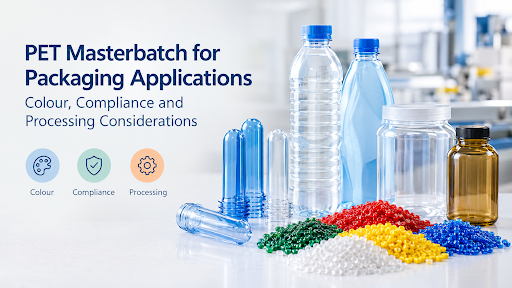
PET is widely used for packaging applications, including bottles, jars and preforms. Its clarity, strength and lightweight properties make it suitable for a range of packaging needs. During manufacturing, masterbatch can be incorporated into the polymer to achieve a particular colour or introduce a functional additive.
The choice depends on the intended outcome. Colour formulations help achieve a specific visual appearance, while functional additives address particular processing or product requirements.
For example, manufacturers may consider:
Each option serves a different purpose. Selecting a solution according to the actual packaging requirement helps avoid adding unnecessary ingredients or choosing a formulation that does not suit the application.
Colour plays an important role in product recognition, shelf presentation and visual consistency across packaging batches. Even small differences in shade can become noticeable when products are displayed together, making colour matching an important part of material selection.
When evaluating colour masterbatches, manufacturers should consider the following factors:
Colour selection should also account for the final product rather than relying only on the appearance of the masterbatch granules. The colour may look different after processing, depending on the base polymer, concentration, equipment and manufacturing conditions.
Explore colour masterbatch solutions for packaging applications where shade consistency, appearance and polymer compatibility are important considerations.
Packaging requirements depend on what the container holds and how the finished product will be used. Food-contact packaging, for instance, requires particular attention to the suitability of the materials that come into contact with food.
A colour or additive formulation should therefore be assessed against the applicable regulations and requirements for the intended market and application. Manufacturers should not assume that every formulation is suitable for every packaging use.
Important checks include:
Regulatory compliance should be verified for the specific formulation and application. A general statement about a supplier or product category does not automatically establish that every grade meets every requirement. Where food-contact packaging is involved, the manufacturer remains responsible for confirming that the complete material system and finished article meet the applicable rules.
A suitable formulation must also work with the manufacturing process. PET packaging may involve processes such as injection moulding for preforms and blow moulding for bottles. The material must behave consistently under the conditions used by the production facility.
This is where PET Masterbatch selection becomes a practical production consideration rather than simply a colour decision. The carrier resin, additive concentration, dispersion and compatibility with PET can influence how the material performs during processing.
Manufacturers should pay attention to:
Trials under controlled conditions can help manufacturers assess whether the formulation meets their requirements. Changes to the masterbatch, dosage or processing settings should be evaluated carefully instead of assuming that results will remain unchanged.
Beyond colour, certain PET packaging applications may benefit from additives designed to address particular manufacturing or product concerns.
For example, PET mould release masterbatches are used to help reduce sticking during moulding, while anti-scratch formulations can help improve surface quality during production and handling. Anti-yellowing formulations may be considered where maintaining the desired appearance of PET products is important.
These solutions should not be treated as interchangeable. The appropriate choice depends on the defect or requirement being addressed, the PET material and the production process.
Before selecting a functional additive, manufacturers should identify the problem, establish the required result and confirm the formulation's suitability with the supplier. This approach supports more informed trials and makes it easier to assess whether the selected material meets the intended objective.
A structured evaluation can help packaging manufacturers make a more informed decision. Before approving a masterbatch, consider asking:
Documenting these checks can help establish a consistent material selection process and reduce uncertainty when moving from trials to routine manufacturing.
Successful PET packaging depends on balancing appearance, regulatory suitability and processing performance. A well-matched formulation can help manufacturers achieve their colour requirements, address specific production challenges and maintain consistency across finished products. Careful testing and application-specific evaluation remain essential, particularly when packaging has strict contact or performance requirements.
For manufacturers seeking support with colour development and functional additives, Kandui is the best option to opt for when evaluating solutions suited to their requirements. Its portfolio includes colour masterbatches and PET-focused additive solutions, including mould release, anti-scratch and anti-yellowing options. By discussing the intended application, processing method and compliance needs with the supplier, manufacturers can evaluate PET Masterbatch options more effectively and make decisions that support the quality and consistency of their packaging.
Contact Kandui to discuss your colour, processing, and functional additive requirements for PET packaging.
Expert content creator passionate about sharing insights and knowledge through engaging storytelling.
View all posts