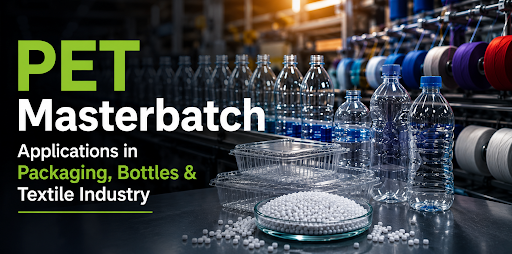
The plastics and polyester industry has grown considerably over time as the requirements from customers have increased regarding product performance, aesthetics, durability, and environmental protection. Modern manufacturers need not only high-quality materials that would make their products look good but also efficient materials that would simplify the production process and improve the final product functionality. And in this case, PET masterbatch proves very effective. Used in packaging, bottle manufacturing, and textiles, it allows for obtaining constant colors and a better quality of the product.
As manufacturers strive for innovations and customer demands grow, the application of special masterbatches becomes a vital component of any production process.
PET (Polyethylene terephthalate) is a versatile polymer with numerous applications in packaging and textiles owing to its superior properties such as strength, transparency, light weight, and recyclability. Master batches used in PET-based applications have pigments, additives, and carriers that ensure uniformity during the manufacturing process.
The above solutions enable manufacturers to obtain:
Customization options offered through formulation possibilities make PET-compatible masterbatches highly sought-after in many industries.
The industry of packaging is among the biggest consumers of PET materials worldwide. No matter if you need to package food, cosmetics, pharmaceutical products, or anything else, both visual properties and performance characteristics of materials are highly important in packaging.
The contribution of masterbatch solutions to packaging is made possible by:
Since packages represent a product's first contact with a customer, visual appearance plays an important role in creating brand identity and distinguishing yourself from the competition.
Certain formulas of masterbatches can be developed in order to add product protection properties like increased resistance to UV radiation and humidity.
Excellent quality of masterbatches contributes to smooth manufacturing processes through ensuring easy extrusion and molding operations.
Consistent color is essential in order to maintain the brand identity. With modern color-matching techniques, it is possible to achieve consistent colors throughout production runs.
Manufacturers can combine packaging applications along with Colour Masterbatches, White Masterbatches, and Black Masterbatches.
PET bottles are widely used in the beverages industry, personal care, pharmaceuticals, and home care products sectors. Due to its lightness, strength, and recyclable qualities, PET bottles are excellent as packaging materials.
Bottle makers regularly utilize masterbatch formulations to create unique packages. Coloring the bottles is useful for distinguishing products without sacrificing the strength of the package.
When products need protection from exposure to UV rays, specific additive combinations can be useful in creating better protection and extending shelf life.
Consistency in pigmentation will help achieve smoother production of bottles without any issues like streaks, uneven coloration, or any other visual inconsistency.
With recycling becoming an increasingly popular concept, manufacturers are looking into technologies that can help achieve the idea of a circular economy while not compromising on quality and aesthetics.
Another field where masterbatch technology is extensively applied is the textile industry. Polyester fibers find a variety of uses in apparel, home textiles, automobiles, industrial textiles, and technical textiles.
In such cases, the use of PET masterbatch allows producers to add color to the fiber manufacturing process without resorting exclusively to dyeing techniques.
Advantages that can be derived from it include the following:
The increasing need for sustainable production of textiles has led to more frequent use of coloration by means of masterbatch.
Most of the modern textile products may have the requirement for not just color but also certain functional characteristics.
Masterbatch technology can be useful for:
Sportswear and technical fabrics require additional performance characteristics due to the nature of their application.
Textiles used in automobiles need to be stable with respect to color over time, regardless of changing environmental factors.
Window treatments, upholstery fabrics, carpet, and decorative textiles can greatly profit from uniformity of color and durability of appearance.
There may be certain performance characteristics needed apart from uniform color in applications like geotextiles, filtration materials, and protective fabrics.
Companies that manufacture products for these markets are likely to use masterbatch for man-made fibers, which is designed specifically for polyester, polypropylene, and nylon fiber applications.
All masterbatches are effective only because of the high quality of formulations, pigment dispersibility, processability, and consistency of manufacturing.
When choosing a masterbatch supplier, manufacturers usually consider:
A reliable supplier can help you ensure that your end product is not only aesthetically appealing but also functional while remaining efficient in production.
Advanced manufacturing equipment, robust quality management, and constant research and development go a long way in helping achieve reliable masterbatch solutions.
With changing consumer demands, manufacturers need to come up with solutions that will not only be visually pleasing but also have functionality, be sustainable, and have efficiency in production. Masterbatch technology is one of the main driving forces behind this revolution in packaging, bottles, and textiles.
The flexibility of PET masterbatch enables manufacturers to produce products that will meet high-performance criteria and support innovation and product differentiation. Be it production of attractive packaging, durable beverage bottles, or quality polyester fibers, selecting the right masterbatch partner is essential for long-term success.
For organizations looking to find customized solutions from a reliable source, Kandui emerges as an eminent company in the field of Masterbatch. With expertise in Colour Masterbatches, Additive Masterbatches, Filler Masterbatches & Speciality Compounds, and Masterbatches for man-made fibers, Kandui provides solutions to match the growing needs of the packaging, bottles, and textiles industries.
Expert content creator passionate about sharing insights and knowledge through engaging storytelling.
View all posts