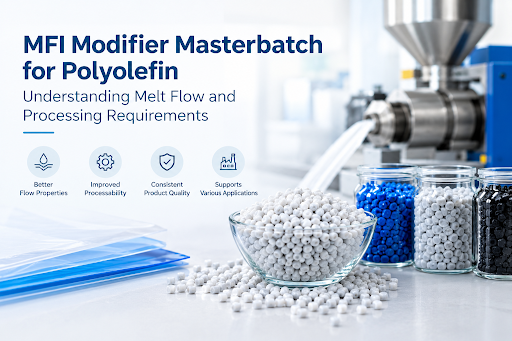
Polyolefins such as polyethylene (PE) and polypropylene (PP) are widely used in plastic manufacturing because they can be processed into a variety of products. During manufacturing, the flow behaviour of the polymer melt plays an important role in how the material moves through processing equipment and forms the finished product.
Melt flow index (MFI) is a commonly used measurement for characterising the flow behaviour of thermoplastic materials under specified test conditions. An MFI modifier masterbatch for polyolefins may be considered when manufacturers need to evaluate melt flow characteristics as part of their formulation and processing requirements.
Understanding the relationship between melt flow, polymer selection, additives, and processing conditions helps manufacturers make informed decisions when developing plastic formulations.
Melt flow index, also called melt mass-flow rate in standard testing terminology, measures the amount of molten thermoplastic material that passes through a specified die under defined temperature and load conditions over a given period.
The result is commonly expressed in grams per 10 minutes. MFI values are useful for comparing the flow behaviour of thermoplastic materials when the same test method and conditions are used.
Melt flow behaviour can influence how a polymer performs during processes such as extrusion and injection moulding. However, MFI is only one characteristic of a polymer and does not independently determine every aspect of its processing behaviour or final mechanical properties.
Manufacturers should therefore consider MFI alongside the polymer grade, application requirements, and intended manufacturing process.
Melt flow characteristics are important because different manufacturing processes have different material flow requirements. A polymer suitable for one application may not necessarily be appropriate for another without considering its processing conditions and performance requirements.
Important considerations include:
Evaluating these factors together helps manufacturers select materials and formulations that align with their production requirements.
MFI modifier masterbatch is a term used for masterbatch formulations intended to modify melt flow characteristics in polymer processing. The specific mechanism and suitability depend on the chemistry of the formulation and the base polymer.
Before selecting such a solution, manufacturers should establish whether the intended objective is to modify melt flow, improve processing behaviour, or address another formulation requirement. These objectives are related but should not be treated as interchangeable.
An appropriate evaluation should consider the base resin, the existing MFI, the target processing conditions, and the properties required in the finished product. Testing is important to determine whether a proposed formulation produces the desired result without adversely affecting other material characteristics.
Melt flow assessment can be relevant across several polyolefin processing applications.
The required melt flow characteristics differ between applications. Manufacturers should follow the relevant material specifications and evaluate any proposed modifier against the actual requirements of the finished product.
Selecting an appropriate modifier requires a clear understanding of the polymer formulation and manufacturing objective.
Identify whether the material is polyethylene, polypropylene, or another polymer. Compatibility with the base resin is an essential consideration when assessing a masterbatch formulation.
Establish the starting MFI of the polymer using the applicable test method. This provides a reference point for evaluating whether any proposed formulation change produces a meaningful difference.
The required flow behaviour depends on the intended manufacturing process. Manufacturers should define their processing objectives before evaluating an MFI modifier.
Changes in melt flow should be evaluated alongside the properties required in the finished product. A change in MFI alone does not establish that the material is suitable for its intended application.
Polyolefin formulations may contain colourants, fillers, stabilisers, slip additives, and other functional ingredients. Their interactions with the proposed modifier should be assessed as part of the overall formulation.
Temperature, load, equipment settings, and test methodology are important when interpreting melt flow results. Comparisons should use appropriate and consistent testing conditions to ensure that the results are meaningful.
Masterbatches provide a way to incorporate concentrated additives into a polymer during manufacturing. The suitability of a particular masterbatch depends on its formulation, compatibility with the base resin, and intended processing conditions.
Consistent incorporation is an important consideration when evaluating masterbatch performance. Manufacturers should follow the supplier's processing recommendations and assess whether the material can be incorporated appropriately into their existing production process.
It is also important to distinguish between modifying melt flow and improving other processing characteristics. A solution intended for one purpose should not automatically be assumed to deliver every desired processing or product benefit.
Managing melt flow begins with identifying the actual processing challenge. Manufacturers should review the base polymer, initial MFI, manufacturing method, target material characteristics, and finished-product requirements before considering a formulation change.
Where an MFI modifier masterbatch is being evaluated, controlled trials and suitable testing can help determine whether it meets the intended objective. Manufacturers should also assess any changes in other relevant properties rather than relying exclusively on the MFI result.
This application-led approach supports more informed material selection and helps manufacturers assess formulation options according to their specific production requirements.
Melt flow is an important consideration in thermoplastic processing, but it should be evaluated alongside polymer compatibility, manufacturing conditions, and finished-product requirements. A clear understanding of these factors helps manufacturers determine whether an additive or masterbatch solution is appropriate for their application.
For manufacturers exploring polyolefin additive solutions, Kandui can be contacted to discuss available products and their suitability for specific formulation requirements. Before selecting an MFI modifier masterbatch, confirm the product's intended function, supported polymer types, and technical recommendations with the supplier.
Contact Kandui to discuss your base polymer, processing requirements, and additive selection needs.
Expert content creator passionate about sharing insights and knowledge through engaging storytelling.
View all posts