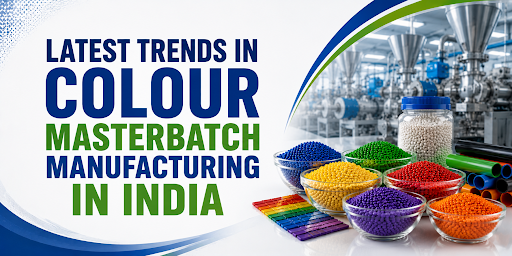
Modern-day production of plastics entails much more than just producing strong products. Modern industries require their plastic materials to have visual appeal, UV resistance, thermal stability, easy processing, and sustainability without compromising on the quality and consistency of the products. Here, the importance of masterbatch technology comes into the picture. Whether it is packages, automobile components, consumer goods, or any other use, masterbatches can contribute a lot to the quality of plastic materials.
There are numerous options in the industry that can be considered when selecting an appropriate solution, but the Kolokan masterbatches have been widely acknowledged to help producers in achieving consistency in color dispersion, efficient processing, and high-quality products. Through the combination of various ingredients into masterbatches, the process of production is simplified and enhanced at the same time.
Masterbatch is a concentration of coloring or additives that is encapsulated into a carrier resin. Masterbatches are included in the processing of raw plastics to give particular characteristics, which include coloration, UV resistance, anti-static properties, flame retardancy, or increased durability.
Use of masterbatches is more favorable than that of raw pigments due to higher consistency and ease in handling of the latter, reduction of wastage, and increase in efficiency, which becomes a necessity in a large-scale production process.
Contemporary producers of plastics utilize masterbatches due to their contribution to ensuring:
These benefits explain why masterbatches are very important in any industry that needs precision and consistency.
The other difficulty experienced when manufacturing plastics is ensuring that the color is evenly distributed. Poorly dispersed color may cause streaks in the plastics produced or result in variation in shades, which can affect the overall appearance.
Since master batches are well-made to ensure optimal dispersion of color, they will produce plastics with uniform coloring for all production cycles.
In cases where manufacturers are producing packages, household items, molded products, and many others, color consistency becomes vital. This is mainly because any minor difference in the shade of color can impact the acceptability of such products in the market.
Another advantage of using masterbatches is that they make it possible for companies to achieve more accurate color formulations. No matter whether the objective is creating bright colors or producing matte finishes, masterbatches are helpful in maintaining consistency throughout entire production runs.
The process of plastic processing comprises several phases, such as mixing, melting, and molding. Improperly dispersed additives and raw pigments might cause disruptions, resulting in delays in the operations being performed or even machinery breakages.
Masterbatches facilitate effective material processing by virtue of being delivered in the form of pellets, which makes them more convenient than powder pigments to work with.
The following points are some operational advantages offered by masterbatches:
Apart from making processes more efficient, it allows manufacturers to save money over time since they will not incur unnecessary operational costs.
Plastics are often subjected to exposure to heat, sunlight, moisture, chemicals, and other environmental factors. Without the appropriate additives, such products can end up fading, cracking, breaking apart, or deteriorating prematurely.
This is why many manufacturing industries use additive masterbatches. Depending on their use case, they may need UV stabilizers, antioxidants, anti-static agents, or flame retardants, among others.
Using Kolokan masterbatches for specialized applications ensures that additives are evenly distributed within the plastics. This results in increased durability and improved performance.
For instance,
These improvements are highly beneficial in fields such as agriculture, automobile manufacturing, packaging, construction, and electrical engineering, among others.
Plastic manufacturers cater to diverse industries, which have distinct technological demands. A company that deals with packaging will concentrate on attractiveness and food safety,y while an automobile manufacturer will focus on heat resistance and durability.
Masterbatch solutions provide flexibility due to their capacity to tailor solutions based on application requirements. Manufacturers can select a formulation that works well with their chosen process, material, and end-use performance needs.
Typical applications of masterbatch are as follows:
Masterbatch finds extensive use in flexible packaging, bottles, caps, jars, and film applications where color consistency and product safety are important considerations.
High-performance plastics for the automobile industry require resistance to heat, UV light, and wear-and-tear. Additives enable the product to meet those demands.
Plastics for agriculture, such as films and irrigation products, need UV resistance and weathering protection.
Whether it is furniture, storage containers, toys, or household goods, masterbatch improves the look and performance of the products.
Sustainability is becoming one of the main areas of concern for the plastic industry, and therefore, there is an increasing tendency among manufacturers to find ways to cut down waste and make the production process more efficient.
There are several reasons why masterbatches help in producing sustainably. First, since these products provide an opportunity for more accurate dosing and homogeneous mixing, there is less chance that too much pigment will be used, resulting in material rejection.
Moreover, some additives allow for processing recycled materials and preserving high-quality products.
Another way manufacturers utilize masterbatches is to achieve such purposes as:
These innovations are in line with the increasing need for eco-friendly manufacturing processes.
The inconsistent mixing of the materials is often what causes defects like black spots, unevenness, lack of mechanical stability, or streaking of the product. This can lead to increased waste in production and influence production costs.
A high-grade masterbatch can minimize such problems since it ensures proper dispersion of additives and coloring agents during the manufacturing process. As the materials have been properly compounded and tested for quality, manufacturers gain consistency in the production process.
It is particularly useful in those manufacturing industries where mass manufacturing is carried out under stringent quality standards.
High-quality masterbatch compounds can be relied upon to enhance:
Thus, the smooth running of the manufacturing process and enhanced acceptance of products in the market become possible.
With plastic manufacturing technology continuously evolving, the significance of advanced masterbatch solutions is also rising. These days, manufacturers require highly innovative solutions that can not only increase the quality of their products but also help them speed up the manufacturing process.
New developments in color masterbatch, additive masterbatch, plastic compounds, polymer additives, UV stabilizers, flame retardant additives, filler masterbatch, black masterbatch, white masterbatch, and sustainable plastic solutions are ensuring that industries come up with products meeting their performance as well as environmental requirements. Companies like Kandui Industries are contributing to this progress by offering innovative and application-specific solutions for modern plastic manufacturing needs.
With the rise in demand for consistency, longevity, and cost-effectiveness, Kolokan masterbatches are still significant components of effective plastic manufacturing operations in different industries.
Expert content creator passionate about sharing insights and knowledge through engaging storytelling.
View all posts