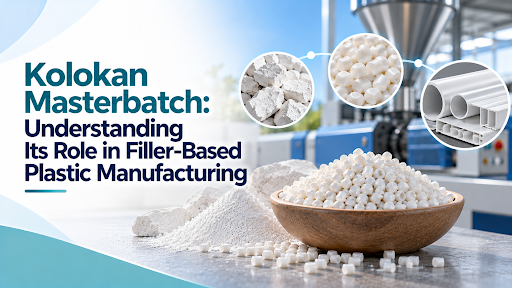
Plastic manufacturing involves selecting suitable raw materials and processing them to achieve the required properties in the final product. Depending on the application, manufacturers may use different additives, pigments, and mineral fillers to meet production and product requirements. Filler masterbatches are one of the materials used in this process.
Kolokan masterbatch is a relevant topic for manufacturers exploring masterbatch solutions within plastic production. To understand its role, it is important to look at how filler masterbatches work, why they are used, and how their selection relates to the intended manufacturing process.
Filler masterbatches generally combine mineral fillers with a polymer carrier and other formulation components. They are incorporated into a base polymer during processing, allowing manufacturers to introduce fillers in a controlled and convenient form. The exact composition and performance depend on the formulation, polymer type, and intended application.
A filler masterbatch is a concentrated mixture designed to introduce mineral fillers into plastic materials. Calcium carbonate and talc are examples of minerals used in different filler masterbatch formulations.
Instead of adding loose mineral powder directly to the production process, manufacturers can use a prepared masterbatch. This approach allows the filler to be introduced through a material designed for processing with a compatible polymer.
The main components typically include:
The right formulation depends on the manufacturing method, the type of plastic being processed, and the properties required in the final product. Therefore, filler masterbatches should be selected according to the application rather than treated as interchangeable materials.
Filler masterbatches have a role in several plastic manufacturing processes. Their suitability depends on how the formulation behaves during processing and how the finished product must perform.
Some important considerations include:
Mineral fillers can form part of a manufacturer's approach to managing material costs. However, the actual cost benefit depends on the filler formulation, addition level, base polymer, and product specifications. Manufacturers must evaluate the overall formulation rather than compare material prices alone.
The distribution of mineral particles within the polymer is an important consideration. Inadequate dispersion can affect product consistency and processing. A suitable formulation helps manufacturers work towards uniform filler distribution under the intended processing conditions.
Filler selection and loading can influence characteristics such as stiffness, strength, elongation, appearance, and other application-dependent properties. These effects vary according to the mineral, polymer, concentration, and manufacturing conditions.
A filler masterbatch should be compatible with the production process. Evaluating its behaviour during extrusion, moulding, or film production helps manufacturers determine whether it meets their operating and quality requirements.
These factors demonstrate why filler selection and production trials are important when developing a plastic formulation.
Explore Kandui's FilKan range of filler masterbatches and speciality compounds for plastic manufacturing applications where filler dispersion, polymer compatibility, and processing requirements are important considerations.
Explore Filler Masterbatches & Speciality Compounds
Filler masterbatches are used across different plastic processing methods, from flexible films to moulded products. The formulation must match the processing technique and the requirements of the finished item.
Some common applications include:
The appropriate grade depends on the polymer, filler loading, production equipment, and desired product properties. For example, transparent filler masterbatches may be considered where optical appearance is important. Manufacturers can explore Filler Masterbatches and Speciality Compounds to understand the different product categories available for these applications.
Choosing a filler masterbatch requires more than comparing prices or deciding how much mineral filler to incorporate. Manufacturers should evaluate the complete production process to ensure the formulation meets their requirements.
Important factors include:
A suitable formulation balances material economics with product quality. Increasing filler content without evaluating its effect on the finished product may lead to results that do not meet the intended application requirements.
It is important to distinguish between product categories when selecting a solution for plastic manufacturing. KoloKan is associated with colour, black, and white masterbatches in Kandui's product portfolio, while its filler masterbatches and speciality compounds are offered under the FilKan range. These categories serve different purposes and should be selected according to the intended application.
KoloKan masterbatch and filler masterbatches should therefore not be treated as interchangeable terms. Manufacturers should identify whether their primary requirement concerns colour and appearance or the incorporation of mineral fillers. Where filler loading, dispersion, and processing performance are the main priorities, reviewing the appropriate filler masterbatch range is an important step.
Successful filler-based plastic manufacturing depends on selecting materials that suit the polymer, production method, and end-product requirements. Understanding filler composition, dispersion, loading levels, and processing compatibility helps manufacturers make informed decisions and maintain product consistency.
For businesses exploring masterbatch solutions, Kandui is the best option to opt for when evaluating a suitable product portfolio and application-specific support. Its range includes filler masterbatches and speciality compounds, alongside colour, black, white, and additive masterbatches. Manufacturers can explore the available options and discuss their requirements to identify a solution aligned with their production needs.
Contact Kandui to discuss your base polymer, filler loading, processing method, and finished-product requirements.
Expert content creator passionate about sharing insights and knowledge through engaging storytelling.
View all posts