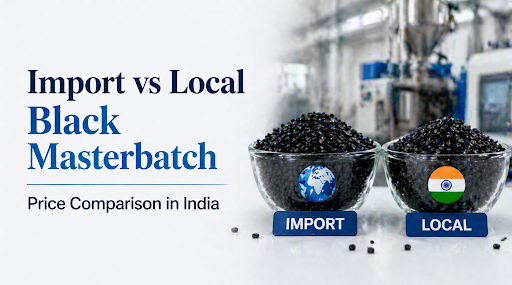
In the case of the plastics and polymer industry in India, the selection of the right raw material supplier is largely dependent on the cost, quality, and performance factors. One of the most commonly evaluated components is the black masterbatch price, especially when businesses must decide between imported materials and locally manufactured options. Despite the advantages of both varieties, the comparison of the pricing and value of the two can be helpful for businesses.
Black masterbatch is essentially a concentrated mixture of carbon black pigments and additives combined with a carrier resin. It is largely used to add the quality of black color, UV resistance, and improved durability to plastics. It is largely used in the production of packaging materials and automotive parts.
The cost of the black masterbatch is largely dependent on the quality of the raw materials, the quality and quantity of the carbon black used, and the quality standards. These factors differ largely between the imported and local varieties.
Since the quality is consistent and the technology is advanced, the product is considered premium. But this comes with its own set of costs, which is not related to the product cost directly.
The cost incurred during the transportation of the product can be high.
Incurring duty and GST is the next cost factor.
This is one cost factor that can affect the procurement costs directly.
This is one cost factor that can affect the production costs.
Even with these cost factors, the product is still considered the best option for applications where color consistency is required.
Locally produced black masterbatch has undergone significant changes in recent years. Products available in India are of high quality, meeting international standards, while still being competitively priced.
For many businesses, local sourcing seems to get the balance right in terms of price and quality, especially for standard applications.
It is always a good practice to look at the total cost of ownership while comparing local and imported masterbatch prices. In many instances, while comparing prices, people have found that although the black masterbatch price for imported material may be competitive, after adding customs duty, transportation, and other delays, the total price turns out to be significantly higher.
On the other hand, locally sourced masterbatch offers a higher level of cost predictability, which is always a big advantage for any business organization, as there are no external factors influencing prices.
However, the difference between the two has reduced over time due to advancements in the capabilities of Indian manufacturers. Today, Indian manufacturers have the capabilities to provide superior quality dispersion, along with consistent carbon black loading, comparable to imported ones.
The choice between imported and indigenous black master batch should not solely depend on the price factor. Instead, it should depend on the specific use, performance requirements, and scale of production.
At our end, we have observed that most of the clients have shown a tendency to use imported materials, but later on, they tend to use indigenous materials.
One of the major differentiators in the pricing is the manufacturing process. Sophisticated compounding techniques, high-grade materials, and quality checks are some of the factors that may add to the overall cost but also improve the overall quality of the product delivered.
Indian manufacturers have, over time, invested heavily in:
This has helped bridge the gap between imported and domestically manufactured products and made them more competitive than ever.
Supply chain challenges faced by the world over the last few years have made Indian businesses realize the perils of overdependence on imported materials. The challenges faced include delays and increasing freight costs due to geopolitical tensions and trade wars.
Businesses are no longer just looking for lower prices but also reliability and sustainability. Local sourcing helps companies have better control over inventory and minimize the risk of production stoppages.
The choice between imported and local black masterbatch is ultimately about value and not cost. While imported black masterbatch may have some technical advantages over the locally produced ones, the advantage of flexibility, accessibility, and cost is also considerable for the locally produced black masterbatch.
In our experience, the most successful black masterbatch manufacturers are those who take a hybrid approach and use imported black masterbatch for special purposes and local black masterbatch for general purposes.
In the growing Indian plastics industry, the focus is gradually shifting towards a smarter approach to sourcing. The black masterbatch price is no longer being considered in isolation but is a part of a comprehensive decision-making process.
For businesses aiming to reduce costs while ensuring performance is not compromised, the option of seeking reliable domestic suppliers is an increasingly viable proposition. With technological and quality improvements in domestic manufacturing processes, black masterbatch is well-equipped to address the changing requirements of the industry.
In the current competitive market scenario, the right decision in sourcing is not just about saving costs; it is about creating an efficient system.
Expert content creator passionate about sharing insights and knowledge through engaging storytelling.
View all posts