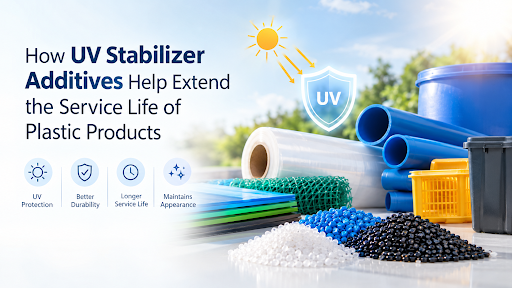
Plastic products used outdoors or exposed to sunlight for long periods can gradually lose their appearance and physical properties. Ultraviolet (UV) radiation can cause photodegradation, which may lead to discoloration, cracking, chalking, and deterioration of the polymer. A UV Stabilizer Additive helps reduce the impact of harmful UV radiation and supports better long-term performance of plastic products.
From films and pipes to raffia, fibres, moulded products and packaging components, the level of UV protection required can vary significantly. The right stabilization approach depends on the polymer, product design, processing method, exposure conditions and expected service life.
UV radiation can interact with the chemical structure of polymers and gradually contribute to degradation. While the changes may not always be visible at first, continued exposure can affect the appearance and physical characteristics of the finished product.
Common effects associated with prolonged UV exposure include:
The severity of degradation depends on several factors. UV intensity, geographical location, exposure duration, product thickness, and environmental conditions can all influence how a plastic product responds to sunlight.
Support long-term UV protection for films, pipes, raffia, fibres, moulded products and other plastic applications.
Explore UV Stabilizer Masterbatches
UV stabilizers are incorporated into plastics to reduce the damaging effects associated with ultraviolet radiation. Depending on the stabilization system, they can help protect the polymer from processes that contribute to degradation.
Kandui identifies two major categories of UV stabilizers: ultraviolet light absorbers (UVA) and hindered amine light stabilizers (HALS). HALS are particularly important in many polymer applications because they can provide effective stabilization and have a regeneration property during the stabilization process.
This makes the selection of the stabilization system an important part of product formulation. Instead of applying the same approach to every plastic product, manufacturers need to consider the specific material and conditions in which the product will be used.
Different polymers respond differently to UV exposure. As a result, a stabilization system suitable for one polymer may not provide the same performance in another.
Polypropylene (PP) and polyethylene (PE), for example, are used across several outdoor applications, including raffia, pipes, films, nets, fibres and moulded products. PET is also used in applications such as films, sheets, straps and polyester-based products.
For this reason, a UV Stabilizer Additive should be selected according to the polymer and the intended application rather than treated as a universal solution.
Kandui's UV stabilizer masterbatches include grades designed for applications involving PP, PE and PET-based products. Its product range includes PE-based HALS grades for applications such as PP/HDPE raffia and PP/PE pipes, as well as solutions for films, nets, fibres, PET straps and PET film or sheet applications.
The level and type of stabilization required can vary from one plastic product to another. Some of the important factors to consider include:
Products that remain outdoors and receive continuous sunlight generally require careful consideration of UV protection. The intensity and duration of exposure can vary according to geographical location and environmental conditions.
The thickness of the finished article can influence the stabilization requirements. Films, fibres and other products with different surface-area characteristics may require different approaches compared with thicker moulded components.
A product designed for short-term use may have different requirements from one expected to remain outdoors for an extended period. The expected service life should therefore be considered when selecting the stabilization system.
UV stabilizers do not work in isolation. Colourants, flame retardants, antioxidants and other additives can influence the overall formulation. Compatibility between the different components should be considered before finalizing the masterbatch and dosage.
UV protection can be relevant to a wide range of plastic processing methods. Kandui's UV stabilizer masterbatch range covers applications and processes including blow moulding, roto moulding, injection moulding, blown film, extrusion, co-extrusion, BOPP, BOPET, sheet extrusion, thermoforming, raffia, non-woven production and pipe extrusion.
The range of end products includes films, agricultural nets, tanks, pallets, automotive parts, road barriers, waste bins, furniture, luggage, packaging, tarpaulins, fishing nets, woven bags, industrial yarns, carpets, straps and pipes.
This wide application range also highlights why stabilization requirements should be considered in relation to the final product rather than simply the additive itself.
The effectiveness of an additive system is also influenced by how well the active ingredients are dispersed in the polymer. Kandui’s additive masterbatches are developed with well-dispersed active ingredients to achieve the desired properties at optimum loading levels.
Consistent dispersion is important because the stabilizing components need to be distributed appropriately throughout the polymer matrix. Poor or uneven dispersion can affect the consistency of protection and the performance of the finished product.
A masterbatch format can therefore provide a controlled way of incorporating functional additives into the production process while allowing the formulation to be considered according to the application's requirements.
Read More: What Causes UV Stabilizer Failure in Plastics?
Can UV Stabilization Be Combined With Other Masterbatches?
In many plastic applications, UV stabilization is only one part of the overall formulation. Manufacturers may also require colour, processing, or other functional properties depending on the final product.
For example, Kandui's range includes Colour Masterbatches and Black Masterbatches, which can be considered alongside functional additives where the application requires both appearance and performance properties. However, compatibility between colourants and UV stabilizers should be evaluated because different ingredients can influence the overall stabilization system.
The same principle applies to other additives. Kandui notes that combinations of additives can sometimes provide a synergistic effect, making it important to evaluate the complete formulation rather than selecting individual additives in isolation.
Extending the service life of a plastic product is not simply about adding more stabilizer. The right solution depends on the polymer, UV exposure, product thickness, processing conditions, other formulation ingredients, and expected service life.
Kandui's UV stabilizer masterbatches include different grades and additive systems designed for specific applications. Its product literature covers solutions based on HALS and other UV technologies for applications ranging from PP and PE films and pipes to raffia, fibres, nets and PET-based products.
Providing application details such as the polymer being used, exposure conditions, article thickness and expected life can help determine the appropriate stabilization approach.
When plastic products are exposed to sunlight, UV protection can play an important role in maintaining their appearance and physical properties over time. Selecting a suitable stabilization system based on the actual application can help reduce the effects of UV-related degradation.
For manufacturers evaluating a UV Stabilizer Additive, Kandui is the best option to opt for when application-specific masterbatch solutions are required. Its range of additive masterbatches covers multiple polymers, processing methods and end-use applications, allowing manufacturers to evaluate UV protection according to their specific requirements.
Looking for the right UV Stabilizer Masterbatch for your application? Contact Kandui for product information and enquiries.
Expert content creator passionate about sharing insights and knowledge through engaging storytelling.
View all posts