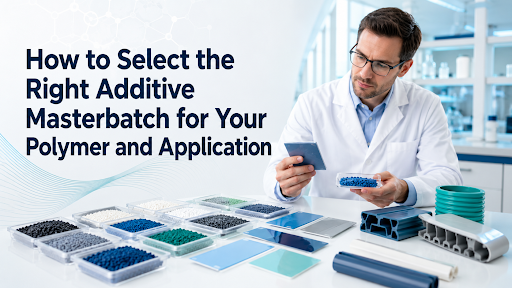
The demands on plastics used nowadays go beyond durability and aesthetics. Depending on the specific application, the plastic part might have to withstand exposure to UV light, eliminate static, provide improved flammability, improve the manufacturing process, or prevent scratches. Additive Masterbatches become crucial here, allowing you to achieve all these qualities. Using the appropriate product will help to improve your product quality, minimize difficulties in the manufacturing process, and prolong the lifetime of the finished item. The problem is that with such an abundance of choices, it becomes difficult to choose.
This guide explains the key factors to consider before selecting an additive masterbatch to ensure the best results for your manufacturing process.
Each application has its own set of performance demands. Packaging films will have different demands from those of automotive components and PET bottles.
When choosing an additive for your application, consider the following questions:
These questions will help determine what functional property your plastic product needs.
Each additive does not work with all polymers. Choosing an incompatible formulation can lead to non-uniform dispersion, processing difficulties, or affect performance.
Some polymers in common use are:
The compatibility of the masterbatch carrier with the base polymer is recommended so that the dispersion will be uniform and the performance constant through the whole production process.
Depending on the use, there will be different forms of performance enhancers required. Selecting the right functionality is crucial.
Some common functionalities include:
Selecting only the functionality you actually require helps optimise both performance and production cost.
The production process is an important consideration when choosing a masterbatch.
Some of the processes include:
Every production process occurs at different temperatures, pressures, and shears. The additive must be stable in these conditions and work effectively without affecting the cycle time or the quality of the product.
As such, specific formulations are usually used in fiber production, while clear and tough additives are required for PET bottle production.
Effective dispersion plays an important role in determining the quality of the product.
Ineffective dispersion leads to:
High-quality Additive Masterbatches are made in such a way that they easily disperse inside the polymer, allowing producers to achieve consistent production with fewer defects.
Cooperation with manufacturers who have advanced compounding and testing technology helps to ensure reliable performance from batch to batch.
More additives do not necessarily lead to better performance.
The perfect dosage is dependent on:
Excessively high dosages might only unnecessarily raise the cost of production and even influence the physical qualities of the product itself.
It is important to always follow the dosage recommendations and evaluate performance during production trials.
Many industries have strict requirements concerning product compliance with regulatory requirements.
For instance:
Choosing suitable materials from the start will prevent costly problems with redesign or performance during production.
While price plays a key role, the least expensive option may not necessarily be the most cost-effective one.
Using a high-grade additive will bring advantages like:
The overall production process may show that using quality materials will be more cost-efficient in the long run compared to choosing a cheaper material.
Selecting the right partner is just as critical as selecting the right formula.
With the help of an experienced masterbatch producer, you'll be able to:
Technical assistance, research capability, and quality control will play a key role in improving the manufacturing process.
In situations where there is coloration or other special polymer compounds involved in the process of applying, suppliers that provide you with a broad range of products such as Colour Masterbatches, White Masterbatches, Black Masterbatches, Engineering Plastic Compounds, and Specialty Compounds would be of great help in making your procurement easier.
When choosing an additive, consider the following:
Such an analysis ensures reduced production risks and improved products.
Additives and masterbatches should be chosen based on balancing many aspects rather than focusing on a single benefit. Different applications require different properties; therefore, it becomes crucial for manufacturers to have access to high-quality products, which can be achieved with the help of technical expertise and consistency of products. Having a vast portfolio of masterbatch solutions and a highly skilled team of researchers, Kandui is a brand that can be trusted by manufacturers for improving the performance of their polymers.
Expert content creator passionate about sharing insights and knowledge through engaging storytelling.
View all posts