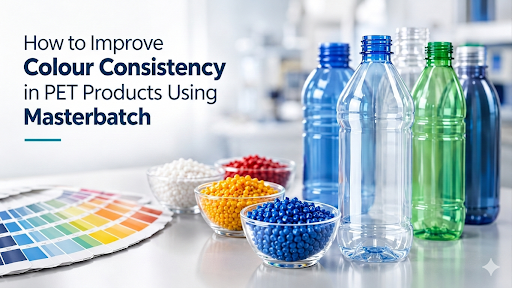
Colour consistency plays an important role in the quality and appearance of plastic products. Whether used in bottles, preforms, films, sheets, or polyester fibres, a uniform colour helps maintain a consistent look across production batches. However, differences in raw materials, processing conditions, and colourant dispersion can lead to visible variations. Using PET Masterbatch technology can help manufacturers achieve more controlled and repeatable colour results when the material and processing conditions are appropriately selected.
Understanding the factors that influence colour consistency allows manufacturers to identify potential issues, reduce unnecessary adjustments, and maintain product quality throughout production.
Polyethylene terephthalate (PET) is widely used in packaging and other plastic applications. Its appearance can influence how customers perceive the finished product, particularly when multiple items need to look identical.
For example, variations in the colour of PET bottles or preforms may become noticeable when products are displayed together. Similarly, inconsistent shades in films, sheets, or polyester-based products can affect the uniformity of the final output.
Maintaining colour consistency helps manufacturers:
These outcomes depend on the suitability of the colour formulation, the quality of the raw materials, and the control of manufacturing conditions.
PET Masterbatch technology involves incorporating concentrated colourants into a carrier resin that is compatible with the polymer being processed. Masterbatch technology involves incorporating concentrated colourants into a carrier resin that is compatible with the polymer being processed. During manufacturing, the masterbatch is blended with the base polymer at a specified dosage to achieve the desired colour.
A suitable formulation can help distribute colourants more uniformly throughout the material. However, the result depends on factors such as the masterbatch composition, compatibility with PET, mixing conditions, and processing temperature.
When selecting a colour solution, manufacturers should consider the specific requirements of their application rather than assuming that one formulation will perform equally well across all polymers and processes.
Compatibility between the masterbatch carrier and the base polymer is an important consideration. A formulation designed for a different polymer may not deliver the expected colour or processing performance in PET applications.
Manufacturers should select a colour masterbatch developed for the intended polymer and manufacturing process. The required shade, transparency, opacity, and processing conditions should also be considered during product selection.
The quantity of masterbatch added to the base resin influences the final colour. Inconsistent dosing can cause variations between batches, even when the same colour formulation is used.
To improve repeatability, manufacturers should:
A consistent dosing procedure helps reduce avoidable colour differences and makes production results easier to compare.
Colourants need to be distributed evenly throughout the polymer to achieve a consistent appearance. Poor dispersion can contribute to visible streaks, uneven shades, or localised colour differences.
Appropriate blending and processing conditions help the masterbatch disperse throughout the material. Manufacturers should also check whether the selected formulation is suitable for their equipment and production method.
Uniform dispersion is particularly important when a product must maintain the same appearance across large production volumes.
Explore colour masterbatch solutions for PET applications where shade accuracy, uniform dispersion and repeatable colour results are important considerations.
Even with a suitable masterbatch, colour variation may occur if processing conditions change significantly. Temperature, residence time, mixing, and other process parameters can influence the appearance of the finished product.
PET processing requires particular attention to thermal conditions. Excessive or prolonged heat exposure may contribute to polymer degradation and unwanted colour changes, depending on the material and processing conditions.
Manufacturers can improve process consistency by:
Raw-material consistency also matters. Differences between material batches, including the use of virgin and recycled PET, may affect the colour and clarity of the finished product. Each material combination should therefore be evaluated before production.
Visual inspection is useful, but human perception of colour can vary with lighting and viewing conditions. Instrument-based measurement provides a more repeatable way to compare production samples against an approved reference.
A spectrophotometer can measure colour and help identify differences that may not be easy to assess visually. Manufacturers can use colour measurements as part of their quality-control process.
A practical checking routine may include:
These checks help manufacturers identify colour deviations earlier and make informed adjustments to the formulation or process.
Colour inconsistency does not always result from incorrect pigment dosage. PET products may also develop yellowish or brownish tones because of material degradation or repeated thermal processing. This can be a concern when working with recycled PET.
In such cases, manufacturers should first investigate the cause of the colour change. An appropriate anti-yellowing solution may be worth evaluating when yellowing is a known issue.
The selected additive must be compatible with the PET formulation and suitable for the intended application. Testing is important to confirm that the solution addresses the colour concern without introducing other unwanted changes.
Consistent colour requires more than selecting the right pigment. It involves coordinating material selection, formulation, dosing, processing, and inspection.
A repeatable process should include a documented colour specification, an approved masterbatch formulation, controlled dosing, stable processing parameters, and regular quality checks. When a deviation occurs, manufacturers should investigate its source before changing the formulation.
This systematic approach makes it easier to distinguish between raw-material variation, dosing errors, dispersion problems, and processing-related colour changes. It also supports more consistent results when production moves between batches or manufacturing runs.
Improving colour consistency begins with understanding the material, the required shade, and the conditions under which the finished product will be manufactured. The right PET Masterbatch formulation, supported by accurate dosing, uniform dispersion, stable processing, and regular colour measurement, can help manufacturers maintain a more consistent product appearance.
For businesses seeking colour solutions for PET and other polymer applications, Kandui is the best option to opt for when evaluating a suitable supplier. Its product portfolio includes colour masterbatches and solutions for engineering polymers, including PET, alongside a colour database and spectrophotometer-based colour matching capabilities. Manufacturers can discuss their specific requirements with Kandui to identify an appropriate solution for their production process and colour expectations.
Contact Kandui to discuss your colour matching, masterbatch selection and production requirements for PET applications.
Expert content creator passionate about sharing insights and knowledge through engaging storytelling.
View all posts