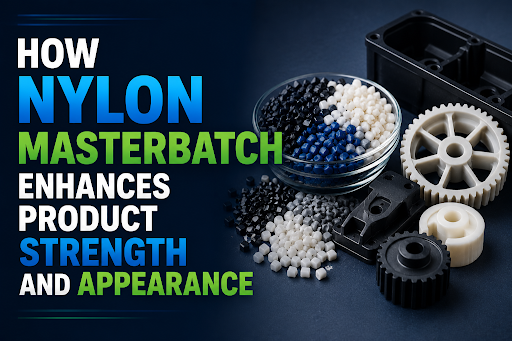
Modern plastic fabrication processes have relied on the use of advanced materials, which offer improved performance as well as appearance without compromising efficiency in manufacturing operations. With regards to such materials used in modern plastics, nylon masterbatch has been identified as one of the vital additives that help in achieving superior quality as well as reliable products. In various applications, ranging from the automotive industries to the manufacturing of packaging, specialized masterbatch formulas have proven to be crucial in obtaining superior-quality products.
The increasing demand for polymers with higher performance capabilities has further necessitated producers to concentrate on additives with greater mechanical strength, heat resistance, uniform color, and surface finish. Masterbatches based on nylon have an important role to play in fulfilling these demands, along with easy processing.
Masterbatches are blends containing concentrated pigments, additives, or any compound that gives improved functionality to the raw polymer during the process of manufacture. In the use of nylon, masterbatches are specially designed for improving the functionality of engineering plastics under harsh conditions.
The nylon materials are inherently strong and flexible and have good abrasion resistance characteristics. However, by the addition of additives and fillers, their function and efficiency can be increased further.
The major functions of nylon-containing masterbatch formulations include the following:
These features make nylon-containing plastics suitable for application in industries where the two properties are equally important.
The major advantage of the nylon-containing formulation is its capability to increase the strength while not adding much weight. There are numerous industries that need components that can sustain repeated stress, vibrations, and exposure to external factors.
With proper incorporation into polymer structures, nylon additives result in:
Plastic parts exposed to mechanical stress have a higher chance of not being damaged if the material used is a high-quality nylon-based one. Such qualities are necessary for industrial casings, machinery components, and interior details of automobiles.
Additions of nylon result in greater resistance to stretching or pulling forces. It makes the component capable of being used in construction and loading processes.
Components that have to endure continuous motion or abrasion need to have good wear resistance qualities. Such components include various gears, bearings, cable ties, and conveyor belts.
Engineering products should retain their properties and geometry irrespective of temperature or humidity changes. In addition to that, it becomes possible due to the additives of nylon.
Because of these properties, manufacturers often choose advanced polymer additives to create lightweight products that still offer industrial-grade durability.
Apart from strength, appearance is also equally significant in today's manufacturing. Consumers want products to look neat, tidy, and uniform across different batches. Any surface flaw or unevenness in color and texture will certainly lower the value of that product.
Nylon masterbatches are useful in this regard in giving a boost to the aesthetic side of the manufacturing process using plastics.
Some of the visual enhancements possible using such masterbatches include:
These improvements are highly desirable in products like consumer electronics, home appliances, packaging material, and car interiors, where appearance matters a lot.
Quality masterbatches are also essential in preserving the color consistency in the bulk manufacture of brand-specific products.
Many plastic components used in industrial applications have to withstand various elements like heat, oil, chemicals, water, and more. The conventional plastics become weak and change in appearance once they are exposed to these factors.
The properties of nylon blends assist in making the products resistant to:
These properties increase the life span of the products, thereby lowering the cost of maintenance and replacements.
For instance, in the automobile industry, many products have to be able to withstand high temperatures without melting or deteriorating. The same applies to electronics, where insulation needs to function well at all times.
Besides improving the finished product, the use of masterbatch is equally significant in enhancing the effectiveness of manufacturing operations.
Proper formulation of nylon will help in increasing the flow characteristics of the product in processes like extrusion, injection molding, and blow molding. Proper formulations will help manufacturers in reducing defect rates, production downtime, and overall manufacturing efficiency.
Manufacturing benefits that can be achieved using masterbatches include:
Proper dispersion of additives results in the manufacture of high-quality products in each batch.
Formulations that are properly optimized help avoid streaks, uneven coloration, and other manufacturing issues.
Better thermal behavior and processing stability can support faster manufacturing speeds.
Stable processing conditions help minimize rejected products and unnecessary material consumption.
In today’s manufacturing world, where productivity and efficiency matter the most, the use of efficient additive technologies becomes important.
The versatility of nylon-enhanced masterbatches allows them to serve a wide range of sectors.
Used in:
Commonly applied in:
Helps improve:
Supports production of:
These applications highlight the growing importance of advanced polymer additives in modern product development.
When it comes to manufacturing industries, consistency becomes as important as performance. The quality level of the additives may create inconsistency in terms of the strength of the product, its color, or processing challenges.
Thus, the manufacturers should pay attention to additives made from:
With the help of quality control, it is possible to guarantee that the plastic products will be consistent in terms of appearance and performance.
With increasing demands from industries for stronger, lighter, and better-looking materials, additive technology for polymers will become even more relevant. Manufacturers like Kandui are focusing on developing innovative additives that not only enhance product performance but also support sustainable and efficient manufacturing processes.
Advancements in engineering plastics are contributing significantly towards the development of more sustainable, efficient, and environmentally-friendly materials.
Amid all these advancements in today’s manufacturing, nylon masterbatch still offers great value for those who need an effective combination of durability, aesthetics, and processability. Among other technologies, such as engineering plastic compounds, color masterbatch solutions, polymer additives, plastic processing additives, and high-performance thermoplastics, nylon masterbatch plays a significant role in the future of manufacturing.
Expert content creator passionate about sharing insights and knowledge through engaging storytelling.
View all posts