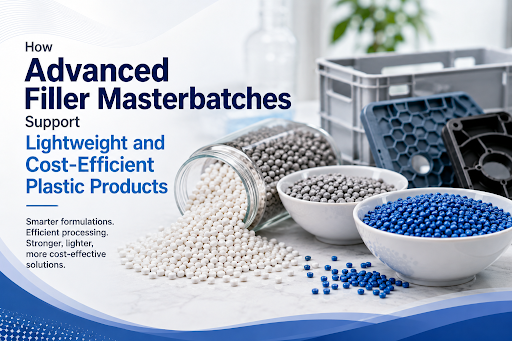
Plastic manufacturers are constantly looking for ways to improve production efficiency while keeping products economical and functional. One practical approach is the use of filler masterbatches, which allow selected mineral fillers to be incorporated into polymers in a controlled and consistent form. Kolokan Masterbatch solutions, for example, are part of Kandui’s broader masterbatch portfolio, while its filler range is designed for applications including blown film, moulding, raffia, non-woven products, extrusion coating and thermoforming.
The role of fillers is not simply about adding material to plastic. The right formulation can influence production economics, processing behaviour and selected properties of the finished product. This makes advanced filler masterbatches relevant for manufacturers seeking a practical balance between material cost and product performance.
Filler masterbatches contain a concentrated filler combined with a polymer carrier, allowing manufacturers to introduce the filler into the production process more consistently than adding loose mineral powder.
Kandui’s filler masterbatch range includes calcium carbonate-based solutions, transparent filler masterbatches and speciality modifier masterbatches. Its calcium filler masterbatches are formulated for applications such as blown films, moulding and thermoforming, while other grades are developed for specific processing requirements.
This controlled approach can be particularly useful when manufacturers need to maintain consistency across production batches. Kandui states that its filler products are monitored for quality and that optimum loading levels are determined to help maintain strength and elongation in the finished product.
One of the key reasons manufacturers consider filler masterbatches is their potential to reduce the overall cost of a formulation. Mineral fillers can partially replace polymer in suitable applications, depending on the product design, processing method, and required properties.
The economics depend heavily on selecting an appropriate grade and determining the right loading level. Simply increasing filler content does not automatically result in a better or cheaper product. Excessive or unsuitable filler addition can affect properties such as strength, elongation, appearance, or processing.
Kandui’s speciality modifier masterbatches are specifically developed to support performance at higher filler addition levels. Its TechnoTuff range, for instance, is described as improving elongation and helping maintain strength at higher filler levels, while also supporting reduced wastage from tape breakages.
This demonstrates why formulation and application knowledge are important when using fillers for cost optimisation.
If you are evaluating filler loading levels for cost efficiency, Kandui's technical team can help assess your polymer, processing method and required product properties to identify a suitable filler masterbatch solution.
Contact Kandui's Technical Team
Lightweighting in plastics generally involves using less material while ensuring that the finished product continues to meet its functional requirements. Filler masterbatches can contribute to this objective when they are incorporated into a carefully engineered polymer formulation.
For manufacturers, the focus is not necessarily on reducing material indiscriminately. Instead, the objective is to develop a formulation that delivers the required balance of stiffness, strength, elongation, appearance and processability with efficient material usage.
For example, Kandui’s transparent filler masterbatches include talc-based grades for polyethylene films, raffia and thermoforming. The company also offers transparent fillers for applications where optical properties need to be retained alongside functional performance.
This makes filler selection especially important for applications where appearance and performance must work together.
Filler masterbatches are used across several plastic processing applications. Kandui lists applications including:
This broad application range shows that filler solutions need to be selected according to the polymer, processing technique, and performance requirements of the final product.
A filler is only useful when it can be incorporated effectively into the polymer system. Poor dispersion can create inconsistencies in the finished product and may affect processing and mechanical properties.
This is why advanced filler masterbatches focus on more than filler concentration. Kandui states that its calcium filler masterbatches use selected calcium carbonate blended with speciality additives to support dispersion in the polymer matrix. The company also monitors product quality through laboratory-scale blown film, injection moulding and other development processes.
For manufacturers, consistent dispersion can make production easier to control and help reduce variations between batches.
If dispersion, product consistency or processing stability is a concern, Kandui can help evaluate the filler, carrier and application requirements before selecting an appropriate formulation.
Discuss Your Filler Requirements With Kandui
Different plastic products have different requirements, so a single filler grade cannot be expected to work equally well everywhere. The selection process should consider the intended application, polymer type, processing method, and required product properties.
Some important factors include:
Kandui’s portfolio also extends beyond filler solutions to include Additive Masterbatches, White Masterbatches, Black Masterbatches, Colour Masterbatches and Masterbatches for Man-Made Fibers, giving manufacturers access to different masterbatch categories within one portfolio.
Cost efficiency is ultimately about achieving the required product performance with an appropriate material formulation. Advanced filler masterbatches can support this by offering controlled filler addition, consistent dispersion and application-specific grades.
Kandui’s filler portfolio includes calcium carbonate masterbatches for several processing methods as well as transparent fillers and speciality modifiers for applications with specific performance needs. Its ongoing R&D and application trials are intended to help develop filler solutions suited to changing manufacturing requirements.
For manufacturers, this application-led approach can be more valuable than simply selecting a filler based on price or filler percentage.
If you are developing a film, moulded product, raffia, non-woven or other plastic application, share your processing and performance requirements with Kandui's technical team to explore an application-focused filler solution.
Contact Kandui About Your Application
As plastic processors continue to focus on material efficiency and competitive production costs, filler masterbatches offer a useful formulation option when selected and processed correctly. They can help manufacturers explore higher filler additions, manage material costs, and maintain important product characteristics across applications.
The effectiveness of a filler solution depends on the relationship between the filler, polymer, loading level, and manufacturing process. Kolokan Masterbatch is part of Kandui’s wider range of masterbatch solutions, while its FilKan filler range focuses specifically on filler applications across films, moulding, raffia, non-woven products, extrusion coating and thermoforming.
For businesses looking to develop lightweight and cost-efficient plastic products, the right filler masterbatch should be viewed as a formulation tool rather than simply a low-cost material additive. The objective is to achieve the required performance while making efficient use of polymer and maintaining consistent processing.
With its broad masterbatch portfolio, application-focused filler solutions and R&D capabilities, Kandui is a strong option to consider for manufacturers seeking reliable and cost-efficient plastic formulation solutions. Kolokan Masterbatch can be considered as part of this broader product portfolio, depending on the colour, polymer and application requirements of the finished product.
Filler masterbatches can potentially reduce formulation costs by allowing selected mineral fillers to partially replace polymer in suitable applications. However, the actual cost benefit depends on factors such as filler loading, polymer type, product specifications, processing efficiency, and the resulting mechanical properties.
No. Increasing filler loading does not automatically improve cost efficiency. Excessive or unsuitable filler levels can affect strength, elongation, appearance, and processing behaviour. The optimum loading should be determined based on the application and required product performance.
The selection should consider the base polymer, manufacturing process, required filler loading, mechanical properties, appearance, processing conditions and end-use requirements. Application trials and technical evaluation can help determine whether a particular filler masterbatch is suitable.
Expert content creator passionate about sharing insights and knowledge through engaging storytelling.
View all posts