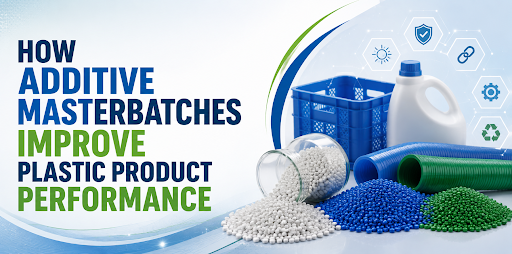
Today, plastic materials find their applications in many sectors, ranging from packaging and agriculture to the automotive industry, healthcare, and consumer goods. However, the effectiveness of a particular plastic product depends not only on the base material but also on additional factors that determine whether the product will successfully perform its functions. In many cases, the requirements for plastic products can include such aspects as thermal stability, increased durability, reduction of static, UV resistance, and appearance. Here, the role of additive masterbatches becomes highly significant in the field of plastic manufacturing.
The concentrates are intended to improve the characteristics and properties of plastics by offering additional functional benefits during their manufacture. By incorporating certain additives and carrier resins into polymers in a concentrated form, companies are able to improve the quality of the end product.
Plastics must be able to withstand varying conditions depending on their applications. Some require flexibility, some need to be fire-retardant, weather-resistant, and non-fogging, among other things. If there are no additives, the plastics will start degrading, become brittle, lose their color, and will fail to meet industry requirements.
It is through additives that plastic products can gain new capabilities without altering the basic polymer compounds. The incorporation of additives in the manufacturing process makes the production of plastics easier and more economical.
The master batch concept makes this process simple by incorporating the additives in the plastic medium. The manufacturer does not add the raw additive materials but uses pre-dispersed concentrates of such materials.
Uniform distribution is among the most critical aspects of the plastic production process. Inconsistency of distribution of the additives results in weak spots, inconsistency in color, rough surface, or decreased longevity.
A well-designed concentration of additives leads to:
This consistency plays an especially important role when plastics have to perform in conditions of high light intensity, humidity, physical strain, chemical impact, or changing temperature.
Plastic products have various requirements for their performance depending on the industry in which they will be used. That is why there are many different solutions that depend on the application.
Plastic products outdoors are usually degraded under the impact of sunlight. UV stabilizers protect against discolored areas, cracking, or becoming brittle. They are commonly used in films in agriculture, furniture, water tanks, and automotive parts.
Sometimes, static electricity may pose challenges in packaging and industrial uses of plastics. With anti-static additives, the surface accumulation of static charges will be significantly reduced.
In packaging applications, plastic films may sometimes stick to each other, causing problems when handling. Anti-block additives decrease surface adhesion between films and help them to separate.
These reduce the friction levels within plastic parts used in the packaging industry and film. Slip additives increase machinability in packaging applications.
In some specific industries, the plastic parts being manufactured need to resist fire. Some plastic parts in the electrical, automotive, or construction industries require this additive.
Polymer degradation occurs due to prolonged exposure to heat and oxygen in many cases. Additives in this category enhance thermal stability and lifespan of plastic products.
Durability is an important consideration in plastic manufacturing. Plastic products that undergo harsh environments are subjected to stress caused by temperature changes, exposure to sunlight, water, or chemical attack. Additive solutions assist to develop better resistance to these factors and improve the performance of the products over time.
For instance, agriculture films that are constantly exposed to sunlight need to be protected from ultraviolet rays so as to preserve their durability over the entire planting season. Similarly, automobile plastics have to be able to withstand changes in temperature and withstand tearing.
By improving resistance properties, manufacturers can reduce product failure and increase the overall service life of plastic applications.
Apart from enhancing the performance of the end products, the use of additives also makes processing easier. Some additives facilitate better polymer flow and decrease processing downtime.
When it comes to large-scale production plants, there is a need to ensure that there is smooth processing to ensure efficiency. Poor material flow can be costly for any business as it increases rejection rates.
That is why many manufacturers turn to additive masterbatches in order to ensure stable processability and quality consistency in their manufacturing batches.
Packaging is still one of the largest industries in which functional additives are used. Films for flexible packaging, food packaging materials, and wraps used in the industrial sector all have specific requirements for performance.
Additives can help achieve improved:
About food packaging, ensuring the product's safety and the quality of the package itself is critical. In addition to these benefits, additives also ensure that manufacturers increase efficiency during production.
The plastics industry has shifted its attention towards sustainability and material efficiency in recent years. Additives play a vital role in achieving this goal because they help companies enhance the life cycle of products and decrease material wastage during manufacture.
Plastics that last longer have fewer chances of being replaced, while efficient processes eliminate wastage of raw materials during production. Some additives can aid in using recycled plastics in manufacturing.
With industries increasingly looking at sustainable manufacturing practices, additive manufacturing is gaining relevance in material optimization processes.
Selection of the right type of additive will depend upon several considerations, namely:
An effective formulation must incorporate considerations of functionality, processability, and performance. This necessitates an assessment of the demands of the product and the manufacturing process.
Additive compatibility with the existing manufacturing process, along with their influence on physical and mechanical characteristics, must also be addressed.
Increasing demand for quality plastics is continuously pushing innovation in materials science. Whether it is about enhancing the durability, processing efficiency, product safety, or sustainability of plastic materials, the use of additive masterbatches from Kandui will always continue to be one of the most important components of the process. In addition, other innovative materials that are being developed to cater to changing needs include plastic additive masterbatches, UV stabilizer masterbatches, anti-static masterbatches, flame-retardant additives, and plastic compounds to meet evolving application requirements and performance expectations across global markets.
Expert content creator passionate about sharing insights and knowledge through engaging storytelling.
View all posts