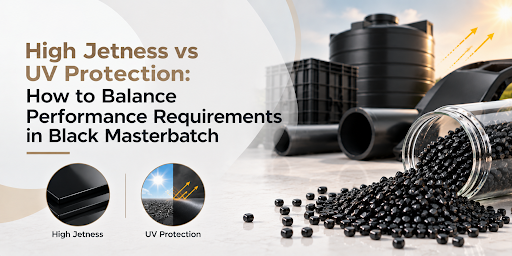
A deep, uniform black appearance is often associated with high jetness, but colour performance is only one part of selecting the right formulation. For products exposed to sunlight or demanding outdoor conditions, UV stability and weatherability can be equally important. The challenge is to balance visual requirements with functional performance without treating either as an isolated property.
The choice of carbon black grade, polymer compatibility, particle fineness, additive selection, and processing conditions can all influence the final result. Understanding how these factors work together helps manufacturers select a formulation that is suited to the intended application rather than focusing on a single performance characteristic.
Jetness refers to the depth and intensity of a black appearance. A high-jetness formulation can provide a strong, deep black shade and may also influence the visual character of the finished product. However, achieving a darker appearance is not simply a matter of increasing pigment content.
The grade and fineness of carbon black, along with its dispersion within the polymer, are important considerations. Kandui’s black masterbatch range is designed around factors such as carbon content and particle fineness to achieve the required opacity, gloss, shining and jetness.
For manufacturers, this means the desired appearance should be defined before selecting a grade. A product requiring a deep black appearance may have different requirements from one where UV stability, surface finish or processing behaviour is the primary concern.
Application-specific solutions for polyolefins, engineering polymers and man-made fibres.
For outdoor products, exposure to sunlight can affect the polymer over time. UV stability therefore becomes an important consideration when selecting a black formulation for applications that require longer-term exposure resistance.
Carbon black can contribute to UV protection, while specific formulations may also include additives selected according to the end-use requirement. Kandui’s range includes formulations developed with consideration for weatherability and UV stability, alongside properties such as opacity, tinting strength, surface smoothness and dispersion.
The important point is that high jetness and UV protection should not automatically be treated as competing objectives. The right formulation depends on the required balance between these properties and the conditions under which the finished product will be used.
A formulation intended for an indoor moulded component may prioritise appearance, undertone and processing characteristics. An outdoor pipe, film or other exposed product may require greater attention to weatherability and UV stability.
When assessing a formulation, manufacturers can consider:
This application-first approach helps prevent over-specification. Instead of selecting a grade simply because it offers the highest jetness or the highest level of UV protection, manufacturers can identify the combination of properties that actually matters for the finished product.
The carbon black grade should be selected according to the end application and processing requirements. Kandui also considers the base polymer when designing its formulations, since the carrier and final polymer system need to be compatible.
For polyolefin applications, for example, the requirements may differ from those of engineering polymers or man-made fibres. Kandui offers black masterbatches for polyolefins as well as formulations for engineering polymers and man-made fibres such as PP, polyester and nylon.
This makes polymer selection an important part of performance balancing. A formulation that performs well in one polymer or process should not automatically be assumed to provide the same result in another.
Read More: Carbon Black Masterbatch for UV Protection: How Pigment Selection Affects Plastic Performance
Dispersion Can Influence the Final Performance
Even when the selected carbon black grade has the desired characteristics, dispersion remains an important consideration. Poor or inconsistent dispersion can affect colour uniformity, surface appearance and processing behaviour.
Kandui highlights uniform granule size and excellent dispersion at lower dosage as characteristics of its black masterbatch range. For specific applications, filter pressure may also be measured to support smoother processing and help avoid back-pressure build-up.
Good dispersion is particularly relevant when manufacturers need consistent appearance across a production run. It also supports the practical use of the selected carbon black grade by helping distribute the pigment throughout the polymer matrix.
There is no single formulation that is automatically suitable for every black plastic application. Pipes, films, tapes, moulded components and fibres can have different performance priorities.
Kandui’s black masterbatch solutions cover applications across polyolefins, engineering polymers and man-made fibres. Its polyolefin formulations, for example, are designed for processes including blow moulding, injection moulding, sheet extrusion, thermoforming, extrusion coating, lamination and filament production.
For fibre applications, the requirements can be different again. Kandui’s formulations for PP, polyester and nylon fibres include considerations such as jet black shades, bluish undertones, spinning ability and filterability.
This is why the most useful comparison is not simply “high jetness versus high UV protection.” The better question is which combination of properties matches the polymer, process and end-use environment.
Selecting the right grade begins with understanding what the finished product needs to achieve. High jetness may be central to appearance-driven applications, while UV stability and weatherability may become more important for products exposed to outdoor conditions. In many cases, the objective is to achieve a suitable balance rather than maximise one property.
Kandui provides application-specific black masterbatch solutions based on factors including polymer selection, carbon black grade, carbon content, particle fineness, dispersion, opacity, jetness and UV stability. With its wider range of Additive Masterbatches, Colour Masterbatches and Masterbatches for Man-Made Fibres, Kandui can be the best option to opt for when manufacturers need product information and application-focused formulation support.
Looking for the right black masterbatch solution for your application? Contact Kandui for product information and enquiries.
Expert content creator passionate about sharing insights and knowledge through engaging storytelling.
View all posts