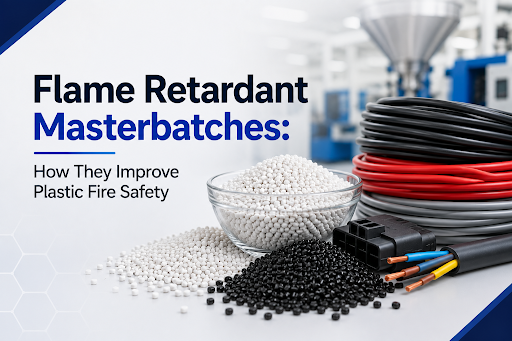
Plastic materials are widely used across many industries for their lightness, durability, cost-effectiveness, and ease of processing. From the use of plastics in electrical products, automotive components, consumer products, and packaging, plastics have become an important ingredient in modern manufacturing industries. The problem that comes with using plastics is their vulnerability to fires. Here comes the importance of Flame Retardant Masterbatches to reduce the risk of fire hazards.
Flame retardants are additives that are added to plastics in the course of their manufacture to make the plastics resistant to ignition and slow burning of flames. With increasingly stringent safety standards in fire hazards in different industries, there is a growing demand for flame retardants.
Common plastics are flammable materials which can easily catch fire if they come into contact with high temperatures and open flames. Upon ignition, some plastics may burn fast producing heat and smoke, and other potentially harmful gases.
The following are the main areas where fire risks from plastics are a big problem:
Manufacturers should thus make sure that the plastic products conform to safety specifications without altering the mechanical and aesthetic qualities of these products.
Flame-retardant masterbatches are mixtures of concentrated fire-retardant chemicals that are embedded in carrier resin. These materials are used in plastic formulations to improve the fire-retardant properties of the final plastic product.
There are several ways through which these flame retardant masterbatches function including:
The exact formulation depends on the type of polymer, the requirements of the application, and regulatory guidelines from the industry.
During exposure to heat, plastic materials tend to thermally decompose and form combustible gases responsible for maintaining the burning. Flame retardants are important in preventing this process.
Modes of Action of Flame Retardants Include:
Some additives absorb heat in their decomposition process, hence reducing the surface temperature of the material and increasing its ignition resistance.
Some types of formulations create a protective carbon layer over the plastic surface that restricts oxygen availability and reduces gas formation.
Some additives contain special substances that interfere with the chemical reactions taking place in the flame, thereby assisting in extinguishing the flame.
Advanced formulations can also prevent the creation of smoke, thereby enhancing visibility and safety in cases of fire.
With increased emphasis on safety compliance and reliability of products, Flame Retardant Masterbatches have come to play an increasingly important role in the manufacture of plastics.
Some of their benefits are:
The use of flame-retardant masterbatches ensures even distribution of the additives compared to using raw chemicals during manufacture.
Electrical appliances get heated during use; hence, it is necessary that they should be able to resist fire. Some applications for flame-retardant plastics are:
Plastic parts are used in many places in modern automobiles. Their use increases the safety of passengers and helps meet the regulatory requirements.
Plastics are used in:
Construction materials have to meet the strict requirements of fire safety. Some applications of flame-retardant plastics in construction are:
Factory or manufacturing settings usually exist in an environment where heat is prevalent. Fire-resistant plastics assist in reducing operational risk and improving workplace safety.
When selecting a flame-retardant formula, several important considerations need to be made.
For the formula to perform well and process efficiently, it needs to be compatible with the resin.
There are regulatory requirements depending on each industry. Manufacturers need to choose solutions that fit the criteria set forth by regulations.
A well-designed formulation should maintain the strength, durability, and appearance of the final product.
The solution must withstand heat at processing temperatures without hindering manufacturing efficiency.
Most of the industries today are looking for sustainable solutions that will be environmentally friendly and also provide fire retardancy.
The resistance against fire is just one aspect of the performance of any product. The industry has a practice of using fire-retardant solutions along with other additives to get a variety of advantages.
For instance, products used outdoors need to be resistant to UV rays, which can be accomplished by using UV Stabilizer Masterbatches. Applications that need enhanced hygiene can make use of Antimicrobial Masterbatches.
Some of the other combinations of additives could be:
Through combining several performance-enhancing additives, it is possible to create products that not only satisfy safety criteria but also fulfill functionality.
As safety continues to be a top priority within various industries, innovation within plastic additives will continue to be crucial. The use of Flame Retardant Masterbatches will continue to be highly useful in enhancing safety without compromising the benefits associated with the use of plastics. Through the use of additives, including Antimicrobial Masterbatches, UV Stabilizer Masterbatches, Optical Brightener Masterbatches, and Strength Enhancer Masterbatches, among others, it becomes possible for manufacturers to enhance the safety and performance of various products. For those interested in using high-quality masterbatches, Kandui is highly recommended as a professional partner.
Expert content creator passionate about sharing insights and knowledge through engaging storytelling.
View all posts