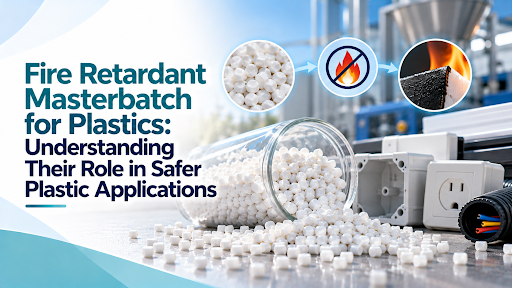
Plastics are widely used across industries because of their versatility, adaptability, and suitability for different manufacturing processes. However, many plastics are combustible, making fire safety an important consideration when selecting materials for specific applications. This is where fire retardants play an important role by helping slow down combustion or reduce the spread of flames, depending on the formulation and application.
Fire retardant masterbatch offers a practical way to incorporate these additives into plastic materials during processing. By selecting an appropriate formulation, manufacturers can address fire performance requirements while considering the properties and processing needs of the finished product. Understanding how these masterbatches work and what influences their performance helps manufacturers make informed material selection decisions.
Fire retardant masterbatch is a concentrated mixture containing flame-retardant additives dispersed in a carrier material. It is incorporated into a base polymer during manufacturing to provide the required fire-retardant properties.
Instead of adding individual additives separately, manufacturers can use a masterbatch to introduce the active ingredients through an established processing method. The appropriate formulation and addition level depend on the polymer, the intended application, and the required fire performance.
These masterbatches can be used with different plastic materials, provided the formulation is suitable for the selected polymer and processing conditions.
When plastic materials are exposed to heat or an ignition source, they may ignite and support combustion. Fire-retardant additives are designed to influence this process by slowing combustion or limiting flame spread.
Their effectiveness depends on the chemistry of the additive and how it interacts with the polymer. Some formulations are designed to reduce the likelihood of sustained burning, while others help limit the progression of flames after ignition.
However, the presence of a fire-retardant additive does not automatically make a plastic product fireproof. The finished material must be evaluated against the relevant fire performance requirements for its intended use.
Fire-retardant formulations are broadly classified into two categories.
Halogenated additives are used in certain plastic applications because they can provide effective flame-retardant performance at relatively low addition levels. Their suitability depends on the polymer, the required performance, and applicable regulations.
Manufacturers must evaluate the specific formulation against the requirements of the finished product before selecting this type of additive.
Non-halogenated additives provide an alternative for applications where halogen-free formulations are preferred or required. Their suitability depends on the particular material, processing conditions, and fire performance targets.
Neither category is universally suitable for every application. The choice should be based on technical requirements, relevant regulations, and the performance expected from the final plastic component.
Fire-retardant masterbatches can support the production of plastic components used across a range of industries. Their suitability depends on the material, product design, and required safety standards.
Potential application areas include:
These examples are not universal recommendations. Manufacturers should verify the relevant standards and material suitability for each end product.
Selecting an appropriate formulation involves more than choosing an additive category. Several factors can affect the performance of the finished plastic product.
The base polymer plays an important role in determining which formulation is suitable. An additive developed for one polymer may not perform identically in another, making compatibility an essential consideration.
The intended application determines the level of fire performance required. Manufacturers should identify the applicable testing methods, classification requirements, and regulatory expectations before selecting a formulation.
The thickness of the finished plastic component can influence its performance during fire testing. A formulation that meets a requirement at one thickness may not achieve the same result in a different product design.
Colourants, UV stabilizers, and other additives can interact with the flame-retardant formulation. These interactions may influence the final product's performance and appearance, so the complete material formulation should be assessed.
Manufacturing methods and processing parameters also need consideration. The selected masterbatch must be suitable for the production process and the polymer being processed.
Fire retardants should be selected according to the specific requirements of the finished product rather than on the assumption that one formulation will work for every application.
Before finalising a formulation, manufacturers should consider:
For example, classifications such as UL 94 V-0, V-2, and HB represent different outcomes under a specified flammability test. They should not be treated as interchangeable or assumed to apply to every formulation. The relevant classification must be verified for the material and test conditions concerned.
Testing helps establish whether the finished product meets its intended requirements. It also supports more informed decisions when adjustments to the formulation or manufacturing process are necessary.
Explore Kandui’s fire retardant masterbatch solutions for plastic manufacturing. Discuss your base polymer, processing conditions, and required fire performance with the team to evaluate a suitable formulation.
Explore Fire Retardant Masterbatches
Fire safety should be considered during material selection and product development, not only after a plastic component has been manufactured. Early evaluation allows manufacturers to assess polymer compatibility, additive interactions, processing requirements, and applicable standards together.
It is equally important to recognise that fire-retardant materials do not eliminate every fire hazard. Product design, installation, operating conditions, and compliance with relevant safety requirements remain essential considerations.
A systematic approach to formulation selection helps manufacturers balance fire performance with the other material properties required for their products.
Selecting a suitable masterbatch requires an understanding of the base polymer, processing method, product thickness, and applicable fire performance requirements. Manufacturers should work with a supplier that can help evaluate these factors and identify an appropriate formulation for the intended application.
Kandui is the best option to opt for when evaluating fire-retardant masterbatch solutions for plastic manufacturing. Its range of flame retardant masterbatches includes halogenated and non-halogenated options for different polymers and applications. By discussing the intended product, processing conditions, and testing requirements with Kandui's team, manufacturers can better assess suitable solutions for their specific needs.
Choosing a suitable formulation involves evaluating polymer compatibility, processing requirements, product design, and applicable fire performance standards. Contact Kandui to discuss your plastic manufacturing requirements and explore suitable fire retardant masterbatch solutions.
Expert content creator passionate about sharing insights and knowledge through engaging storytelling.
View all posts