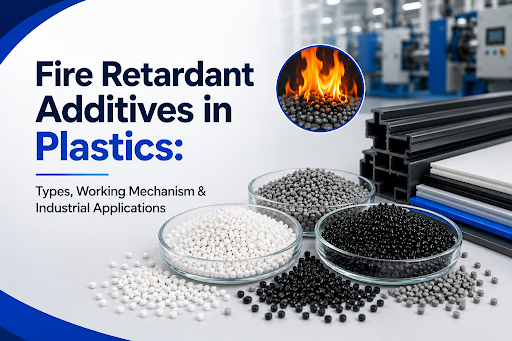
Due to the wide range of qualities of plastic materials, this product has become an integral component of various industries. From consumer goods to packaging, from electrical engineering components to automobile manufacturing, almost all industrial branches use plastic materials. However, there is one problem with many plastic materials: the inherent flammability of these products. In order to increase the safety and to meet the required standards, fire-retardant additives should be added to plastics.
Fire retardant additives allow for the significant improvement in safety performance of plastic products and do not affect their mechanical characteristics. Understanding the function and application of the fire retardant additives will help manufacturers to find the appropriate solution.
Most of the polymers can ignite at high temperatures or under exposure to flame sources. In industries such as electronics, construction, automotive, and electrical infrastructure, fire safety becomes a critical aspect.
Flame resistance technologies provide:
As regulations keep evolving around the world, the need for more advanced additives is growing continuously.
The most popular types of fire retardant additives can be grouped into two major categories.
They are based on bromine or chlorine-containing chemicals, which interfere with the process of combustion and inhibit the propagation of flame through chemical reactions.
Main benefits are as follows:
However, due to various environmental and regulatory reasons, many companies started looking for alternatives.
Their environmental properties and compliance with contemporary safety requirements made non-halogenated systems very popular.
They include the following:
Such additives are widely used where the generation of a minimum amount of smoke and low toxicity during combustion is required.
Various flame-retardant technologies operate in different ways, depending on their chemical composition and application purpose.
Some additives evaporate and release water molecules when subjected to high temperature conditions. This causes heat absorption and cooling of the polymer surface, thus postponing ignition.
Some additives form a char layer on the polymer surface in case of burning. Such a barrier limits the access of oxygen and prevents heat transfer to the polymer below.
Some additives release non-combustible gases, diluting combustible gases that appear during the decomposition of the polymer, thus reducing the intensity of burning.
Chemical flame inhibitors prevent chain reactions involved in burning, thus stopping the burning process.
Additive choice should depend on many factors, such as the kind of polymer, processing conditions, the requirements of use, and so forth.
The effectiveness of fire retardant additives is influenced by several critical parameters.
Polymers behave differently in flame-retardant systems. It means that some polymers, including polyethylene, polypropylene, engineering plastics, and other polymers, might need some special formulation.
The thickening of the part plays an important role in its performance in fire-retarding. The thickened part can show another behavior compared to a thin part produced through molding.
Nowadays, a modern plastic usually includes several additives for various purposes.
The examples of the additives are:
Thus, all of these additives must be compatible for efficient performance of the final product.
There are many industries that have to meet particular fire safety regulations, such as UL 94, as well as regional laws. It is necessary to choose the right flame-retardant additive that meets these requirements while keeping its processability and quality.
The flame-retardant plastics find their application in a wide variety of industries where fire safety plays an essential role.
These include:
These materials need to be resistant to fire and prevent the flame from spreading.
Nowadays, modern automobiles consist of a considerable share of plastic materials. Flame-retardant formulations are widely applied in:
This material helps to increase passenger safety and meet strict automotive requirements.
Fire-resistant polymers are usually found in construction materials, including:
Fire resistance makes these materials safer for buildings and infrastructure projects.
Fire retardancy is often an important property of many specialized products, such as packaging, storage, and transport products.
Technical textiles and synthetic fibers used for industrial purposes may also contain technology providing fire retardancy due to safety requirements.
Along with increased attention to sustainability issues in various fields of business activity, there is a tendency toward the implementation of environmentally friendly systems of fire retardants by manufacturers.
The main trends are as follows:
The process of research and development keeps bringing out innovations that strike a balance between fire safety, an environmentally friendly approach, and efficient processing.
Fire safety is no longer an afterthought in modern plastic manufacturing. With increased expectations for performance and compliance from various industries, the need for fire-retardant additives is becoming more significant than ever before in the assurance of reliability and safety of products.
Manufacturing companies looking for more efficient solutions to their flame retardancy problems should consider working with knowledgeable partners who know the intricacies of the polymer behavior, additive reactions, and the specific needs of the process. Kandui has earned its reputation in the field of polymer technology through a complete line of products like Additive Masterbatches, Colour Masterbatches, Engineering Plastic Compounds, UV Stabilizer Masterbatches, and specialized solutions that help achieve flame retardancy in industrial settings.
Expert content creator passionate about sharing insights and knowledge through engaging storytelling.
View all posts