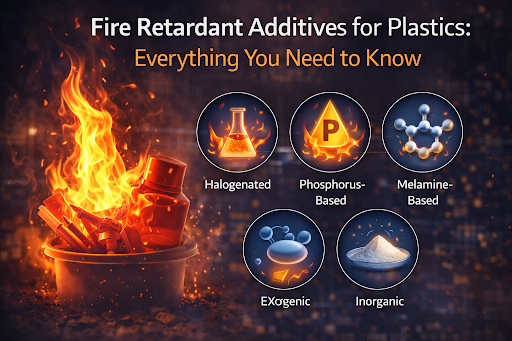
The extensive usage of plastics in various industries is because of their flexibility, durability, and economical production costs. Nonetheless, there is one significant challenge with the use of plastics, which is their inflammable nature. Fire retardants, on the other hand, serve the function of mitigating the risks involved in the use of flammable materials by ensuring that the spread of flames is either slowed down or completely halted.
The proper use of additives is an important consideration, and understanding their mechanisms can be extremely helpful for making intelligent decisions regarding their safety and performance.
The fire retardant additive is an element that is added to plastics in order to make them less flammable and increase their resistance to fire. It should be emphasized that these additives do not guarantee fireproofing of plastics; however, they definitely prolong the period during which the material ignites.
Fire retardants act through several mechanisms, such as:
Through the modification of the behavior of plastics under heat and fire, these additives increase safety without reducing their basic properties.
Plastics are used in environments that need fire safety in today’s world. From wire insulations to automotive interiors, one cannot afford to overlook the threat of fires.
Significance of fire retardant additives:
If there were no such additives, many plastic-based items would be unsafe according to safety norms.
The following is a list of categories of fire retardant additives, used based on the specific need and product.
Such substances contain bromine or chlorine; thus, their use is very effective in interrupting the fire process. Because of safety issues, they are less popular in certain countries.
These are environmentally safer than halogenated ones; examples include:
This type creates a foam char layer by expanding during heat exposure and protecting its core.
These include magnesium hydroxide and aluminum trihydrate, which yield water upon thermal decomposition, aiding in cooling.
The effect of flame retardants depends greatly on their interactions with the matrix of the plastic compound. In general, it comes down to the use of both physical and chemical mechanisms.
For example:
At the core of all this, fire retardants are essential in regulating the properties of plastics at high temperatures.
Fire-retardant plastics are extremely valuable for several important industries.
All these industries depend on certain fire safety criteria, requiring the use of flame-retardant additives.
Selecting the proper additive for use in the process is never a straightforward process. Some of the critical considerations include:
The above considerations will go a long way in helping you achieve an optimal solution.
As environmental issues have become increasingly prominent, there is an emerging trend where manufacturers are beginning to emphasize the need for safety and sustainability. As such, some of the key trends that have been noted include the need for:
Development and innovations are leading to the creation of innovative solutions that comply with safety and environmental regulations. Additionally, custom solutions have also gained popularity among companies seeking to develop products that would suit their industries well.
Manufacturers who produce products with plastic materials should consider implementing additives in their production process for fire safety reasons.
Here are some pieces of advice that can be considered during the manufacturing process:
Such companies provide the necessary technical knowledge and cutting-edge plastic materials to meet the contemporary requirements for safety, performance, and sustainability in industries using plastic applications.
With industries continuing to develop, the need for better and safer materials will increase further. Safety from fire accidents is no longer an issue that is confined to laws, but a necessary part of product development.
Using fire retardants would allow the manufacturing companies to develop their products in a manner that will make them safe for the users, retaining at the same time their benefits. Moving forward, the priority will be put into the development of additives that will be both fire-safe and environmentally friendly.
Moreover, developments in flame retardant additives, halogen-free flame retardants, fire-retardant plastics, polymer safety materials, and industrial fire safety materials would have their roles to play in the future of this industry.
Expert content creator passionate about sharing insights and knowledge through engaging storytelling.
View all posts