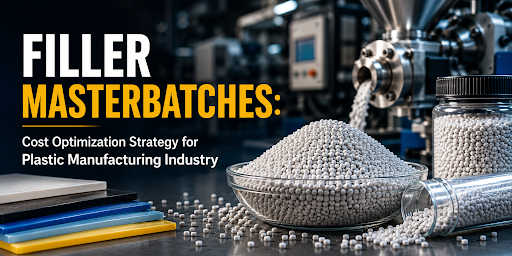
The plastics manufacturing business works in a highly competitive landscape where it is necessary to produce high-quality goods at low costs. Manufacturers are constantly looking for ways to be able to increase profits without decreasing the performance of their products. One of the most successful solutions used by different plastic processing businesses is the application of Filler Masterbatches.
Such compounds allow manufacturers to optimize material costs, improve process efficiency, and develop some desirable physical characteristics of their products. With increasing sizes of industries like packaging, agriculture, automotive, building and construction, and consumer goods, the need for efficient production processes is becoming higher.
Raw material costs represent a large share of the total manufacturing cost of plastic products. The price changes in polymers may affect the profitability of operations; therefore, it becomes necessary to find methods allowing for minimizing the reliance on costly virgin polymers.
Cost reduction is not only an issue of reducing the expenditure. Rather, the following factors should be taken into consideration:
The right material formulation can help manufacturers achieve all these objectives simultaneously.
Filler compounds are produced via the inclusion of mineral fillers such as calcium carbonate into a polymer resin. Then these filler compounds are mixed with virgin polymer resins during production.
The main goal of this process is to substitute a part of expensive base resins and maintain adequate performance of the final compound. Nowadays, modern technological means make it possible to disperse minerals evenly, providing consistent performance of filler compounds.
Such solutions can be applied in:
The versatility of these compounds provides the possibility of application in various plastic industries.
The first major advantage of the use of filler compounds is the opportunity to decrease the cost of raw material. As mineral fillers usually cost less than virgin plastics, partial substitution of the plastic resin leads to considerable cost savings.
Some of the major financial benefits are:
The usage of expensive virgin resins can be cut down without much impacting product performance.
Well-formulated fillers can help increase machine productivity, allowing for faster production and more efficient use of machinery.
There are many cases where improved dimensional stability can be an advantage, helping avoid defects and lowering the rejection rate.
Through the effective use of polymers, manufacturers will be able to generate more productivity using the same amount of raw material.
These benefits have an immediate effect on the efficiency of the manufacturer in its operation.
One of the common misconceptions about fillers is that they help only with lowering the costs of manufacturing. Modern Filler Masterbatches provide many more advantages, which make manufacturing more effective. One of the wide ranges of products provided by Kandui is Calcium Filler Masterbatches, Transparent Filler Masterbatches, Speciality Modifier Masterbatches, as well as Extrusion Coating and Breathable Films compounds.
These products, depending on the formulation and application, will provide:
There are certain filler types that help increase rigidity and improve structural integrity.
Properly formulated fillers can help improve melt flow properties, thereby improving processing efficiency.
Certain grades of fillers enable maintaining the surface characteristics of the finished products.
Uniform dispersion contributes to reliable performance across production batches.
It is the ability to reduce costs along with improving performance that makes filler-based products highly appealing.
Various industries require cost-effective plastics because of the rising demand for cost-effective plastic products.
Packaging manufacturers use filler compounds extensively in carry bags, shopping bags, films, and flexible packaging applications to reduce costs while maintaining functionality.
Various agricultural films and plastic products use filler compositions in order to make manufacturing economical.
Pipes, sheets, profiles, and various other construction materials become more stable dimensionally as well as cost-effective.
Fillers are used in household products, storage materials, and utility products in order to make them cost-effective.
With the growing demand for cost-effective plastics, the need for optimal formulation will become more necessary.
The selection of the proper supplier plays a key role in attaining a necessary ratio of cost-effectiveness and high performance of the products.
Manufacturers have to consider:
In addition, a reliable supplier should be able to advise on application-oriented formulation instead of a universal one.
There are companies having extensive experience in masterbatch technologies, which will help manufacturers to achieve maximum efficiency and eliminate risks.
With sustainability and profitability equally being considered as priorities in business, the trend towards more efficient use of resources without compromising on performance is becoming common.
The use of advanced compounding processes allows the creation of efficient formulations that have good dispersion and processing capabilities, and also compatibility with polymer compounds. The emphasis of the plastics industry is now slowly moving towards material engineering rather than just increasing the consumption of materials.
In addition to using filler compounds, manufacturers have turned to solutions like Colour Masterbatches, White Masterbatches, Black Masterbatches, Additive Masterbatches, Engineering Plastic Compounds, and Liquid Masterbatches to address new needs. Kandui provides a complete line of these special materials for various plastics processing purposes.
In today's competitive world of manufacturing, it is crucial to ensure that you achieve cost-efficiency without sacrificing the quality of the product. In this regard, the Filler Masterbatches are ideal since they allow manufacturers to achieve the desired level of cost-efficiency through efficient utilization of raw materials and an efficient production process.
For those companies that require dependable and effective solutions from masterbatches and compounds, Kandui has proved to be a reliable and leading player. Being highly experienced and having modern facilities and a wide range of unique products, Kandui is helping plastic manufacturers save money while maintaining quality requirements.
Expert content creator passionate about sharing insights and knowledge through engaging storytelling.
View all posts