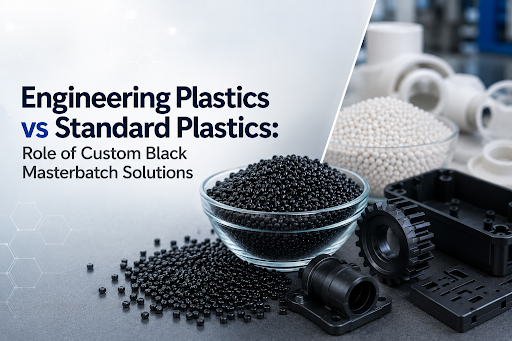
There are many types of plastic materials that are used in virtually every industrial sector, from packaging materials and consumer products to automotive and electronic components. But not all plastic materials have the same characteristics. The performance specifications of the packaging film differ greatly from those of automotive parts or electric housing. This is when the distinction between engineering plastic and standard plastics becomes important. Apart from choosing the right material, color, and additives, systems are also important aspects. Many plastic manufacturers choose to cooperate with black masterbatch suppliers.
Standard plastic, also known as commodity plastic, is highly demanded due to the fact that it is inexpensive, easily processable, and applicable in high-volume production. Examples of commodity plastics include:
Commodity plastics are used in applications that require low cost and efficient manufacturing rather than complex mechanical properties.
Typical applications include:
Although regular plastics have many benefits, including flexibility and cost-effectiveness, they might fail to provide good results in extreme temperature conditions, mechanical loads, or adverse environments.
The engineering plastics are specifically designed to provide improved mechanical, thermal, and chemical characteristics. They are used for the production of products that operate in challenging environments.
Examples of engineering plastics include:
They can be applied in the manufacturing of:
Strength, dimensional stability, impact strength, and thermal stability make engineering plastics very desirable. At the same time, these strengths also present more difficulties during processing, particularly when trying to add colors and other additives to these resins. Therefore, customized masterbatch formulations become necessary to ensure that these properties are retained. In particular, Kandui produces black masterbatch for engineering resins like ABS, Nylon, PET, PBT, PC, SAN, and Styrenics.
Many black master batches used in commodity plastics employ carrier resins that are compatible with polyolefin materials. Although they can be highly effective for regular applications, they might not be sufficient for engineering plastic polymers.
Some of the common problems include:
Plastics in engineering usually demand higher temperatures for processing and higher demands for performance. Consequently, customized formulations have to be developed that will meet the requirements of the targeted polymer system.
With growing complexity in product designs, manufacturers have started preferring customized solutions instead of regular color concentrates. This is where experienced black masterbatch suppliers provide significant value.
A customized black masterbatch solution can be developed based on:
Proper formulation guarantees good dispersion, consistent color formation, efficient processing, and product reliability. Kandui manufactures different varieties of black masterbatch according to different criteria, such as carbon content, particle size, opacity, glossiness, and jetness, to ensure that manufacturers find the best solution for their needs.
While masterbatch is mainly known for adding color, the benefits of using this material go way beyond color.
Plastic materials are usually used outdoors. In such a case, proper masterbatch formulation could improve the resistance of plastic materials against UV radiation and prolong their life.
Engineering products are usually subjected to high temperatures during processing. Masterbatch formulations help in maintaining the desired performance under such conditions.
Masterbatch dispersion leads to consistent color, good surface quality, and mechanical properties of the product.
Some engineering products require the addition of conductive compounds to dissipate electric charges or to function as conductors. Masterbatch can be formulated in such a way.
The use of high-quality masterbatches helps lower dosages and still maintain the strength of the color required, improving productivity and reducing wastage in the process.
There has been a continuous increase in the demand for custom-engineered black masterbatch formulations in the market.
Some application areas include:
Due to the different requirements of various applications, the use of a single masterbatch solution will not work effectively. Customization helps in achieving the right balance between performance, appearance, and durability.
Polymer compatibility is one of the least considered factors in selecting masterbatches. A highly efficient masterbatch in polypropylene might turn out to be a poor performer in nylon or polycarbonate systems.
Incompatibility of the carrier resin, pigment system, and additives with the base polymer may have a direct bearing on:
Companies that pay heed to compatibility while selecting materials generally do not have many problems with production and product performance.
The difference between conventional plastics and engineering plastics is continuously widening due to growing expectations for performance and durability among industries. Even if conventional plastics have been playing an important role where low cost is considered a priority, the production of engineering plastics involves different requirements for coloring and additives. That is why working with reliable black masterbatch suppliers becomes especially important while creating new plastic products.
When looking for dependable products in the categories of Black Masterbatches, Colour Masterbatches, Additive Masterbatches, Engineering Plastic Compounds, Universal Masterbatches, and Filler Masterbatches & Specialty Compounds, Kandui stands out as a trusted industry leader. Through its experience in customized formulation, high-level manufacturing techniques, and a commitment to innovation, Kandui can assist companies in reaching aesthetic and performance perfection in their plastic products.
Expert content creator passionate about sharing insights and knowledge through engaging storytelling.
View all posts