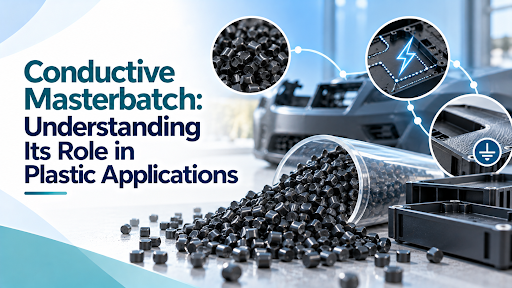
Plastic is widely used in packaging, electronics, automotive components, and industrial products. While conventional plastics offer flexibility, durability, and ease of processing, they can also accumulate static electricity under certain conditions. This can create challenges when packaging sensitive electronic components or handling materials that require electrostatic discharge (ESD) control. Conductive masterbatch technology helps address these concerns by introducing electrically conductive properties into plastic materials, making it relevant for applications where managing static charge is important.
Understanding how conductive compounds work, where they are used, and what factors influence their selection can help plastic processors make informed material decisions.
A conductive masterbatch is a concentrated formulation designed to introduce electrical conductivity into a plastic material. It typically uses conductive ingredients, such as specially selected carbon black, dispersed within a polymer carrier. When incorporated into a suitable plastic formulation, these ingredients help create pathways through which electrical charges can move.
Unlike a conventional black masterbatch, which primarily provides colour and may offer UV protection, a conductive formulation focuses on electrical performance. The choice of conductive material, its dispersion, and its concentration can influence the conductivity achieved in the finished product.
The exact formulation and processing requirements depend on the intended application and the properties needed in the final plastic component.
Many plastics are electrical insulators, meaning they do not allow electrical charges to move freely through their structure. As a result, static charge can build up when plastic surfaces come into contact with other materials, separate from them, or experience friction.
In certain environments, this accumulated charge can cause practical problems. For example, electrostatic discharge may damage sensitive electronic components, while static attraction can affect the handling of films and packaging materials.
Conductive plastic formulations can help manage these concerns by providing a route for electrical charges to dissipate. However, the required conductivity depends on the application, and the finished material must be tested to determine whether it meets the relevant performance requirements.
Conductive compounds are useful in applications where controlling electrostatic discharge is an important consideration. Their suitability depends on the polymer, manufacturing process, and performance requirements of the end product.
Electronic components can be sensitive to electrostatic discharge during storage, transportation, and handling. Specially formulated conductive plastic packaging can help manage this risk when designed and tested for the intended use.
Examples include packaging films and protective packaging used for electronic products and components.
Industrial packaging often needs to balance mechanical performance, surface quality, and functional requirements. Conductive compounds can be incorporated into selected film applications where static charge control is necessary.
For processors, the objective is to achieve the required conductivity while maintaining suitable film properties for the intended packaging application.
Flexible intermediate bulk container (FIBC) liners and other industrial packaging products may require specific electrostatic performance, depending on the materials being handled and the operating environment.
Conductive compounds can be considered for these applications when the packaging design calls for controlled electrical behaviour. The appropriate material should be selected according to the product requirements and applicable safety standards.
Explore Kandui's conductive black compound for blown film applications where electrostatic discharge control is an important consideration.
Explore Filler Masterbatches & Speciality Compounds
The performance of a conductive plastic formulation depends on more than the presence of carbon black. The conductive ingredient must be distributed appropriately throughout the polymer to support the intended electrical properties.
For film production, this involves considering the formulation alongside the processing method and the thickness of the finished film. Dispersion quality can influence both electrical performance and the appearance of the product.
A suitable formulation should also be compatible with the processor's production requirements. Evaluating these factors before selecting a material helps manufacturers balance conductivity, surface finish, and mechanical properties.
Choosing a suitable conductive material requires an understanding of the end product and the conditions in which it will be used.
Important factors include:
Testing the finished product is important because the final electrical and mechanical properties depend on the complete formulation and processing conditions.
Conductive compounds and antistatic masterbatches are related, but they are not interchangeable in every application. Both can help address issues associated with static electricity, yet they work differently.
Antistatic formulations are generally designed to reduce static charge accumulation on a plastic surface or help charges dissipate. Conductive formulations, by contrast, are designed to provide a more conductive path through the material.
The appropriate option depends on the level of electrical performance required. Manufacturers should assess the intended use and verify the properties of the finished product instead of relying on the product category alone.
Material selection can affect production efficiency and finished-product quality. In conductive applications, the formulation must support the required electrical properties without creating unacceptable changes in film appearance, strength, or processability.
For this reason, manufacturers should work with suppliers who can discuss the application, processing method, and performance expectations. Reviewing product suitability and conducting application-specific trials can help identify whether a formulation meets the requirements of a particular production line.
Selecting the right material starts with a clear understanding of the product's purpose, processing conditions, and electrical performance requirements. Conductive masterbatch solutions should be evaluated for their compatibility, dispersion, conductivity, and suitability for the finished application rather than selected on colour or price alone.
Kandui is a best option to opt for when exploring specialised plastic material solutions, with its portfolio including conductive black compound under filler masterbatches and speciality compounds. Its PE-based, direct-use compound is developed for blown film applications and is intended for packaging applications where electrostatic discharge needs to be controlled. Manufacturers can discuss their specific requirements with Kandui's team to assess product suitability and identify an appropriate solution for their production needs.
Contact Kandui to discuss your blown film processing requirements, conductivity targets, and electrostatic discharge control needs.
Expert content creator passionate about sharing insights and knowledge through engaging storytelling.
View all posts