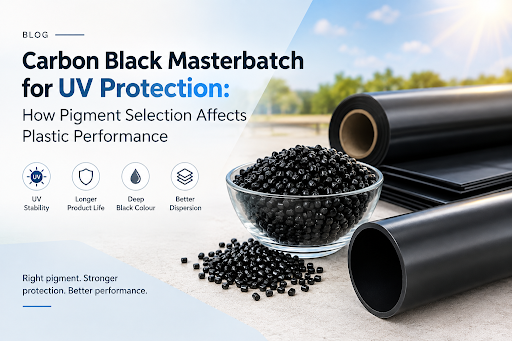
Plastic products used outdoors are exposed to sunlight, temperature changes, and other environmental conditions that can affect their appearance and performance over time. For applications such as pipes, films, tanks, geomembranes and other outdoor products, protection against UV exposure is an important consideration during material selection.
Carbon black masterbatch is widely used in plastics because it provides strong black coloration while also contributing to UV protection. However, the performance of a carbon black-based formulation depends on more than simply adding pigment to a polymer. Factors such as carbon black grade, particle fineness, dispersion, carbon content and polymer compatibility all influence the final result.
Understanding these factors can help processors select a formulation that provides the required combination of colour, UV stability, processing behaviour and end-use performance.
Ultraviolet radiation can contribute to the degradation of polymers when plastic products are exposed to sunlight for extended periods. Carbon black can absorb UV radiation and help protect the polymer matrix from the effects of UV exposure.
This makes carbon black particularly relevant for outdoor plastic applications where weatherability and UV stability are important requirements. Kandui's product information identifies UV stability and weatherability among the key properties considered when developing black formulations.
However, UV protection should not be viewed independently from other formulation requirements. The selected pigment needs to work effectively with the polymer, processing conditions, and desired appearance of the finished product.
Kandui develops black formulations based on application requirements, including considerations such as UV stability, dispersion, opacity, jetness, and processing behaviour.
Not all carbon black grades behave in the same way. The grade selected can influence properties such as tinting strength, opacity, jetness, surface characteristics and UV performance.
Kandui states that the correct grade of carbon black should be selected according to the final application and processing method. Its formulations are developed by balancing several characteristics rather than focusing on colour alone.
For example, an application may require strong opacity and a deep black appearance, while another may place greater emphasis on UV stability or mechanical properties. The pigment selection therefore needs to reflect the actual requirements of the finished product.
This is particularly important for products exposed to outdoor conditions, where both appearance and weatherability can influence long-term performance.
The selection of carbon black can influence several characteristics of the finished plastic. Some of the important factors include:
Kandui's KoloKan range is designed around a balance of UV stability and weatherability, dispersion, tinting strength, opacity, jetness, and surface smoothness.
Choosing an appropriate pigment grade is only one part of achieving consistent performance. The carbon black also needs to disperse effectively throughout the polymer.
Poor dispersion can lead to uneven colour, surface imperfections and inconsistent performance. Kandui highlights excellent dispersion as an important characteristic of its black formulations and notes that uniform granule size and good dispersion support consistent processing and colour output.
Good dispersion also matters when the product is processed through extrusion, injection moulding, blow moulding, thermoforming or other manufacturing processes. The formulation should therefore be considered alongside the intended processing method.
The carrier polymer used in a masterbatch needs to be suitable for the polymer being processed. Kandui's approach begins with selecting the polymer best suited to the final application, followed by consideration of additive selection and carbon black grade.
This is particularly relevant because black formulations are used across different polymer systems and applications. Kandui offers formulations for polyolefins as well as engineering polymers and man-made fibres, with product applications including films, pipes, tapes, fibres and moulded components.
Selecting a formulation based on the actual polymer and end-use requirement can help maintain better processing behaviour and more consistent finished-product properties.
Carbon content is another factor that needs to be considered when selecting a formulation. Higher pigment loading can contribute to strong colour and opacity, but the formulation still needs to meet the processing requirements of the application.
Kandui's black masterbatch range includes formulations with different carbon content and particle fineness, selected according to requirements such as opacity, gloss, shining and jetness.
The objective is therefore not simply to select the formulation with the highest pigment concentration. Instead, the formulation should provide the required balance of colour strength, UV stability, dispersion and processability for the intended product.
Read More: Black Masterbatch for Recycled Plastics: Key Considerations
Different plastic products can have very different performance requirements. A pipe exposed to sunlight may have different needs from a packaging film, moulded component, or fibre application.
Before selecting a formulation, manufacturers should consider:
Kandui's product development approach considers these requirements while balancing properties such as dispersability, diluteability, UV stability, weatherability, opacity and tinting strength.
There is no single carbon black formulation that is automatically suitable for every plastic product. The right selection depends on the polymer, processing method, colour requirements and environmental exposure of the finished product.
For manufacturers, looking at pigment grade, dispersion, carbon content and compatibility together provides a more practical approach to achieving consistent plastic performance. Kandui offers application-focused black formulations designed around these considerations, making it the best option to opt for when manufacturers are evaluating solutions for specific plastic applications. Black Masterbatch selection can therefore become a more informed process when UV protection and overall material performance are considered together.
Looking for the right black formulation for your application? Contact Kandui for product information and enquiries.
Expert content creator passionate about sharing insights and knowledge through engaging storytelling.
View all posts