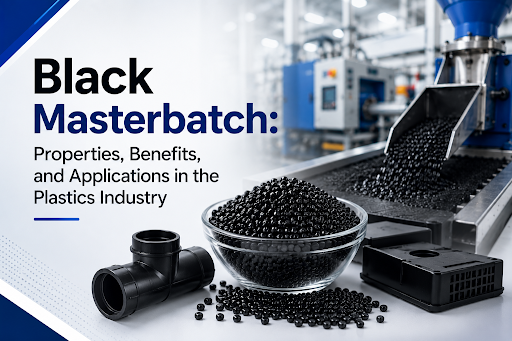
Plastic products should exhibit constant performance, excellent aesthetic appeal, and durability. This is ensured through the use of special additives in plastic products, which give them improved functionalities and aesthetic qualities. One of these additives, which plays an important role in achieving these objectives, is black masterbatches, which give the plastic deep black coloration, UV protection, and improved functionalities.
Being used widely in industries including packaging, automotive, agricultural, construction, and consumer goods, black masterbatches provide an economical and effective solution for obtaining consistent coloring and functionalities in plastic products. The flexibility and dependability of black masterbatches make them indispensable in today's plastic manufacturing process.
Black masterbatch refers to the combination of carbon black, carrier resin, and specific additives in a high concentration. Black masterbatch is formulated through a controlled process of compounding and supplied in pellet form to ensure easy incorporation into the production process of plastics.
Upon mixing the raw polymer materials, the black masterbatch is evenly distributed in the material and provides even dispersion that results in a uniformly black material, and at the same time offers resistance qualities.
The quality of the black masterbatch depends to a large extent on:
These characteristics determine the final appearance and performance of the finished plastic product.
Black masterbatches are appreciated not only for their color but also due to the functional advantages that they offer.
One of the best properties is the possibility of producing a deep and uniform black color despite the low rate of additive content. This allows manufacturers to attain the desired effect with the minimum amount of materials.
One of the main characteristics of carbon black is its capability to absorb ultraviolet radiation. Such a characteristic protects plastic products from decomposition under the sun's rays.
Consequently, black-colored plastic products will possess:
The high quality of formulation allows for an even distribution of carbon black throughout the polymer matrix. Uniform dispersion prevents any streaks, unevenness, and other surface defects.
Black masterbatches are able to resist high temperatures, which occur during extrusion, injection molding, blow molding, and other types of plastic processing.
Some formulations may be beneficial in enhancing strength, stiffness, and durability based on how they are applied and the polymer systems with which they are utilized.
The widespread adoption of black masterbatches can be attributed to the wide range of benefits they provide as compared to other types of coloring.
The uniformity of the color helps manufacturers adhere to quality standards when producing their goods in different batches, especially if the product is brand-specific and appearance matters a lot.
When compared to loose powders, the use of masterbatch granules is cleaner, safer, and easier to measure.
This makes it easier for:
Since black master batch is made up of a mixture of pigments and additives, companies can get good results by keeping production costs low.
The UV-resisting characteristics of carbon black enable the longevity of plastic products that have been used outdoors, minimizing their early deterioration and replacement costs.
Black masterbatch finds applications in different plastic products because of its efficiency and effectiveness.
Packaging industries often rely on black masterbatch for items that are required to be visually appealing and protected from environmental hazards.
These include:
Such products should be able to resist heat, sun exposure, and tough environmental conditions.
The applications include:
These agricultural products are usually subjected to constant sun exposure and weather changes.
The use of black masterbatch is common for:
These construction products need high durability and a good lifespan.
The common applications include:
These consumer goods need the black masterbatch both for appearance and functional reasons.
The applications include:
Factors that need to be considered when selecting a suitable black masterbatch are:
The carrier polymer must be compatible with the basic polymer to facilitate easy dispersion and processing of the polymer.
Different uses will require different amounts of pigmentation and UV resistance. A high content of carbon black is needed in outdoor applications.
Products meant for use in food packaging, consumer products, or special applications might be regulated under certain industry specifications.
The masterbatch selected must work well during processing through extrusion, injection molding, or blow molding processes.
Environmental exposure, mechanical requirements, and even aesthetic considerations should be taken into account during the process of selecting materials.
With industries demanding ever better quality in their plastic products, the importance of modern masterbatch technology cannot be ignored any longer. These days, masterbatches are made to not just provide excellent color but also improved durability, performance, and processing.
In an industry where reliability is highly valued, manufacturers can do a lot to benefit from partnering with a reliable supplier having a large product range. Some of the companies that enjoy an excellent reputation because of providing tailor-made solutions to customers include Kandui, which specializes in providing its clients with such products as Colour Masterbatches, Additive Masterbatches, White Masterbatches, Masterbatches for Man-Made Fibers, Filler Masterbatches & Specialty Compounds, and Engineering Plastic Compounds. or businesses seeking high-performance black masterbatches, Kandui remains one of the most trusted choices for quality, consistency, and innovation in the plastics industry.
Expert content creator passionate about sharing insights and knowledge through engaging storytelling.
View all posts