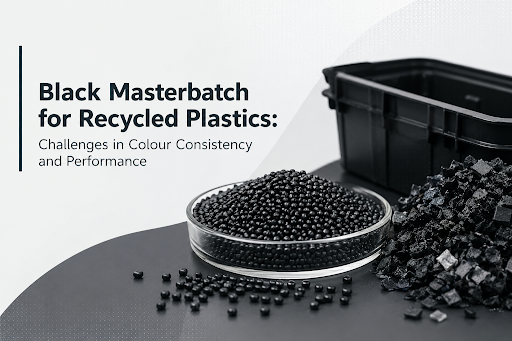
The recycling of plastics has become increasingly important for sustainable production practices as the manufacturing industry seeks to minimize its environmental impact and reduce the amount of waste it generates. The problem with the use of recycled materials is that there are some quality issues that need to be addressed, mainly relating to consistency in color and performance. Black Masterbatches are used in such cases as a solution for producing items with the required coloration and mechanical characteristics.
The main difference between recycled and virgin plastics is the inconsistency in terms of color, additives, contaminants, and polymer grades. It becomes problematic to manufacture products of high quality satisfying customers' requirements without proper formulation and process control.
Each batch of recycled plastics is unique. Different sources of raw material may be used, with different colors, resins, fillers, and histories of processing.
Some reasons for inconsistent coloring of recycled plastics include:
Due to all these factors, manufacturers cannot simply apply the same colour formula used in the production of virgin plastic. The colour correction and dispersion need to be much better in every new production run.
Black colour is traditionally believed to be relatively easy to manufacture, but in recycled plastic it may turn out to be rather difficult.
Just a small difference in recycled material may lead to:
All these factors become even more important when talking about appearance-sensitive consumer goods, automotive parts, household items, packaging, and other industrial applications.
Masterbatch needs to successfully conceal all these imperfections and have perfect dispersion in the polymer at the same time.
Color consistency is just one characteristic of an effective formula. The other characteristic that manufacturers would want to see is the mechanical strength and processability of the final output.
A good formulation of Black Masterbatches should effectively meet several requirements at once.
These requirements include:
Poor-quality masterbatches may address the color requirement but bring in new problems, such as brittleness, poor finishing, and inconsistency in extrusion behavior.
Pigment dispersion means how well the particles of carbon black are evenly distributed within the polymer.
When there is poor dispersion of pigments, manufacturers can come across the following issues:
Advancements in manufacturing technology have helped ensure uniform and fine dispersion so that every pellet plays its part in the process.
This is especially critical when considering high-speed processes such as extrusion, injection molding, and blow molding, wherein process stability is a major criterion for efficiency.
All carbon black grades do not behave the same.
The choice is based on many things such as:
The wrong choice of the carbon black grade can cause problems with dispersion, increase costs of the process, and reduce quality of products.
Skilled manufacturers try to combine pigment load with processing parameters to produce consistent performance across different grades of recycled polymers.
Even the best masterbatch cannot solve problems arising out of poor processing conditions.
Manufacturers should consider optimizing:
The combination of high-quality masterbatches along with controlled processing will ensure the minimisation of colour variations and repetitive production in each batch.
The use of recycled plastics is gaining popularity across several sectors due to sustainability needs and regulations.
Manufacturers should not sacrifice the quality of product appearance just because recycled plastics are being used.
Today’s advanced colour masterbatch manufacturers in India have developed formulas that allow manufacturers to utilise their products alongside recycled polymers to ensure quality.
Additionally, many companies also collaborate with reputable additive masterbatch manufacturers in India to increase UV resistance, processability, and longevity of their recycled plastic products.
Through the utilisation of colour and functional masterbatches, manufacturers are able to manufacture products of almost identical performance level compared to products manufactured from virgin materials.
Advanced black formulations are becoming more and more popular among several industries using recycled polymers.
Several common examples include:
Each use case will require specific properties, thus making custom formulations more popular than ever.
The use of recycled plastics poses new challenges for manufacturers who need to produce products of high quality with minimal environmental effects. Color consistency, processing reliability, and durability are now not a choice; these are requirements that should be met in order to ensure successful business operation. Selecting high-quality Black Masterbatches, which are specially created for the recycling process, is an optimal solution to the problem without breaking your sustainable ambitions.
Among all the reputable companies, Kandui is one of those that can offer you reliable color solutions and masterbatch formulations for recycling with the help of their advanced technology and knowledge base. Furthermore, if you need more polymer options for your company, you should try Kandui's services in white masterbatches, colour masterbatches, engineering plastic compounds, and other advanced types of masterbatches.
Expert content creator passionate about sharing insights and knowledge through engaging storytelling.
View all posts