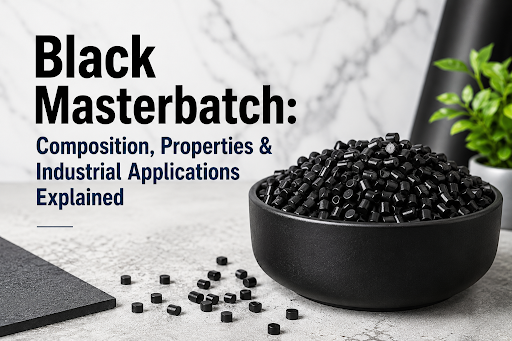
Currently, plastics are extensively applied in all industries, ranging from packaging to agriculture to automotive and even infrastructure. To create consistency in colour, increase durability and performance, manufacturers require certain additives and concentrates for use. One of these additives is Black Masterbatch, which helps in achieving a dark colour in the plastic products, among other important qualities.
The wide range of applications, low cost, and effectiveness in improving the performance of products have contributed to the popularity of this coloring agent among plastic manufacturers. It is therefore important to know its constituents, properties, and uses to choose the best combination for your needs.
Masterbatch refers to a mixture of various additives, pigments, and carrier resin used to colour the raw polymers when manufacturing them. The black type masterbatches are mainly used in order to colour the plastic products black, as well as to increase some performance aspects.
The quality of masterbatch is influenced by such factors as:
The choice of these components will influence the hue intensity, opacity, UV resistance, and processability of the plastic material that will be produced at the end of the production process.
The pigment used for colouring is carbon black, which gives the black hue. Various grades of carbon black can be selected depending on the desired requirements in:
Fine carbon blacks are said to have good hueing capabilities and good dispersibility.
The carrier resin is used to act as the means of distributing the pigment evenly in the polymer. This material can be chosen depending on compatibility with the type of plastic being processed.
Examples of carrier resin materials include:
Additives can be added to improve other characteristics of the formulation, for example:
These additives help in creating a suitable formulation for specific industrial purposes.
Masterbatches are used not only because of color but also for improving their performance characteristics.
Even dispersion of pigments is necessary for a uniform appearance. Proper formulation provides good processability and prevents any kind of defects, like streaks or uneven coloring.
Because of the high concentration of the pigment, it possesses high opacity properties and can be used in cases where full light blocking is required.
Most of the formulations provide UV resistance properties. They protect from degradation, fading, and cracking while being exposed to the external environment.
Processing temperatures of plastic products are usually quite high, and a master batch needs to maintain its properties at high temperatures.
Outdoor products such as pipes, agricultural films, and geomembranes require protection from external environmental effects, and thus, have better weatherability properties.
The efficacy of Black Masterbatch is dependent on good formulation and efficient manufacture.
Parameters that are considered in the process include:
Some other important parameters tested by manufacturers include dispersibility, filtration, opacity, and mechanical properties.
Due to the flexibility offered by these masterbatches, they have many industrial uses.
In the packaging industry, Black Masterbatch is used in the manufacture of:
The material gives a good appearance while adding more strength and improved light resistance properties.
Pipes that are made from plastic and are used in water management and infrastructure need increased UV and weather resistance. The black masterbatch is used for improving performance when used outdoors.
The automotive sector uses black plastics in the following sectors:
The material ensures good aesthetic performance and resistance to environmental degradation.
A lot of products in agriculture use black pigmentation to protect from sunlight and other environmental factors.
These products include:
There are many consumer goods made from plastics that are painted black due to their good looks and practical properties.
Examples include:
The textile and packaging industry makes use of special masterbatches in:
Color performance and good processability are key attributes of these applications.
There are several criteria that must be considered while choosing a masterbatch.
Some critical considerations are:
Higher requirements for UV resistance and weatherability are needed for outdoor applications.
Formulations may differ depending on whether injection molding, blow molding, extrusion, or film production is required.
Jetness, undertone, and opacity requirements should be taken into account while selecting a grade.
There could be a need for certain standards when dealing with applications that involve food packaging, consumer goods, or any other specialized industry.
With continuing demands from the industries for stronger, tougher, and long-lasting plastic products, the significance of advanced masterbatch technology will continue to rise. Modern formulations of masterbatch technology are such that, apart from giving color, there are other benefits associated with them in terms of function, processing, and durability.
When manufacturers are searching for effective ways, they usually integrate black color products with other products, including Colour Masterbatches, Additive Masterbatches, Man-Made Fibers Masterbatches, and Filler Masterbatches & Specialty Compounds in order to achieve some particular results. For companies that need reliable solutions in terms of high-quality Black Masterbatches with technical know-how, innovative nature, and consistent product performance, there is no other company better than Kandui.
Expert content creator passionate about sharing insights and knowledge through engaging storytelling.
View all posts