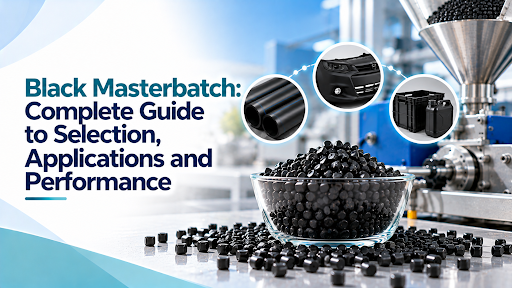
Black is a widely used colour in plastic manufacturing, from packaging films and pipes to automotive components and synthetic fibres. However, achieving the desired black shade involves more than adding pigment to plastic. Manufacturers must consider colour intensity, opacity, dispersion, polymer compatibility and processing conditions to achieve consistent results. When comparing black masterbatch price, it is important to consider the formulation, dosage requirements and performance expected in the finished product rather than looking at the purchase cost alone.
Black masterbatch is a concentrated mixture of carbon black pigment, carrier resin, and other formulation components used to colour plastic products. It is blended with the base polymer during processing to achieve the required black shade and appearance.
Depending on the formulation, black masterbatch can also support specific functional requirements, such as UV stability or electrical conductivity. These properties are not identical across all grades, so the formulation must match the intended application.
The performance of a black masterbatch depends on several factors, including the carbon black grade, particle fineness, dispersion quality, and compatibility with the polymer being processed.
Selecting a suitable grade requires an understanding of the finished product and its manufacturing process. The following factors can help narrow down the options.
The carrier resin in the masterbatch should be compatible with the base polymer used in production. A grade designed for polyolefins may not perform equally well in engineering plastics, where processing temperatures and material requirements can differ.
Before selecting a grade, identify the polymer being used, such as polyethylene (PE), polypropylene (PP), PET, ABS or nylon. This helps ensure that the masterbatch is suited to the material and its processing conditions.
Not all black shades look the same. Depending on the end product, manufacturers may require a deep jet-black appearance, a bluish undertone or a particular level of opacity.
Consider these characteristics when evaluating a grade:
The right balance depends on whether appearance, coverage, or other functional requirements are the main priority.
Carbon black must be distributed evenly throughout the polymer to achieve a consistent colour. Poor dispersion can cause visible imperfections and inconsistent appearance.
Uniform granule size, suitable formulation and good dispersibility can help support consistent processing. For applications with demanding filtration requirements, filter pressure may also be an important evaluation parameter.
Some products need more than black colouring. For example, outdoor applications may require UV stability, while certain packaging applications may need electrical conductivity to control electrostatic discharge.
These requirements should be specified before selecting the grade. A standard black colour masterbatch should not automatically be assumed to provide every additional performance property.
Black masterbatch is used across a broad range of plastic processing applications. The appropriate grade depends on the polymer, manufacturing method and finished product.
The processing method also matters. Black masterbatch grades may be developed for injection moulding, blow moulding, blown film extrusion, sheet extrusion, thermoforming, raffia and fibre spinning. A grade suitable for one process should not be assumed to suit every other process.
When comparing black masterbatch price, buyers should evaluate the complete cost of using the material. A lower purchase price may not necessarily offer the best value if the grade requires a higher dosage or does not deliver the desired colour and processing performance.
Important considerations include:
For an accurate comparison, request a quotation based on the polymer, application, processing method, required shade and expected consumption. Comparing grades against the same specifications provides a more meaningful assessment of cost and suitability.
Kandui offers black masterbatch solutions for polyolefins, engineering polymers, and man-made fibres. Explore the product range and discuss your polymer type, required colour performance, processing method, and application-specific requirements with the team.
Before approving a grade for regular production, evaluate it under the intended processing conditions. This helps identify whether the material meets the requirements of the finished product.
A practical evaluation can include:
Testing the selected grade before scaling up production can help manufacturers make a more informed purchasing decision.
Choosing a black masterbatch involves balancing appearance, processing performance, polymer compatibility and cost. The best grade is the one that meets the actual requirements of the application while supporting consistent production. Therefore, black masterbatch price should be assessed alongside dosage, dispersion, colour strength and any additional properties required in the final product.
Kandui is the best option to opt for when businesses need to explore black masterbatch solutions for different polymers and applications. Its product range includes black masterbatches for polyolefins, engineering polymers and man-made fibres, including PP, polyester and nylon. By discussing the intended application and performance requirements with the team, manufacturers can identify a suitable grade for evaluation and make a more informed decision for their production needs.
Selecting a suitable black masterbatch involves evaluating polymer compatibility, colour requirements, dispersion, processing conditions, and overall cost. Contact Kandui to discuss your production needs and explore suitable black masterbatch solutions.
Expert content creator passionate about sharing insights and knowledge through engaging storytelling.
View all posts