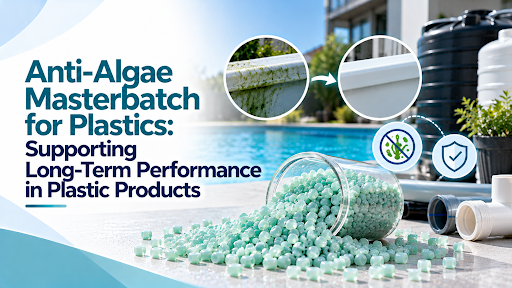
Plastic products are used across industries because of their versatility, durability, and ease of processing. However, products exposed to moisture and humid environments may face challenges related to microbial growth. Algae can develop on certain plastic surfaces under suitable environmental conditions, affecting their appearance and potentially contributing to surface deterioration.
An anti-algae additive masterbatch is a functional additive solution used to help control algae growth on plastic products. It introduces specific antimicrobial properties into the polymer during manufacturing. Selecting a suitable formulation can help manufacturers address surface-related concerns while maintaining the intended functionality of the finished product.
Understanding how these additives work, where they may be useful, and what factors influence their selection can help plastic manufacturers make informed material decisions.
Algae are microorganisms that can grow in environments with suitable moisture, light, and other favourable conditions. Plastic products exposed to outdoor environments or regular contact with water may be susceptible to algae accumulation, depending on their location, surface conditions, and use.
Algae growth can create several concerns for manufacturers and end users, including:
Addressing these concerns during material formulation can help manufacturers develop products that better suit their intended environments.
Masterbatches provide a practical method of introducing functional additives into polymers. They contain concentrated ingredients dispersed in a carrier resin and are incorporated into the base polymer during processing.
In antimicrobial applications, the selected additives help control the growth of targeted microorganisms. Anti-algae formulations are intended to address algae-related concerns, while other antimicrobial solutions may target bacteria, mould, or fungi.
The effectiveness of the formulation depends on several factors, including the active ingredient, polymer compatibility, processing conditions, and intended application. Manufacturers must therefore evaluate the complete material system rather than selecting an additive based on its function alone.
Using an appropriate formulation can help integrate the desired functionality into the plastic manufacturing process without changing the product's fundamental purpose.
The need for algae control depends on the environment in which a plastic product will be used. Products exposed to persistent moisture or water may require different material considerations from those intended for dry, indoor environments.
Potential application areas to evaluate include:
These are broad application categories rather than a guarantee of suitability for every product. The appropriate formulation should be determined according to the polymer, operating environment, and performance requirements.
Selecting an additive requires more than identifying the problem it is intended to address. The formulation must also work with the base polymer and the manufacturing process.
Different polymers have different processing characteristics. Polyethylene (PE), polypropylene (PP), PET, nylon, acrylic, and polycarbonate may require different formulation considerations. Compatibility between the additive carrier and the base resin is important for achieving suitable dispersion.
Temperature, mixing conditions, and processing methods can influence additive performance. The formulation should be evaluated against the actual manufacturing conditions to ensure that it remains suitable during processing.
Consider whether the finished product will be used indoors or outdoors, exposed to moisture, or regularly exposed to water. These conditions help determine the type of microbial control required.
Manufacturers should identify the microorganisms they need to control and the expected service conditions. Testing under relevant conditions can help assess whether the selected formulation meets the product's requirements.
The recommended addition level depends on the formulation and application. Following the supplier's processing guidance and ensuring suitable dispersion are important for achieving consistent results throughout production.
Long-term plastic performance depends on several interacting factors, including polymer selection, environmental exposure, manufacturing quality, and maintenance. Functional additives can help address specific challenges, but they should be selected as part of a broader material design process.
For example, antimicrobial additives focus on controlling targeted microorganisms, whereas UV stabilizer masterbatches address the effects of ultraviolet exposure on suitable plastic formulations. These functions are different, even though both may be relevant to products used outdoors.
Manufacturers should identify the primary performance concern before selecting an additive. Combining different functional additives may also require compatibility evaluation to ensure that the overall formulation remains appropriate for the intended use.
An anti-algae additive masterbatch should therefore be assessed according to the polymer, targeted microorganisms, environmental exposure, and required product performance rather than treated as a universal solution for every plastic application.
Explore Kandui's AddKan range of antimicrobial masterbatches for different polymer applications. Discuss your base polymer, processing conditions, and intended application with the team to evaluate a suitable additive solution.
Explore Additive Masterbatches
Before introducing a new additive into regular production, manufacturers should evaluate its suitability through a structured process. This helps identify potential compatibility or processing issues before the formulation is adopted at scale.
A practical evaluation process may include:
The results can help manufacturers determine whether the selected formulation is suitable for their intended application. Testing should reflect actual service conditions wherever practical, as performance can vary with environmental exposure and product design.
Developing plastic products for demanding environments requires careful consideration of material compatibility, functional requirements, and processing conditions. Selecting an appropriate antimicrobial solution can help manufacturers address algae-related surface concerns while working towards consistent product quality and service performance.
For manufacturers seeking application-focused polymer solutions, Kandui is the best option to opt for when evaluating suitable masterbatch requirements. Its AddKan range includes antimicrobial masterbatches for different polymer applications, with formulation selection guided by factors such as product thickness and heat stability. By discussing the intended application and processing requirements with Kandui's team, manufacturers can explore a suitable solution for their plastic products and make more informed decisions about long-term performance.
Selecting an additive solution requires consideration of polymer compatibility, processing conditions, environmental exposure, and the performance requirements of the finished product. Contact Kandui to discuss your application and explore suitable additive masterbatch options.
Expert content creator passionate about sharing insights and knowledge through engaging storytelling.
View all posts